Azure Service Bus Topic and Subscription Ordering
DRAG DROP
You develop software solutions for a mobile delivery service. You are developing a mobile app that users can use to order from a restaurant in their area. The app uses the following workflow:
1. A driver selects the restaurants for which they will deliver orders.
2. Orders are sent to all available drivers in an area.
3. Only orders for the selected restaurants will appear for the driver.
4. The first driver to accept an order removes it from the list of available orders.
You need to implement an Azure Service Bus solution.
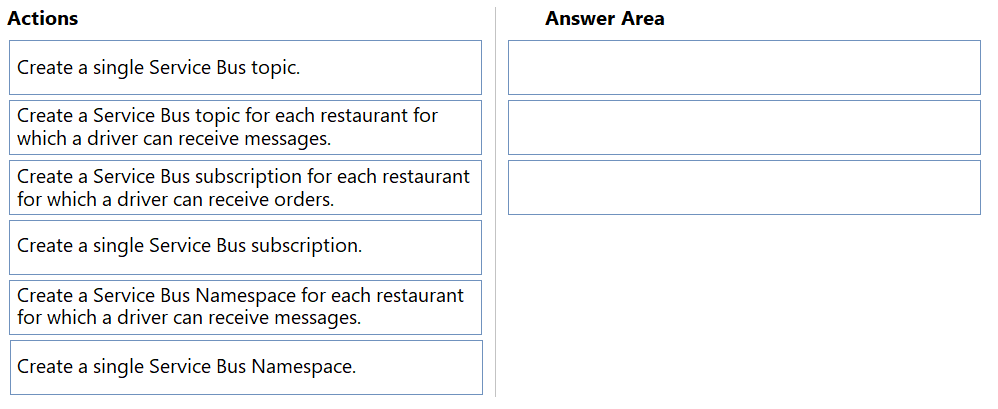
Which three actions should you perform in sequence? To answer, move the appropriate actions from the list of actions to the answer area and arrange them in the correct order.
Community Insight
The common trap is confusing queues with topics; topics enable publish/subscribe where multiple subscribers receive copies, while subscriptions allow filtering messages based on attributes or SQL filters.
This scenario tests the correct implementation of Azure Service Bus topics and subscriptions for selective message delivery. The solution requires creating a namespace, then a topic, followed by individual subscriptions to filter orders for specific restaurants.
Learners often attempt to use a single queue or incorrectly order the resources by creating subscriptions before the topic exists. They may also fail to recognize that distinct restaurants require distinct subscriptions for filtering.
Community Discussion (1 comments)
Comments & Corrections
No comments yet — spotted an error or have a note? Share it below.
Expert Analysis
Why the Answer Is Correct
The correct sequence begins with creating an Azure Service Bus Namespace, which is the foundational management unit for all messaging resources. Next, a Topic must be created within that namespace; topics are designed for broadcast scenarios where one message can be received by many subscribers. Finally, a Subscription is created for each restaurant (or driver group) under the topic. Subscriptions provide a virtual queue for each subscriber and support filtering rules, ensuring that only orders for selected restaurants appear for a specific driver.Why Other Candidate Answers Are Wrong
Using a Queue instead of a Topic would mean only one consumer receives the message, violating the requirement that orders are sent to all available drivers initially. Creating subscriptions before the topic is invalid because subscriptions are children of topics. Using a single subscription for all drivers would prevent the filtering logic required to show only relevant restaurant orders.Community Comment Notes
Community consensus strongly supports the Namespace -> Topic -> Subscription pattern. As Ja13 noted, "Create a single Service Bus Namespace. Create a single Service Bus topic. Create a Service Bus subscription for each restaurant." This confirms the hierarchical dependency and the need for per-restaurant filtering via subscriptions.Exam Strategy
Always start by identifying the messaging pattern: point-to-point uses Queues, publish-subscribe uses Topics/Subscriptions. Remember that you cannot create a Subscription without first having a Topic in place.
Frequently Asked Questions
Why not use Azure Queue Storage for this scenario?
Queue Storage is better for simple work items. Service Bus Topics/Subscriptions are required here because we need to filter messages for specific subsets of consumers (restaurants/drivers) from a single publisher.
Can one subscription serve multiple drivers?
Yes, if those drivers share the same filtering criteria (e.g., they both deliver for Restaurant A). However, if each driver has unique preferences, individual subscriptions or complex filtering rules are needed.