What Azure AI Language entity linking returns for each statement
Short answer
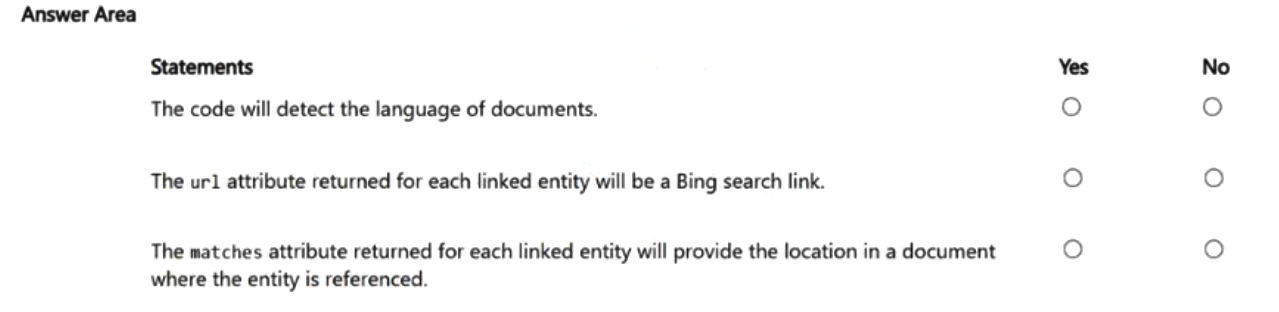
Statement 1: No — the code calls recognize_linked_entities, not detect_language. Statement 2: No — the LinkedEntity url points to the data source (e.g., Wikipedia), while bing_entity_search_api_id is separate. Statement 3: Yes — each match returns a Location with the text offset and length.
Question
You are building a solution that students will use to find references for essays.
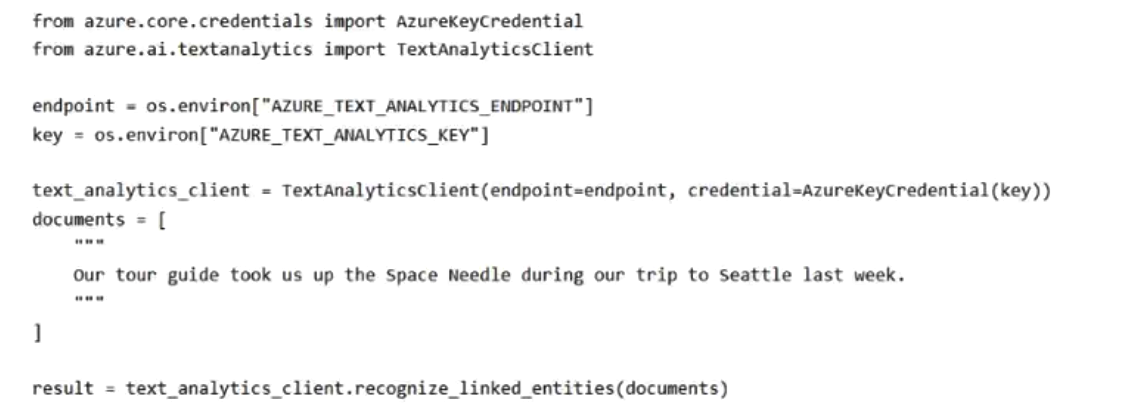
You use the following code to start building the solution.
For each of the following statements, select Yes is the statement is true. Otherwise, select No.
NOTE: Each correct selection is worth one point.
Key Takeaways
You must know the exact response shape of recognize_linked_entities: separate API for language detection, data-source URLs (not Bing), and match locations via offset and length.
This AI-103 hotspot tests the outputs of Azure AI Language's recognize_linked_entities operation in a reference-finding solution. The verdict: the code does not detect language and does not return Bing URLs, but it does return the location of each matched entity in the text.
Common mistake: Selecting Yes for Statement 2 because Bing's Knowledge Graph backs entity resolution — the returned url field actually points to the source article (often Wikipedia), and Bing integration is represented by bing_entity_search_api_id.
Expert Analysis
The mechanism being tested. The starter code creates an Azure AI Language (Text Analytics) client and issues a single recognize_linked_entities(documents) call, then iterates over the returned LinkedEntity objects. Every statement has to be judged against exactly what that one operation returns.
Statement 1 — detect the language: No. Language detection is a separate endpoint in the Azure AI Language SDK. recognize_linked_entities performs entity linking against a language model that resolves named entities to a knowledge base; it assumes a default language unless an explicit language hint is passed in the request options. To detect document language you would need a distinct detect_language(documents) call, which this code does not contain.
Statement 2 — the URL comes from Bing: No. Each LinkedEntity exposes a url pointing to the matching article in the underlying data source — most commonly Wikipedia — plus a data_source field naming that source. Bing's Knowledge Graph is what powers entity resolution behind the scenes, and the SDK even exposes a separate bing_entity_search_api_id attribute, but that is an integration identifier, not the url itself. Learner comments on this item make precisely that distinction, and it is the trap: the mental model "Microsoft service ⇒ Bing link" is wrong here.
Statement 3 — the location of each match: Yes. Entity linking returns not just the linked entity but every place it appears in the input text. For each match the response includes the surface text (text) and a Location object giving the character offset and length within the submitted document. That is what allows you to highlight or hyperlink each occurrence in the student's essay.
Bottom line: for this code the correct mapping is Statement 1 = No, Statement 2 = No, Statement 3 = Yes.
Official Reference
This link opens the official vendor documentation in a new tab.
Exam Strategy
When a HOTSPOT shows code with one SDK call, enumerate the response properties of that exact method and test each statement against them. Resist attributing sibling operations (detect_language) or sibling attributes (bing_entity_search_api_id) to the call in the code. Use fields such as offset and length to confirm any statement about positions in the text.
Frequently Asked Questions
Does recognize_linked_entities detect the language of the submitted documents?
Where do the URLs on linked entities come from — Bing or the knowledge source?
How do I highlight each matched reference in a student's essay?
Discussion 3 contributions
Compiled from public community threads and reader submissions, lightly edited for clarity. Handles and vote tallies are shown as recorded, and comments reflect the views of individual contributors.
From public community threads 3
-
Alvarogc 👍 4Second one should be "no", as the URL is not always from Bing. In fact, there's another parameter for Bing searchs called "bing_entity_search_api_id". Final correct answer: 1. No 2. No 3. Yes Reference: https://learn.microsoft.com/en-us/python/api/azure-ai-textanalytics/azure.ai.textanalytics.linkedentity?view=azure-python
-
Codia 👍 2The correct answer for Statement 2 is No. While Bing's Knowledge Graph is used internally behind the scenes to perform entity resolution, and the SDK exposes a separate bing_entity_search_api_id attribute for API integration, the url field itself links to the underlying data source page (primarily Wikipedia), not a Bing search result URL.
-
8ac3742 👍 1no( not detect_language), no(wikipedia), yes(location) Statement 1: The code will detect the language of documents. (No)The code specifically calls recognize_linked_entities(documents). To detect the language of documents, you must call detect_language(documents). recognize_linked_entities assumes a default language (English, if unspecified) or accepts an explicit language code parameter, but it does not return language detection analysis.Statement 2: The url attribute ... will be a Bing search link. (No)In Azure AI Language / Text Analytics Entity Linking, the default knowledge base used to ground and disambiguate recognized entities is Wikipedia (e.g., [https://en.wikipedia.org/wiki/Space_Needle](https://en.wikipedia.org/wiki/Space_Needle)), not a Bing search link.Statement 3: The matches attribute ... will provide the location in a document where the entity is referenced. (Yes)Each recognized entity in the response has a matches collection containing LinkedEntityMatch objects.Each match object exposes offset (starting character index position in the source text) and length, which explicitly define the exact location where that reference occurs in the document
Reader comments & corrections
No reader corrections yet — spotted an error or have a note? Share it below.
Related Analysis
Practice All AI-103 Questions
Access 88 questions with complete answers and detailed explanations.
View Full AI-103 Practice Test →