Which Request Parameters Maximize Foundry Output Stability and Reasoning?
Short answer
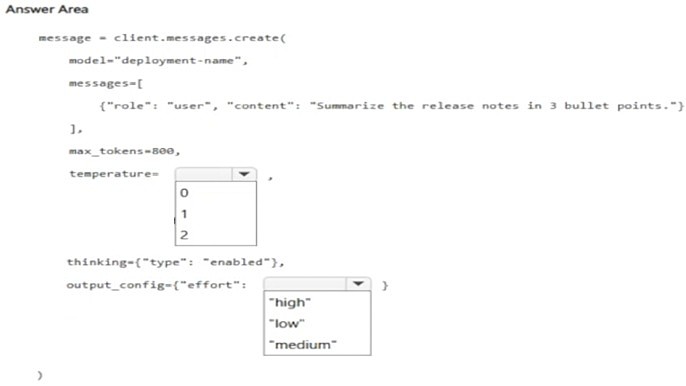
Set temperature to 0 to stop wording variation, and set reasoning effort to high to maximize reasoning quality.
Question
HOTSPOT
You have a Microsoft Foundry project that contains a deployed chat model.
You have a Python service that sends API requests to the model. The service is integrated with an automated validation system that compares generated outputs against approved response patterns.
Stakeholders report that small wording differences are causing validation mismatches.
You need to update the request parameters to improve output stability. The solution must maximize reasoning quality.
How should you complete the Python code? To answer, select the appropriate options in the answer area.
NOTE: Each correct selection is worth one point.
Key Takeaways
The item tests parameter-level tuning of a chat completion call — the trap is picking a middle temperature or a low/medium effort, which trades away either determinism or reasoning depth.
This hotspot asks which Python request parameters to change for a deployed Foundry chat model so automated validation stops failing on minor wording differences. The page establishes that temperature must be set to 0 for stable, repeatable phrasing while reasoning effort must be set to high to preserve maximum reasoning quality.
Common mistake: The most common wrong approach is leaving temperature at a non-zero value such as 1 or choosing effort = medium, because learners assume some randomness is harmless; but any temperature above 0 reintroduces the wording variance that breaks the pattern-matching validator, and a lower effort setting directly contradicts the requirement to maximize reasoning quality.
Expert Analysis
Why the Answer Is Correct
The two required outcomes map directly onto two independent request parameters, so temperature = 0 and effort = "high" jointly satisfy the prompt. Setting temperature to 0 removes sampling randomness, which is exactly what stops small wording differences from triggering mismatches in the automated validation system. Setting reasoning effort to high is the only selection that fulfills the explicit requirement that the solution maximize reasoning quality. Because these parameters are independent, choosing high effort does not undo the determinism gained from temperature 0 — the validator gets stable phrasing and the model still reasons at full depth.Why Other Candidate Answers Are Wrong
Any temperature value above 0 (for example 1) preserves random sampling, so the model can still rephrase identical prompts differently and the validation mismatches will continue. Choosing effort = low or medium reduces the reasoning budget, which directly violates the "maximize reasoning quality" constraint even if output happens to look stable. A temperature of 2 or an out-of-range effort value would either be rejected by the API or introduce even greater instability, so it fails both stated goals. Selecting only one correct parameter and leaving the other at a default does not satisfy the two-part requirement.Community Comment Notes
RICHARDALEX007 summarized the reasoning cleanly, noting that "temperature to 0 (lowest randomness)" paired with effort "to high" satisfies stability and reasoning quality respectively. dinizingrid pushed back by arguing the code targets an Anthropic-style thinking model where "temperature may only be set to 1 when thinking is enabled," but this is a Microsoft Foundry chat-model question and the exam's intended pattern is a deterministic temperature plus a high effort selection. Treat the community split as a reminder to read the requirement clauses literally: one parameter for stability, one parameter for reasoning depth.Official Reference
Exam Strategy
Read the two requirement clauses first and bind one parameter to each: anything about stability, determinism, or repeatable wording points to temperature = 0, and anything about maximizing reasoning depth points to effort = high. Never let one selection satisfy both clauses — this hotspot awards one point per correct selection.
Frequently Asked Questions
Why does temperature 0 fix automated validation mismatches on a Foundry chat model?
Temperature 0 removes sampling randomness, so the model reproduces the same phrasing for the same prompt and the pattern-based validator stops flagging small wording differences.
Does raising reasoning effort to high reduce output stability?
No — reasoning effort controls how much deliberation the model performs, an independent parameter from temperature, so effort high keeps stability while maximizing reasoning quality.
Discussion 2 contributions
Compiled from public community threads and reader submissions, lightly edited for clarity. Handles and vote tallies are shown as recorded.
From public community threads 2
-
RICHARDALEX007 👍 5To maximize output stability/determinism, set temperature to 0 (lowest randomness). To maximize reasoning quality on a reasoning model, set the effort to high. The two highlighted selections satisfy 'improve output stability' and 'maximize reasoning quality' respectively.
-
dinizingrid 👍 1Answer: temperature = 1, effort = “high” This code uses the Anthropic Messages API, so it calls a Claude model in Foundry. Since thinking is enabled, Claude does not allow temperature changes: temperature may only be set to 1 when thinking is enabled. Setting it to 0 returns an error, and 2 is out of range. With thinking on, stability comes from the reasoning itself, not from temperature. effort = "high" gives the deepest reasoning, which is what “maximize reasoning quality” asks for.
Reader comments & corrections
No reader corrections yet — spotted an error or have a note? Share it below.
Related Analysis
Practice All AI-103 Questions
Access 88 questions with complete answers and detailed explanations.
View Full AI-103 Practice Test →