Securing Azure AI Search with Private Endpoints and RBAC
HOTSPOT
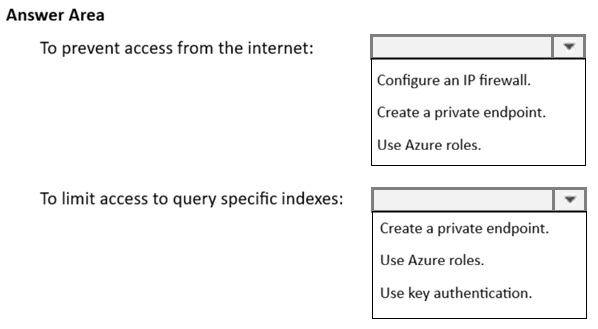
You have an Azure AI Search resource named Search1 that is used by multiple apps hosted in Azure.
You need to secure Search1. The solution must meet the following requirements:
• Prevent access to Search1 from the internet.
• Limit the access of each app to query specific indexes.
What should you do? To answer, select the appropriate options in the answer area.
NOTE: Each correct answer is worth one point.
Community Insight
The common trap is confusing IP firewalls (which filter but don't remove public exposure) with Private Endpoints (which fully isolate the service), and failing to distinguish between management-plane and data-plane permissions.
This question tests securing Azure AI Search by combining network isolation via Private Link with granular access control using Azure RBAC roles.
Candidates often select 'IP firewall' because it restricts access, but this does not meet the strict requirement to prevent internet access. They may also choose 'API keys' for index restriction, which lacks the granularity of role-based access control.
Community Discussion (2 comments)
Comments & Corrections
No comments yet — spotted an error or have a note? Share it below.
Expert Analysis
Why the Answer Is Correct
To prevent access from the internet, you must create a Private Endpoint for the Azure AI Search resource. This uses Azure Private Link to expose the service within your Virtual Network (VN) via a private IP address, effectively removing its public endpoint. To limit access to specific indexes, you should assign Azure RBAC roles (such as 'Search Index Data Reader') at the scope of the specific index or application identity. This provides fine-grained, role-based control over who can query which data.Why Other Candidate Answers Are Wrong
An IP firewall allows you to whitelist specific public IPs, but the service remains publicly accessible; anyone with a whitelisted IP can still reach it over the internet, violating the 'prevent access from the internet' requirement. Using API keys allows access but does not inherently restrict which index an app can query if the same key is used across apps, nor does it provide the auditability and separation of duties that RBAC offers. Management-plane roles like 'Contributor' do not grant data-plane access to search indexes.Community Comment Notes
Community consensus strongly supports the combination of Private Endpoints and RBAC. As Srikantha noted, "Creating a private endpoint routes traffic over a private IP... blocking direct public internet access." AngusSzarpidrut clarified that "An IP firewall only allows or blocks specific public IP ranges — the service is still technically reachable over the internet," highlighting why Private Endpoint is the only valid choice for complete isolation.Exam Strategy
Always read 'prevent access from the internet' as a signal for Private Link/Private Endpoint. When 'limit access to specific resources' is paired with security, look for RBAC rather than API keys or network rules, as RBAC offers the necessary granularity.
Frequently Asked Questions
Does an IP firewall secure Azure AI Search from the internet?
No. An IP firewall filters traffic but keeps the service's public endpoint active. A Private Endpoint is required to remove public internet access entirely.
Can API keys restrict which index an app can query?
Generally no. API keys are typically scoped to the entire search service. RBAC roles allow you to assign permissions to specific indexes or collections.
Related Analysis
Practice All AI-103 Questions
Access 88 questions with complete answers and detailed explanations.
View Full AI-103 Practice Test →