Azure Foundry AI Services for Image Text Extraction and Location Analysis
HOTSPOT
You have 100,000 images.
You need to build an app that will perform the following actions:
• Identify road signs in the images and extract the text on the signs.
• Analyze the text to identify well-known locations.
The solution must minimize development effort.
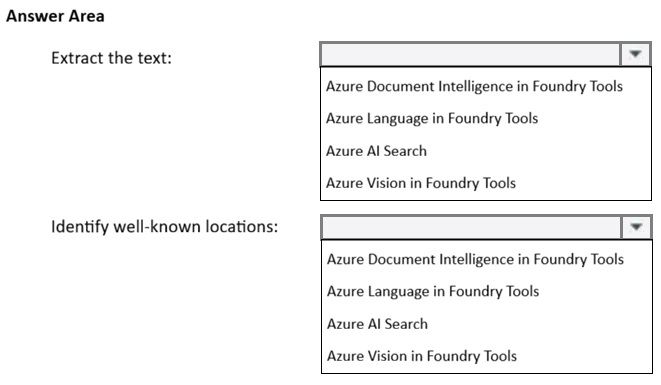
What should you use for each action? To answer, select the appropriate options in the answer area.
NOTE: Each correct selection is worth one point.
Community Insight
The question tests mapping specific data types (images with text vs. extracted text) to their specialized Foundry services, avoiding the trap of using generic LLMs for structured extraction tasks.
This scenario tests the selection of Azure Foundry tools for computer vision and natural language processing. The correct solution uses Azure Vision for OCR on road signs and Azure Language for entity recognition to identify locations.
Learners often select general-purpose models or incorrect combinations like using Azure Speech for image analysis, failing to recognize that Vision is the dedicated service for 'text in the wild' in images.
Community Discussion (1 comments)
Comments & Corrections
No comments yet — spotted an error or have a note? Share it below.
Expert Analysis
Why the Answer Is Correct
For the first action, identifying road signs and extracting text requires Optical Character Recognition (OCR), which is a core capability of Azure Vision within Foundry Tools. This service is optimized for detecting text in natural scenes ('text in the wild'). For the second action, analyzing the extracted text to find well-known locations involves Named Entity Recognition (NER), specifically looking for Geographic entities. Azure Language provides this functionality efficiently without requiring custom model training.Why Other Candidate Answers Are Wrong
Using Azure Speech would be incorrect as it processes audio, not images. Using a generic Large Language Model (LLM) for both steps might work but violates the requirement to 'minimize development effort' because it requires more complex prompting and context management compared to purpose-built APIs. Other services like Form Recognizer are for structured documents, not natural scene images like road signs.Community Comment Notes
As Srikantha noted, the key is distinguishing between OCR capabilities in Vision versus speech or form processing. The community consensus highlights that Azure Vision handles the image-to-text conversion while Azure Language handles the semantic analysis of that text.Official Reference
Exam Strategy
When asked to minimize development effort, always look for purpose-built PaaS services (like Vision or Language) rather than building custom pipelines with general foundation models. Map the input data type directly to the service's primary function: Images -> Vision, Text -> Language, Audio -> Speech.
Frequently Asked Questions
Why not use an LLM for text extraction?
While LLMs can read text, Azure Vision is purpose-built for high-accuracy OCR in natural scenes. Using Vision minimizes development effort by providing a direct API for extraction without complex prompt engineering.
What does Azure Language do for location detection?
Azure Language includes Named Entity Recognition (NER) which can identify 'Geographic' entities in text, allowing you to detect well-known locations from the unstructured text output of the Vision service.
Related Analysis
Practice All AI-103 Questions
Access 88 questions with complete answers and detailed explanations.
View Full AI-103 Practice Test →