Object Detection Model Performance Metrics Analysis
HOTSPOT
You are building a model to detect objects in images.
The performance of the model based on training data is shown in the following exhibit.
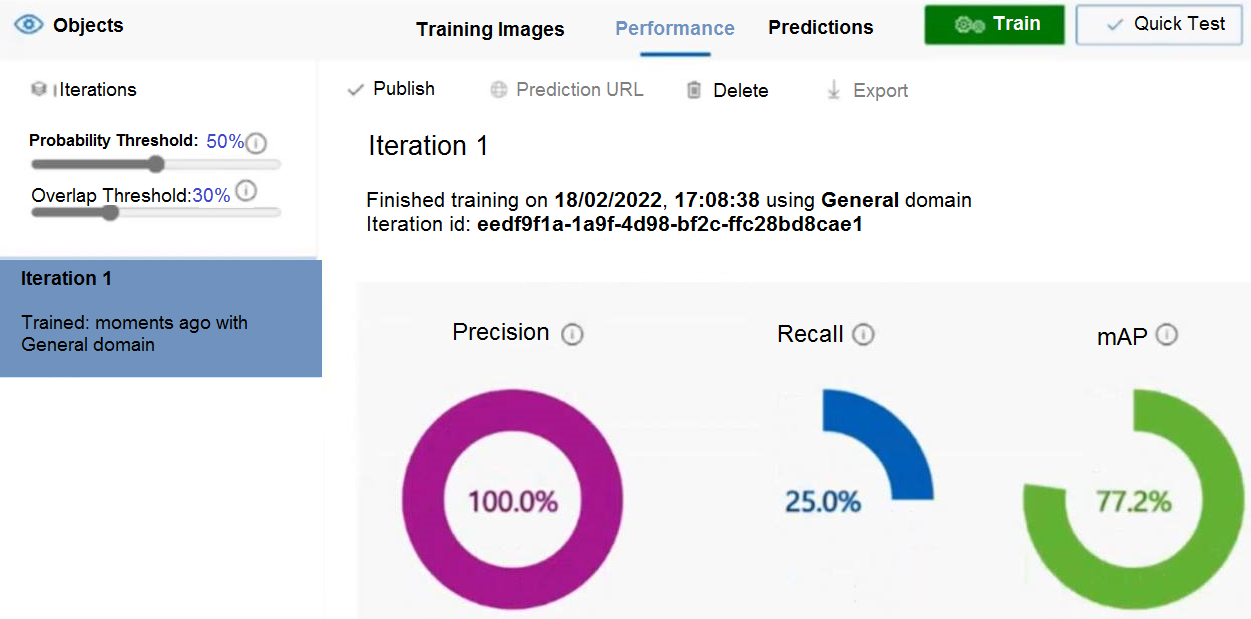 Use the drop-down menus to select the answer choice that completes each statement based on the information presented in the graphic.
NOTE: Each correct selection is worth one point.
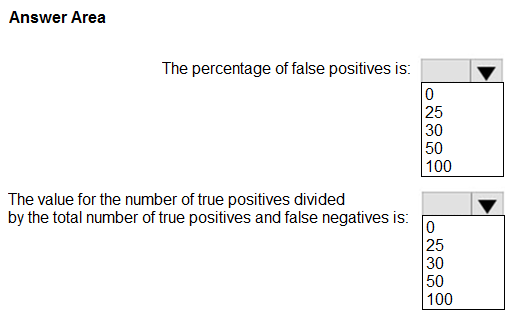
Use the drop-down menus to select the answer choice that completes each statement based on the information presented in the graphic.
NOTE: Each correct selection is worth one point.
Community Insight
The core trap is confusing precision with recall; high training accuracy does not guarantee generalization, requiring careful analysis of the trade-off between false positives and false negatives.
This question requires interpreting model performance metrics like precision and recall from a visual exhibit to identify overfitting or underfitting characteristics in an object detection system.
Learners often assume that high training performance implies the model is perfect for production, failing to account for potential overfitting or the specific metric definitions required by the dropdown options.
Community Discussion (1 comments)
Comments & Corrections
No comments yet — spotted an error or have a note? Share it below.
Expert Analysis
Why the Answer Is Correct
The correct selection depends on accurately calculating or interpreting Precision (TP / (TP + FP)) and Recall (TP / (TP + FN)). If the exhibit shows high true positive rates with low false positives, precision is high. The answer must align with the mathematical definition of the metrics shown in the chart.Why Other Candidate Answers Are Wrong
Incorrect selections typically arise from mixing up True Positives with False Negatives or misinterpreting the y-axis labels. For instance, selecting 'Recall' when the data indicates high precision leads to logical contradictions in the statement completion.Community Comment Notes
As Srikantha noted, "With a Precision of 100.0% (1.0), there are no false positive predictions made by the model." This highlights that if precision is perfect, the denominator (TP+FP) equals TP, meaning FP is zero. Learners should verify these calculations against the exhibit's specific numbers rather than guessing based on general AI principles.Exam Strategy
Always write down the formula for Precision and Recall before looking at the options. Map the values from the graph directly to TP, FP, and FN variables to eliminate ambiguity.
Frequently Asked Questions
How do I calculate Precision from an object detection exhibit?
Precision is calculated as True Positives divided by the sum of True Positives and False Positives. Check the graph for these specific counts.
What does it mean if my model has 100% precision?
It means there are no false positives; every object the model identified was actually present in the image.
Related Analysis
Practice All AI-103 Questions
Access 88 questions with complete answers and detailed explanations.
View Full AI-103 Practice Test →