Azure Custom Vision Project Type and Domain Selection
DRAG DROP
You have a factory that produces cardboard packaging for food products. The factory has intermittent internet connectivity.
The packages are required to include four samples of each product.
You need to build an Azure Custom Vision model that will identify defects in packaging and provide the location of the defects to an operator. The model must ensure that each package contains the four products.
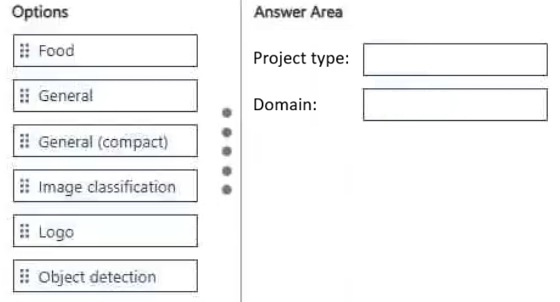
Which project type and domain should you use? To answer, move the appropriate options to the correct targets. You may use each option once, more than once, or not at all. You may need to move the split bar between panes or scroll to view content.
NOTE: Each correct selection is worth one point.
Community Insight
The scenario tests the distinction between Image Classification and Object Detection, specifically identifying that spatial location data requires Object Detection, while offline constraints favor compact domains.
This question tests the correct configuration of Azure Custom Vision for defect detection and object counting in low-connectivity environments. The page establishes that Object Detection is required for locating defects, while General (compact) is optimal for intermittent connectivity.
Learners often select 'Image Classification' because they focus only on identifying defects, failing to recognize that the requirement to provide 'location' necessitates bounding box coordinates provided by Object Detection.
Community Discussion (1 comments)
Comments & Corrections
No comments yet — spotted an error or have a note? Share it below.
Expert Analysis
Why the Answer Is Correct
To satisfy the requirement of providing the location of defects, you must use an Object Detection project type, as it outputs bounding boxes around identified items. Furthermore, the factory has intermittent internet connectivity, which implies a need for edge deployment or offline inference; Azure Custom Vision's General (compact) domain is specifically optimized for smaller models suitable for such constrained environments. Therefore, selecting Object Detection and General (compact) ensures both functional accuracy and operational feasibility.Why Other Candidate Answers Are Wrong
Image Classification cannot determine the specific location of defects within an image, only the overall category of the image content. Standard General domains produce larger models that may not perform well or fit into edge devices used in factories with limited resources compared to the compact variants.Community Comment Notes
Community consensus strongly supports Object Detection due to the explicit need for spatial coordinates. As Srikantha noted, "Object detection: The model must identify specific items... and provide the location." Comments highlight that classification fails the location requirement entirely.Exam Strategy
Always map specific output requirements (like 'location' or 'count') to the correct project type. When infrastructure constraints like 'offline' or 'low bandwidth' are mentioned, prioritize compact or optimized model domains over standard ones.
Frequently Asked Questions
Why can't I use Image Classification for defect location?
Image Classification assigns a label to the entire image but does not provide spatial coordinates (bounding boxes) indicating where the defect is located.
When should I choose General (compact) over General?
Choose General (compact) when deploying to edge devices or environments with limited compute power and intermittent connectivity, as these models are smaller and faster.
Related Analysis
Practice All AI-103 Questions
Access 88 questions with complete answers and detailed explanations.
View Full AI-103 Practice Test →