Configuring Sequential Orchestration and Human-in-the-Loop Checkpoints in Microsoft Foundry
Short answer
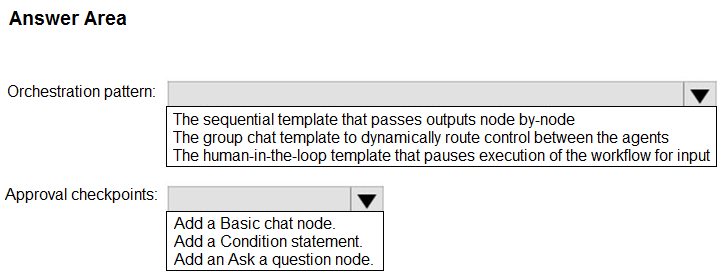
Orchestration pattern: Sequential template; Approval checkpoints: Add an Ask a question node.
Question
You have a Microsoft Foundry project that contains two agents named PolicyWriter and RskReviewer.
PolicyWriter generates daft updates for customer polices, and RiskReviewer reviews the drafts.
In the visual builder, you need to create a workflow that meets the following requirements:
• Finalizes low-risk updates without manual intervention
• Ensures predictable execution across the agents
• Requires user approval for highs updates
What should you configure? To answer, select the appropriate options in the answer area.
NOTE: Each comet selection is worth one point.
Key Takeaways
Tested ability to select sequential orchestration for deterministic agent chaining and 'Ask a question' nodes for human-in-the-loop approval gates.
Learn how to configure sequential orchestration and ask-a-question nodes in Microsoft Foundry to build deterministic AI agent workflows with conditional human approval.
Common mistake: Selecting Parallel orchestration, which fails to pass outputs between agents deterministically, or omitting the approval node for high-risk branches.
Expert Analysis
The scenario requires a deterministic pipeline where PolicyWriter generates drafts that are subsequently reviewed by RiskReviewer. The key phrase "Ensures predictable execution across the agents" dictates the use of a Sequential orchestration pattern, as opposed to parallel or autonomous flows which lack strict ordering.
To handle the conditional logic—automating low-risk updates while requiring intervention for high-risk ones—the workflow must branch based on risk assessment. In Microsoft Foundry's visual builder, this is achieved by adding a Condition statement after the review step. This node evaluates the output (risk level) and routes the flow accordingly.
For high-risk items requiring user approval, the standard pattern is to insert an Ask a question node (human-in-the-loop checkpoint). This pauses the workflow until a human confirms the update, satisfying the requirement for manual oversight on sensitive changes. Low-risk paths bypass this node to finalize automatically.
The common trap is selecting "Parallel" orchestration, which would execute both agents simultaneously without passing outputs, breaking the dependency chain. Another error is using a generic "Switch" instead of the specific "Condition" node designed for branching in Foundry workflows.
Exam Strategy
When a prompt specifies 'predictable execution' or 'draft then review', always choose Sequential orchestration. For requirements involving 'user approval' or 'manual intervention', look for the 'Ask a question' node. Distinguish these from parallel patterns used for independent tasks.
Frequently Asked Questions
What is the difference between Sequential and Parallel orchestration?
How do you implement human approval in Foundry?
Discussion 5 contributions
Compiled from public community threads and reader submissions, lightly edited for clarity. Handles and vote tallies are shown as recorded, and comments reflect the views of individual contributors.
From public community threads 5
-
ExamProAzure 👍 8Orchestration pattern The sequential template that passes outputs node-by-node Approval checkpoints Add an Ask a question node
-
Srikantha 👍 5nswer Key Orchestration pattern: The sequential template that passes outputs node by-node Approval checkpoints: Add a Condition statement.
-
8ac3742 👍 4Orchestration pattern is the sequential template that passes outputs node-by-node Key requirement: "Ensures predictable execution across the agents" and "PolicyWriter generates draft updates... and RiskReviewer reviews the drafts." A sequential template defines a strict, deterministic pipeline: PolicyWriter runs first to generate the draft, passing its output directly to RiskReviewer. Why not "group chat"? The prompt specifically rules out dynamic routing: a group chat dynamically decides which agent speaks next using an LLM coordinator, which makes execution non-deterministic and unpredictable. Why not "human-in-the-loop template"? The question asks for the overall orchestration pattern across the two agents. Low-risk updates must execute automatically without manual intervention, while human review is handled downstream via a branch checkpoint. Why not "human-in-the-loop template"? The question asks for the overall orchestration pattern across the two agents. Low-risk updates must execute automatically without manual intervention, while human review is handled downstream via a branch checkpoint
-
jwlnewsome 👍 4Orchestration pattern: The sequential template that passes outputs node by-node Approval checkpoints: Add a Condition statement. Predictable execution across the agents requires a Sequential orchestration pattern, where PolicyWriter → RiskReviewer execute in a fixed order and outputs are passed between nodes. Finalize low-risk updates without manual intervention and require user approval for high-risk updates requires evaluating the risk score/review outcome and branching accordingly. This is done with a Condition node: If risk = Low → finalize automatically. If risk = High → route to a human approval step.
-
mhussey79 👍 1Orchestration pattern Human-in-the-loop template Sequential template Approval checkpoints Add a Condition statement Add an Ask a question node
Reader comments & corrections
No reader corrections yet — spotted an error or have a note? Share it below.
Related Analysis
Practice All AI-103 Questions
Access 88 questions with complete answers and detailed explanations.
View Full AI-103 Practice Test →