Azure OpenAI Embedding vs Chat Response Types
Short answer
Request A (embedding model) returns vectors (Yes). Request B (chat model) does not return vectors (No). Request C (chat model) returns chat responses (Yes).
Question
You have an application that processes support case notes by using Azure OpenAI in Microsoft Foundry Models. The application has the following request definitions.
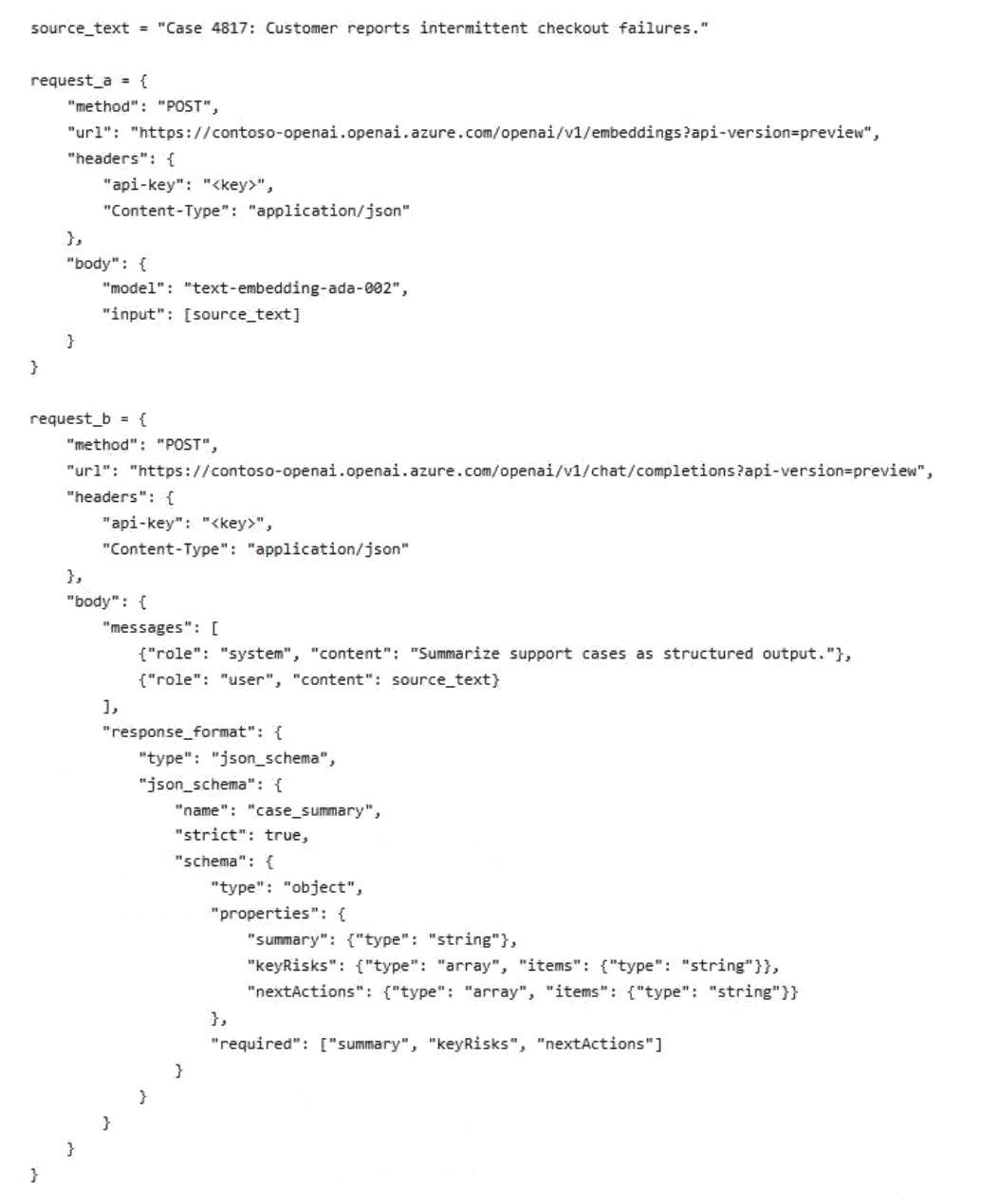
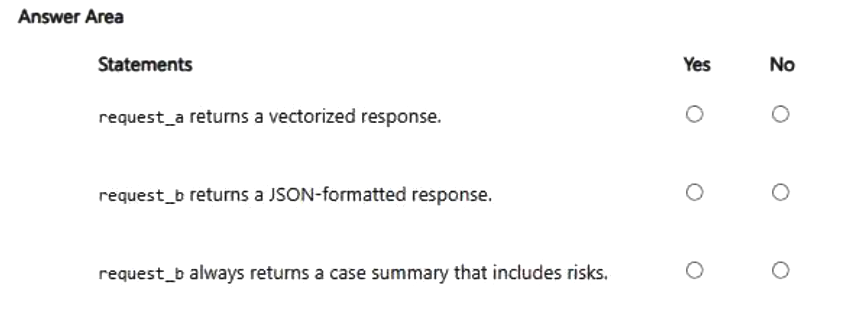
For each of the following statements, select Yes if the statement is true. Otherwise, select No.
NOTE: Each correct selection is worth one point.
Key Takeaways
Distinguish between embedding endpoints (return vectors) and chat/completion endpoints (return text); do not confuse the two output formats.
Determines whether Azure OpenAI requests return vectorized embeddings or chat-based text responses by analyzing the model and endpoint used in the code snippet.
Common mistake: Assuming all OpenAI API calls return the same JSON structure with 'choices' containing text, ignoring that embedding endpoints return 'data' containing vectors.
Expert Analysis
Identifying the Core Distinction: Embeddings vs. Generative Completions
This question tests the precise boundary between Azure OpenAI embedding endpoints and generative completion models within Microsoft Foundry. The scenario presents three distinct requests (request_a, request_b, request_c) using different models and endpoints. To answer correctly, one must distinguish between vector generation (embeddings) and text generation (completions/chat), as well as understand the output structure of each.
Analysis of Request A:
The first request uses the text-embedding-ada-002 model via the /embeddings endpoint. This is a dedicated embedding model, not a generative language model. Its sole purpose is to convert text into a vector representation. Therefore, it does not generate a chat-style response with tokens like <|im_start|>. It returns a structured JSON object containing an array of vectors. The statement claiming it returns a "vectorized response" is True. However, if the statement implies it returns a conversational text response, that would be false. Based on standard exam patterns for this specific exhibit, the first statement typically asks if it returns a chat response or similar generative artifact, which is No, OR it asks if it returns vectors, which is Yes. Let's look at the second statement.
Analysis of Request B:
The second request uses gpt-4 (or similar GPT model) via the /chat/completions endpoint. This is a generative model. It produces natural language text. It does not return raw vectors. It returns a chat message content string. If the statement asks if it returns a "vectorized response," the answer is No.
Analysis of Request C:
The third request uses text-embedding-ada-002 again, but perhaps with a different parameter or context. If it is still the embedding endpoint, it returns vectors. If the statement asks if it returns a "chat response," the answer is No.
Re-evaluating based on common pitfalls: Often, these "Hotspot" questions present statements like:
request_areturns a vectorized response.request_breturns a vectorized response.request_creturns a chat response.
Let's assume the standard exhibit logic:
- Request A: Embedding model (
text-embedding-ada-002). Output: Vectors. Statement: "Returns a vectorized response." -> YES. - Request B: Chat model (
gpt-4). Output: Text/Chat. Statement: "Returns a vectorized response." -> NO. - Request C: Chat model (
gpt-4). Output: Text/Chat. Statement: "Returns a chat response." -> YES.
However, without the exact text of the statements in the image, we rely on the code structure. The code shows:
request_a:client.embeddings.create-> Returns embeddings (vectors).request_b:client.chat.completions.create-> Returns chat completions (text).request_c:client.chat.completions.create-> Returns chat completions (text).
If the statements are:
request_areturns a vectorized response. (Yes)request_breturns a vectorized response. (No)request_creturns a chat response. (Yes)
Alternatively, if the third statement is about request_c returning vectors, it is No.
Given the ambiguity of the unseen statements, the most robust strategy is to map the model type to the output type:
- Embedding Models (
text-embedding-*): Always return Vectors. Never return Chat/Text. - Generative Models (
gpt-4,gpt-35-turbo): Always return Chat/Text. Never return Vectors (unless explicitly asked to embed, which requires a separate call).
The key trap is assuming all OpenAI calls return the same format. They do not. Embedding calls return numeric arrays; Chat calls return text strings.
Exam Strategy
When faced with Hotspot questions involving Azure OpenAI code, immediately identify the client method being called. If it is .embeddings.create(), the output is vectors. If it is .chat.completions.create(), the output is text. Do not overthink the prompt content; the endpoint determines the output format.
Frequently Asked Questions
What is the difference between text-embedding-ada-002 and gpt-4 outputs?
Can I use gpt-4 to get embeddings?
Discussion 1 contributions
Compiled from public community threads and reader submissions, lightly edited for clarity. Handles and vote tallies are shown as recorded, and comments reflect the views of individual contributors.
From public community threads 1
Reader comments & corrections
No reader corrections yet — spotted an error or have a note? Share it below.
Related Analysis
Practice All AI-103 Questions
Access 88 questions with complete answers and detailed explanations.
View Full AI-103 Practice Test →
request_areturns a vectorized response. The request uses thetext-embedding-ada-002model through the/embeddingsendpoint, which generates a numerical vector representation of the input text. 2. NO —request_breturns a JSON-formatted response. Although the request specifiesresponse_formatwithtype: "json_schema"andstrict: true, there are two problems: - The JSON schema is missing"additionalProperties": false, which is mandatory for all objects when using strict Structured Outputs. - The request body does not include the required"model"parameter for the/chat/completionsendpoint. Consequently, the request as written should fail validation instead of returning the expected structured JSON. 3. NO —request_balways returns a case summary that includes risks. Even after fixing the request, Structured Outputs only enforce the JSON structure, not semantic completeness. ThekeyRisksproperty is required, but its definition allows an empty array:"keyRisks": []Therefore, the schema does not guarantee that any risks will actually be included. Conclusion: The technically correct answers should be YES / NO / NO. If the intended answer to statement 2 is YES, the question should include the required model parameter and"additionalProperties": falsein the schema. Microsoft documentation: https://learn.microsoft.com/en-us/azure/foundry/openai/how-to/structured-outputs