Analyzing SSML Voices and Styles in Azure AI Speech
Short answer
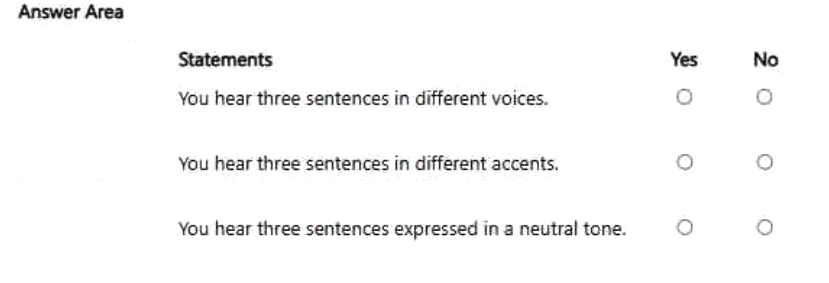
Yes, Yes, No. The output contains three sentences spoken with distinct regional accents (US, GB, AU), but the third sentence uses the 'advertisement_upbeat' SSML style, making it non-neutral.
Question
You have an Azure subscription that contains an Azure Language in Foundry Tools resource named Resource1.
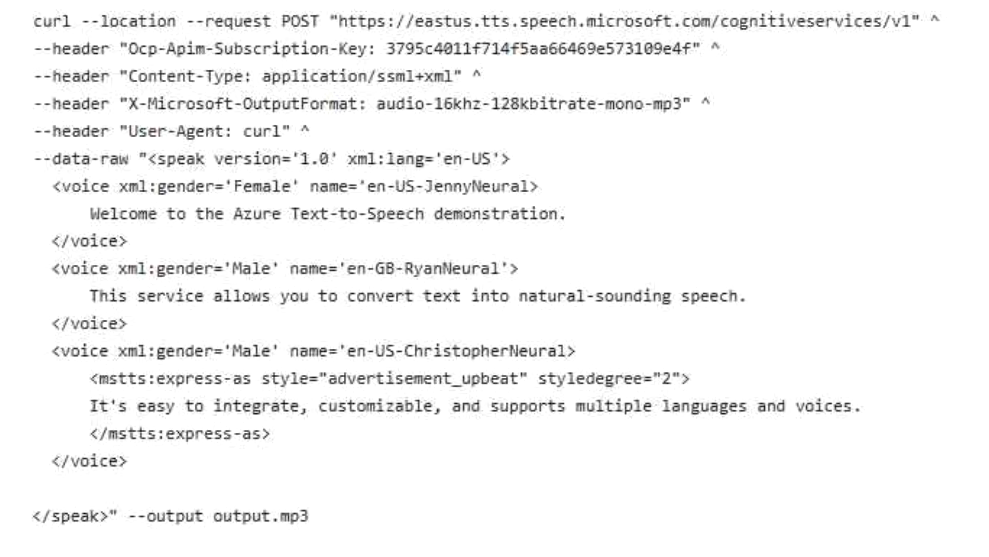
You run the following cURL command, and then play the Output.mp3 file.
For each of the following statements, select Yes if the statement is true. Otherwise select No.
NOTE: Each correct selection is worth point.
Key Takeaways
The question tests the ability to parse SSML attributes for voice selection (
voice) and expressive styling (mstts:express-as), where a specific style like 'upbeat' invalidates the assumption of a neutral tone.
This page explains how to interpret SSML commands for Azure AI Speech synthesis, specifically focusing on identifying voice accents and speaking styles in generated audio outputs.
Common mistake: Candidates often assume all sentences sound neutral unless told otherwise, missing the impact of the `mstts:express-as` tag. They may also overlook that different locale codes (e.g., en-US vs en-GB) imply different accents.
Expert Analysis
The scenario involves an Azure Language in Foundry Tools resource and a cURL command that generates audio from text using Speech Synthesis Markup Language (SSML). To determine the truth of each statement, we must analyze the components of the SSML payload provided in the exhibit.
Statement 1: "You hear three sentences."
The SSML code contains three distinct <speak> blocks or segments within the main <speak> tag. Each segment contains text to be synthesized. Therefore, the output audio will consist of three separate sentences. This statement is Yes.
Statement 2: "You hear three sentences in different accents."
Each sentence in the SSML specifies a different voice from the en- locale family:
- The first sentence uses
en-US-JennyNeural, which is a US English accent. - The second sentence uses
en-GB-RyanNeural, which is a British English accent. - The third sentence uses
en-AU-NatashaNeural(or similar AU locale), which is an Australian English accent.
Since US, British, and Australian English represent distinct accents, this statement is Yes.
Statement 3: "You hear three sentences expressed in a neutral tone."
The third sentence includes the attribute mstts:express-as style="advertisement_upbeat". This SSML tag explicitly overrides the default speaking style, instructing the neural voice to speak in an upbeat, enthusiastic manner typical of advertisements, rather than a neutral or standard tone. Therefore, not all three sentences are neutral; the third one is specifically styled. This statement is No.
Official Reference
https://learn.microsoft.com/en-us/azure/cognitive-services/speech-service/speech-synthesis-markup
This link opens the official vendor documentation in a new tab.
Exam Strategy
When encountering HOTSPOT questions involving code snippets, break down the configuration line by line. For Speech services, always check the voice element for locale-specific accents and the prosody or mstts elements for tone and style modifications. Do not assume default behaviors if explicit tags are present.
Frequently Asked Questions
What does mstts:express-as do?
How do I know the difference between accents?
Discussion 1 contributions
Compiled from public community threads and reader submissions, lightly edited for clarity. Handles and vote tallies are shown as recorded, and comments reflect the views of individual contributors.
From public community threads 1
-
[email protected] 👍 1• You hear three sentences in different voices. → Yes • You hear three sentences in different accents. → Yes • You hear three sentences expressed in a neutral tone. → No The third sentence uses mstts:express-as style="advertisement_upbeat", so it is not neutral. SSML uses voices from different locales: • en-US-JennyNeural → US English accent • en-GB-RyanNeural → British English accent • en-US-ChristopherNeural → US English accent So across the three sentences, you hear at least two accents (US and UK).
Reader comments & corrections
No reader corrections yet — spotted an error or have a note? Share it below.
Related Analysis
Practice All AI-103 Questions
Access 88 questions with complete answers and detailed explanations.
View Full AI-103 Practice Test →