Which Dataverse Column and Key Components Extend Accounts and Contacts?
DRAG DROP
You are designing a data model for a company. The model uses only standard Microsoft Dataverse tables.
You must extend the existing Accounts and Contacts tables to support the following business requirements:
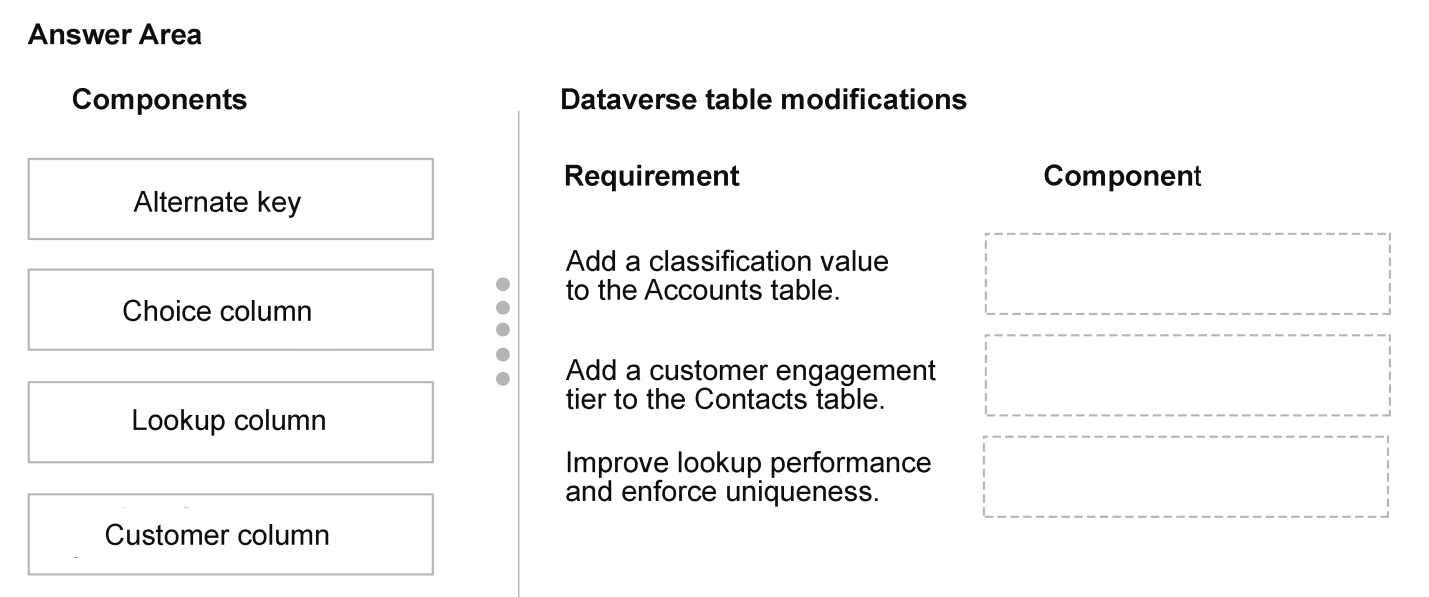
Store an additional classification value on the Accounts table.
Add a field that indicates a customer’s engagement tier on the Contacts table.
Create a mechanism to improve lookup performance and ensure uniqueness across selected fields.
You need to modify the tables to support the business requirements.
Which components should you use? To answer, move the appropriate components to the correct requirements. You may use each component once, more than once, or not at all. You may need to move the split bar between panes or scroll to view content.
NOTE: Each correct selection is worth one point.
Community Insight
The item tests mapping Dataverse column/key types to business needs — the trap is reaching for the polymorphic Customer column (or a plain text column) for engagement tier instead of a Choice column.
This drag-and-drop item tests whether you can pick the right Microsoft Dataverse schema components for extending standard Accounts and Contacts tables: Choice columns for fixed value sets and an Alternate key for lookup performance and uniqueness. The page confirms that Choice column fills both the Accounts classification and the Contacts engagement tier slots, while Alternate key answers the performance and uniqueness requirement.
Choosing the Customer column for the Contacts engagement tier because the requirement uses the word "customer"; the Customer column is a polymorphic lookup to either an Account or Contact record and stores no tier values of its own.
Community Discussion (4 comments)
Comments & Corrections
No comments yet — spotted an error or have a note? Share it below.
Expert Analysis
Why the Answer Is Correct
Dataverse models a fixed, predefined list of values with a Choice column, so "an additional classification value on the Accounts table" is satisfied by adding a Choice column to Account that holds the classification options. "A field that indicates a customer's engagement tier on the Contacts table" is the same shape of requirement — a small enumerated set such as Gold, Silver, Bronze — so it is also a Choice column placed on Contact. The third requirement, "improve lookup performance and ensure uniqueness across selected fields," is exactly what an Alternate key does: it provides a unique index over one or more columns that external systems and integrations can use as a stable, fast reference instead of the GUID primary key. Each requirement therefore maps one-to-one onto Choice column, Choice column, Alternate key.Why Other Candidate Answers Are Wrong
The most attractive distractor is the Customer column, since the requirement literally says "a customer's engagement tier." The Customer column is a polymorphic lookup that points at either an Account or a Contact record; it references an entity, it does not store a tier value, so it cannot hold Gold/Silver/Bronze data. Plain Text or Whole Number columns would technically store a tier, but they allow inconsistent free-form values and lose the option set, default value, and filtering behaviour that a Choice column gives you — the exam expects the purpose-built component. For uniqueness and lookup speed, a plain single-column index or a duplicated text field does not enforce uniqueness across multiple fields; only an Alternate key defines a unique constraint over selected columns and enables faster key-based lookups from external systems.Community Comment Notes
Mirjalol_Rakhmonov raised precisely the ambiguity many learners hit, asking why the engagement tier is ""why this one is not also Choice column?"" — meaning the tier is, in fact, a Choice column too, which is why Choice column is used more than once in this item. Cupupis flagged the Customer distractor with the reasoning that "Since customer field is polymorphic field where you can select contact or account record," which is the correct technical objection to using it for a tier. 427ea93 reinforced the point that a tier "typically represents a select number of choices (gold, S-tier, etc)," so Choice is the right component, and Mr. Jethalal's request for the answer shows the item deliberately offers no option letters — you must reason from the requirement text alone.Official Reference
Exam Strategy
Read each requirement for the underlying data shape before touching the drag targets: a fixed list of values always means Choice column, and "unique" plus "faster lookup" together always mean Alternate key. Reuse of the same component across multiple slots is allowed, so do not force a one-to-one mapping just because an option appears once.
Frequently Asked Questions
Why is the Contacts engagement tier a Choice column instead of the Customer column?
The Customer column is a polymorphic lookup to an Account or Contact record and stores no tier value. A Choice column holds the fixed tier options such as Gold, Silver and Bronze.
How does an Alternate key improve lookup performance in Dataverse?
An alternate key creates a unique index over one or more columns, so external systems can look up records by a stable business value instead of the GUID and duplicates are rejected.