What Business Rule Scope Applies in Canvas vs Model-Driven Apps?
DRAG DROP
A company is creating a canvas app and a model-driven app to manage their customer accounts.
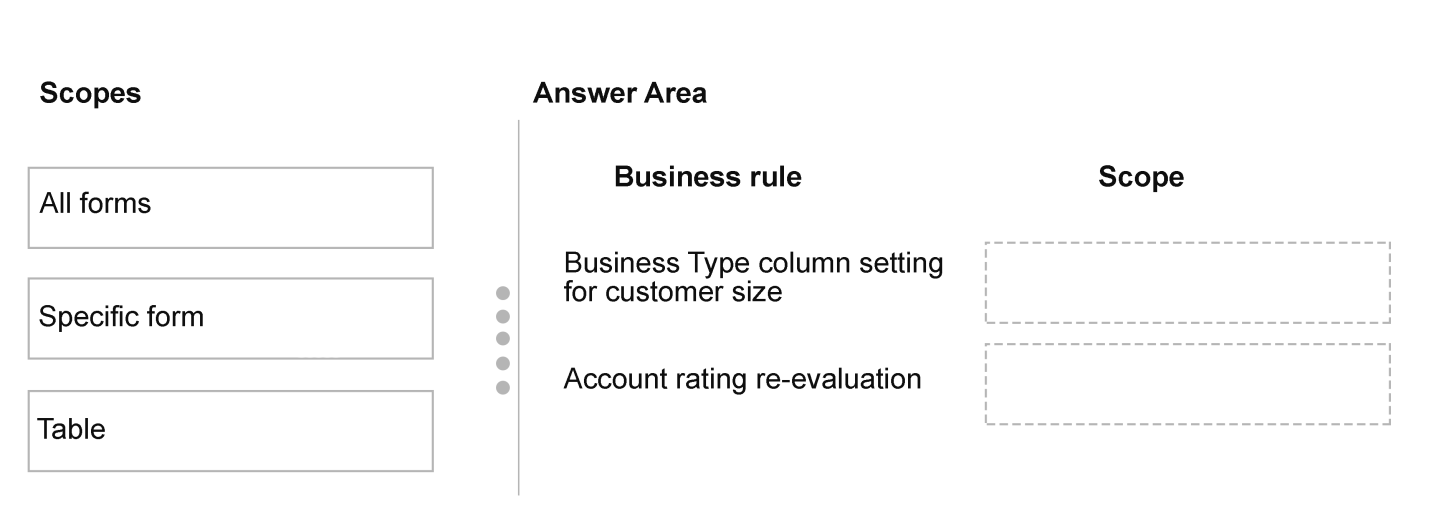
The canvas app requires a business rule to set the Business Type column to large if the customer size is greater than a specific currency value.
The model-driven app requires a business rule to recommend the account rating be re-evaluated when the account goes on credit hold for this app only.
You need to configure the scope for the business rules.
Which scope should you use? To answer, drag the appropriate scopes to the correct business rules. Each scope may be used once, more than once, or not at all. You may need to drag the split bar between panes or scroll to view content.
NOTE: Each correct selection is worth one point.
Community Insight
It tests mapping business-rule scopes to the surface where the rule must run; the trap is treating 'this app only' as a canvas-compatible scope or using Specific form where no form exists.
Dataverse business-rule scope controls whether logic runs against the table or a model-driven form. This question establishes Entity/Table scope for the canvas app rule and Specific form scope for the model-driven app rule limited to one app form.
Learners often assign Specific form to both requirements because both seem app-specific, but a canvas app has no model-driven form context, so its Dataverse business rule must use Entity/Table scope.
Community Discussion (1 comments)
Comments & Corrections
No comments yet — spotted an error or have a note? Share it below.
Expert Analysis
Why the Answer Is Correct
Canvas apps consume Dataverse business rules only when the rule's scope is Entity (Table); that makes the rule evaluate against the table data through the Dataverse connector rather than a model-driven form. The Business Type calculation depends on customer size and should run whenever the record is created or updated from the canvas app, so Table scope is the supported choice. The second requirement is deliberately form-bound: the rating recommendation should appear only in that one model-driven app form, not across every form or server-side process. Specific form scope confines the client-side rule to that form, satisfying 'for this app only' without affecting other apps or forms.Why Other Candidate Answers Are Wrong
Specific form for the canvas rule fails because canvas apps do not host Dataverse business rules in a model-driven form; there is no form scope for the rule to attach to. All Forms would make the model-driven rating recommendation appear on every form for the Account table, which is broader than the stated one-app requirement. Entity/Table for the model-driven rule would also broaden the logic beyond the single form, and using it twice ignores the canvas-vs-form distinction the item is testing.Community Comment Notes
aed747e's note captures the key split: "Canvas Apps require the Table scope" while model-driven apps can use a form-specific scope. That aligns with the requirement wording, where the canvas rule needs server-side/table evaluation and the second rule is intentionally limited to one form. Treat the comment as confirmation of the scope mapping, not as a substitute for checking the requirement details.Official Reference
Exam Strategy
Read the deployment surface first: canvas app = table/entity scope; model-driven form-only = specific form. Then check whether the requirement says 'all forms' or 'this app/form only' before selecting All Forms or Specific form.
Frequently Asked Questions
Why can't a canvas app business rule use Specific form scope?
Canvas apps do not render Dataverse model-driven forms, so the rule has no form context to attach to. Use Entity/Table scope so the rule evaluates against the table data.
Does Specific form scope limit a business rule to one model-driven app?
It limits the rule to that form; if the form is used only in the intended app, the effect is app-only. Other apps or forms using the Account table are unaffected.