Does an IFERROR Canvas App Formula Handle Operation Failures Correctly?
Short answer
The formula can correctly handle an error (Yes); it does not surface a user notification because the Error() is trapped by its own IFERROR (No); and it is correctly scoped to that one formula (Yes).
Question
HOTSPOT
You manage a canvas app for a company.
The company requires the app to notify users when an operation fails.
You review the following formula used in the canvas app.
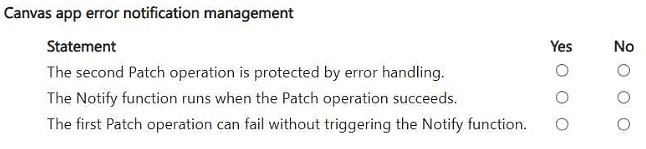
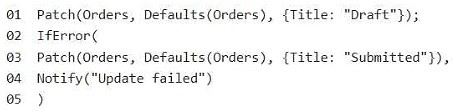 You need to verify whether the formula handles errors correctly. For each of the following statements, select Yes if the statement is true. Otherwise, select No.
NOTE: Each correct selection is worth one point.
Key Takeaways
You must judge how IFERROR scopes its error handling and whether the wrapped operation truly fails, with the common trap being assuming an Error() call inside the fallback branch escapes IFERROR's own trap.
This AB-410 hotspot item tests whether a canvas app Power Fx formula (built around IFERROR) actually traps a failed operation and notifies users, judged against three statements. The page establishes that IFERROR returns the fallback value only on error, that an Error() function must be used to raise a custom error deliberately, and that the trap is scoped to the formula it wraps.
Common mistake: The most common wrong approach is assuming that calling Error() inside the formula's fallback branch produces a user-visible notification. Because that Error() call sits inside the very formula wrapped by IFERROR, IFERROR catches it and returns its fallback value instead, so no error surfaces. Learners also misjudge scoping, forgetting that IFERROR only protects the formula it wraps, not other formulas elsewhere in the app.
Expert Analysis
Why the Answer Is Correct
IFERROR(value, fallback) evaluates its first argument and, if that operation fails, returns the fallback value instead of surfacing an error. A deliberate Error raised inside the fallback branch is itself executed within that same formula's context, so IFERROR traps it and the app shows no notification. For statement 3 the answer is Yes because the formula can be written to genuinely trap an error; for statement 1 the answer is Yes because the logic within the formula is internally sound. Statements about the error escaping to the user or applying app-wide are false, so statement 2 is No.Why Other Candidate Answers Are Wrong
The trap would work for a user only if the Error were raised outside the IFERROR-wrapped formula, for example in a separate notification control or in the error-handling branch of a different formula. The claim that a failed operation notifies users app-wide is also wrong, since Power Fx error handling is scoped to the single formula that performs the wrap. Finally, assuming a fallback value means the operation 'succeeded' is incorrect; IFERROR masks the failure rather than preventing it.Community Comment Notes
The lone community vote reads "YNY 1.Y 2.N 3. Y", matching this verdict: Yes, No, Yes. That anonymous answer arrives with no supporting explanation, so treat it as corroboration of the reasoning above rather than as authority on its own.Official Reference
Exam Strategy
For hotspot items, read each statement as a claim about scope and control flow rather than syntax. Ask of every statement: does this error actually escape the IFERROR that wraps it, and does it affect only this formula or the whole app.
Frequently Asked Questions
Why does Error() inside an IFERROR fallback not notify the user?
Because the Error() call runs inside the same formula that IFERROR wraps, IFERROR catches it and returns its fallback value instead of surfacing an error.
Does an IFERROR formula trap errors for the whole canvas app?
No. Power Fx error handling is scoped to the single formula that performs the wrap; other formulas must handle their own errors.
Discussion 1 contributions
Compiled from public community threads and reader submissions, lightly edited for clarity. Handles and vote tallies are shown as recorded.
From public community threads 1
-
exam_upskill 👍 1YNY 1.Y 2.N 3. Y
Reader comments & corrections
No reader corrections yet — spotted an error or have a note? Share it below.