Build the field technician canvas app in sequence
Short answer
Create a canvas app in Power Apps Studio, connect the app to Dataverse as its data source, then publish the app so technicians can use it on their devices.
Question
This is a case study. Case studies are not timed separately from other exam sections. You can use as much exam time as you would like to complete each case study. However, there might be additional case studies or other exam sections. Manage your time to ensure that you can complete all the exam sections in the time provided. Pay attention to the Exam Progress at the top of the screen so you have sufficient time to complete any exam sections that follow this case study.
To answer the case study questions, you will need to reference information that is provided in the case. Case studies and associated questions might contain exhibits or other resources that provide more information about the scenario described in the case. Information provided in an individual question does not apply to the other questions in the case study.
A Review Screen will appear at the end of this case study. From the Review Screen, you can review and change your answers before you move to the next exam section. After you leave this case study, you will NOT be able to return to it.
To start the case study
To display the first question in this case study, select the “Next” button. To the left of the question, a menu provides links to information such as business requirements, the existing environment, and problem statements. Please read through all this information before answering any questions. When you are ready to answer a question, select the “Question” button to return to the question.
Background
Fabrikam Inc. is an energy provider that operates wind and solar farms across multiple countries and regions. The company uses Microsoft Power Platform to manage asset maintenance, technician workflows, and predictive analytics.
Field technicians use canvas apps on mobile devices to capture inspection and repair data. Operations managers use model-driven apps to monitor asset performance and maintenance history.
The company plans to enhance its platform by introducing AI-driven insights, improving reuse across applications, and establishing a formal application lifecycle management (ALM) strategy.
Current environment
Applications
• Field technicians use an outdated mobile app to log maintenance activities and capture asset readings in SharePoint Online.
• Operations managers use a model-driven app to review maintenance records and asset performance trends.
Development practices
• Developers build and modify applications directly in the production environment.
• There is NO structured ALM process.
• Solutions are NOT consistently used to package or deploy application components.
• Reusable components are inconsistently implemented across apps, leading to duplication.
AI integration
• Fabrikam Inc. plans to actively explore generative AI usage as part of the next phase of work.
Business requirement
Application development
• The outdated mobile app must be replaced with a new app that supports responsive design principles, provides full control over the UI, and allows technicians to take and upload photos directly from their mobile devices.
• The new app for the field technicians requires the name of the technician to be persisted on the home screen only. In addition, work orders must be displayed within a gallery.
• All new apps must connect to a scalable, cloud-based relational data store.
• Apps must support efficient data entry for technicians in the field.
• Reusable UI elements must be implemented to reduce duplication.
AI capabilities
• The company requires a generative AI solution to manage customer complaint responses and create custom inspection reports that align to an existing template.
• Customer complaint responses must be generated in applications and based on emails being sent to a mailbox.
• Custom AI development must be minimized.
Generative AI reusability
• Generative AI solutions must accept dynamic inputs to adapt to different scenarios.
• Generative AI solutions must be reusable across different Power Platform services.
Extensibility
• Custom UI form components must be reusable across applications.
• Use of server-side custom code must be minimized where possible.
Technical requirements
Application lifecycle management (ALM)
• Separate environments must be used for development, testing, and production.
• Solutions must be used to package application components, segmented based on functional areas.
• Managed solutions must be deployed to the production environment.
• Validation must occur before deployment to production.
Data processing
• Aggregated values across related rows must be displayed for reporting.
• Calculations must update automatically as new data is entered. Calculation data must be limited to a maximum length of 10.
Issues
• Duplicate logic exists across multiple canvas apps.
• Developers frequently overwrite changes in production.
• Generative AI solutions produce inconsistent outputs due to missing or inconsistent inputs.
• Maintenance metrics are not consistently calculated across related rows.
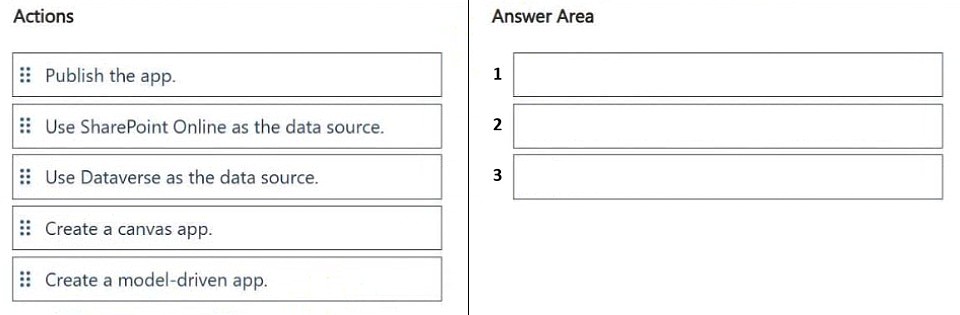
You need to develop an app that meets the business requirements.
Which three actions should you perform in sequence? To answer, move the appropriate actions from the list of actions to the answer area and arrange them in the correct order.
Key Takeaways
The question tests the standard canvas app build workflow, and the trap is choosing SharePoint or a model-driven path instead of Dataverse, or publishing before the data connection exists.
This AB-410 case study asks for the correct build order for Fabrikam's new field technician app. The sequence is create a canvas app, connect Dataverse as the data source, then publish the app.
Common mistake: Connecting the legacy SharePoint Online list or starting from a Dataverse entity, because the requirements explicitly call for full UI control and a scalable cloud relational store.
Expert Analysis
The requirement that fixes the app type Fabrikam's replacement for the legacy mobile app must support responsive design, give full control over the UI, and let technicians take and upload photos from their devices. Those are canvas app characteristics: the maker composes the interface screen by screen, adds camera and image controls, and arranges the home screen and gallery manually. A model-driven app derives its UI from Dataverse metadata, so it cannot deliver this level of layout control. The first action in the sequence is therefore to create a canvas app.
The requirement that fixes the data source The technical requirement states that all new apps must connect to a scalable, cloud-based relational data store, and work orders must be displayed in a gallery while the technician name is persisted on the home screen. Microsoft Dataverse is Power Platform's managed cloud relational service, and it is the store the new app must use. The old SharePoint Online list is the pattern being retired, so connecting to SharePoint would fail the requirement. Connecting Dataverse is the second action.
Why publishing comes last An app saved in the maker studio exists only as a draft; makers and shared testers reach it through a preview link. Only after the layout and data connection are in place does publishing create the live version that technicians open on their devices, and it must be the closing step because it freezes the current configuration as the released version. The correct ordered set is: create a canvas app, connect Dataverse as the data source, then publish the app.
A learner comment offers the identical three-step order — canvas app first, Dataverse second, publish third — which matches this reasoning.
The trap to avoid The wrong sequences either start with the data connection before an app exists, or insert SharePoint/model-driven choices that contradict the stated requirements.
Exam Strategy
For sequence questions, first map each requirement keyword to a technology — responsive layout, full UI control, and camera capture mean canvas app; scalable relational store means Dataverse. Then order the steps as create, configure, release: an app must exist before it can be connected, and it must be connected before it is published for users. Reject any ordering that references retiring technology such as SharePoint when the case study states it is being replaced.
Frequently Asked Questions
Why is a canvas app the right choice instead of a model-driven app here?
Why must Dataverse be the data source rather than SharePoint Online?
Why does publishing come last in the sequence?
Discussion 1 contributions
Compiled from public community threads and reader submissions, lightly edited for clarity. Handles and vote tallies are shown as recorded, and comments reflect the views of individual contributors.
From public community threads 1
-
ah2006 👍 21) Create a canvas app 2) Use Dataverse as the data source 3) Publish the app.
Reader comments & corrections
No reader corrections yet — spotted an error or have a note? Share it below.