Dynamics 365 Sales Product Catalog Configuration
HOTSPOT
Case Study
This is a case study. Case studies are not timed separately from other exam sections. You can use as much exam time as you would like to complete each case study. However, there might be additional case studies or other exam sections. Manage your time to ensure that you can complete all the exam sections in the time provided. Pay attention to the Exam Progress at the top of the screen so you have sufficient time to complete any exam sections that follow this case study.
To answer the case study questions, you will need to reference information that is provided in the case. Case studies and associated questions might contain exhibits or other resources that provide more information about the scenario described in the case. Information provided in an individual question does not apply to the other questions in the case study.
A Review Screen will appear at the end of this case study. From the Review Screen, you can review and change your answers before you move to the next exam section. After you leave this case study, you will NOT be able to return to it.
To start the case study
To display the first question in this case study, select the “Next” button. To the left of the question, a menu provides links to information such as business requirements, the existing environment, and problem statements. Please read through all this information before answering any questions. When you are ready to answer a question, select the “Question” button to return to the question.
Background
AdventureWorks Cycles is a global manufacturer of high-performance bicycles headquartered in Seattle. The company sells products through distributors, specialty retailers, and a growing direct-to-consumer online channel. AdventureWorks Cycles recently expanded its product catalog to include the athlete package, which includes a cycle, connected devices and subscription-based analytics services.
The sales operations team is responsible for configuring the new Dynamics 365 Sales environment. Their goal is to implement AI-driven processes that streamline the lead-to-cash workflow while ensuring that sellers can easily identify the most promising opportunities.
Current Environment
Product managers maintain products and pricing in spreadsheets. Information regarding custom relationships, competitor analysis, and region-specific marketing content is stored in a SharePoint site called the sales portfolio.
The organization has identified reporting challenges they want to resolve:
Regional managers require in-depth reporting using information from the sales pipeline and seller activities, the point-of-sale solution, website analytics, and the accounting system.
Team leads require real-time information on active opportunities, as well as visibility of seller’s appointments and phone calls, without needing to navigate into multiple views.
Sellers must be able to quickly view their own opportunities by phase.
All sellers are assigned Dynamics 365 Sales Enterprise licenses, also, the CFO has requested that Copilot message packs are pre-purchased by using the Copilot Studio subscription license.
A Dynamics 365 sales sandbox environment has been in use for six months. There are 60 leads records with 30 records that are qualified and 20 that are disqualified. Ten of the qualified leads are over three months old.
Business Requirements
Sellers in all regions should be able to review the new mountaineer cycles. The cycles include economy and premium fittings. When creating opportunities, sellers should be able to select a metal type when adding a mountaineer cycle to an opportunity. The metal types include chrome, aluminum, and titanium.
Pricing managers must be able to create deals for the same products in their own currencies and at their own prices, without reference to the cost of the product.
Predictive scoring should be enabled for leads created within the last three months in the sandbox environment.
A segment of leads named Hot is needed that will contain all leads where the source is phone, employee referral or partner. Leads from this segment should be distributed to sellers using a round robin method.
Agents should not be able to take action on any data that is created in the production environment before they are started.
All sellers should be able to access leads disqualified by agents.
Technical Information & Requirements
Agents must use a dedicated service identity to execute write actions with a controlled security role in Dataverse.
The sales operations team lead must be assigned the Power Platform administrator role.
The lead pricing manager must be assigned to the Microsoft 365 billing admin role.
The vice president of sales must be assigned the AI admin role.
Both the sandbox and production environments must be enabled for AI capacity, but usage should be capped on the sandbox environment.
A trial environment must be created, with the sales qualification agent configured. Outreach emails must be automatically generated for leads but only sent when sellers deem it necessary.
All sellers must be assigned a customized version of the salesperson role on the production environment. This role should grant read access only to the leads that the sellers own.
The EnableRoleBasedSystemViews property must be set to true for the production environment.
No Azure subscriptions are available in the tenant.
Issues
The sales qualification agent has disqualified several leads in the trial environment. The vice president of sales has requested to understand the reason for the disqualified leads.
Sellers are not able to create agents in the production environment.
Agent consumption has been unreliable. The company requires that AI capacity is always available to sellers.
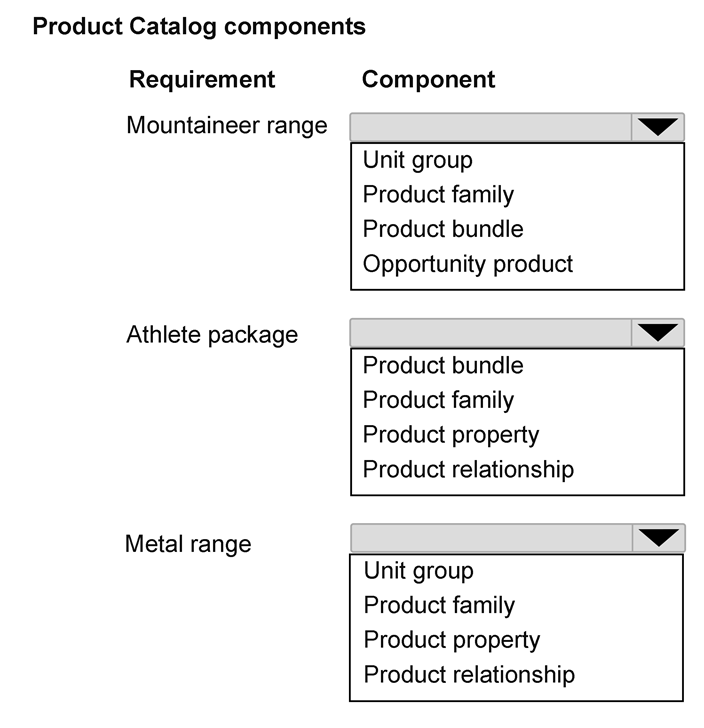
You need to configure the AdventureWorks Cycles product catalog.
How should you configure the product catalog? To answer, select the appropriate options in the answer area.
NOTE: Each correct selection is worth one point.
Community Insight
The question tests the specific mapping of business requirements (grouping, packaging, customization) to Dynamics 365 catalog entities, with the trap being the confusion between 'Family' and 'Bundle'.
This scenario tests the configuration of the Dynamics 365 product catalog to support hierarchical product structures and configurable attributes. The correct setup utilizes Product Families for grouping, Product Bundles for packages, and Product Properties for seller-selectable options.
Learners often confuse Product Families with Product Bundles or misapply Product Properties. A common error is using a Bundle for simple grouping instead of a Family, or failing to recognize that selectable options require a Property.
Community Discussion (4 comments)
Comments & Corrections
No comments yet — spotted an error or have a note? Share it below.
Expert Analysis
Why the Answer Is Correct
The configuration requires three distinct components to meet the business requirements. First, a Product Family is used to group related products, such as the 'Mountaineer' range containing both Economy and Premium variants. Second, a Product Bundle is necessary to group multiple products sold together as a single package (e.g., the athlete package). Third, Product Properties allow sellers to select configurable characteristics, such as metal type (chrome, aluminum, titanium), during the opportunity creation process.Why Other Candidate Answers Are Wrong
Incorrect selections typically involve swapping the roles of Families and Bundles or omitting Properties. Using a Bundle for simple categorization ignores the hierarchy needed for variants. Failing to add Properties prevents the required flexibility in selecting specific fittings or materials.Community Comment Notes
Community consensus confirms that Product Families group ranges, Bundles package items, and Properties handle user selection. One commenter noted: "A Product Family is used to group related products... A Product Bundle groups multiple products... A Product Property allows sellers to choose configurable characteristics." This aligns perfectly with the requirement to group Mountaineer cycles and allow metal type selection.Exam Strategy
Memorize the definitions of Product Family (hierarchy/grouping), Product Bundle (sales package), and Product Property (configurable attribute). When you see 'group', think Family; when you see 'package/sold together', think Bundle; when you see 'select option', think Property.
Frequently Asked Questions
What is the difference between a Product Family and a Product Bundle?
A Product Family groups related products hierarchically (like variants), while a Product Bundle combines multiple distinct products into a single sellable unit.
When should I use a Product Property?
Use a Product Property when sellers need to select specific configurable attributes, such as material or color, for a product during a transaction.
Related Analysis
Practice All AB-210 Questions
Access 100 questions with complete answers and detailed explanations.
View Full AB-210 Practice Test →