Mapping Network Strategic Approaches to Operational Benefits
Short answer
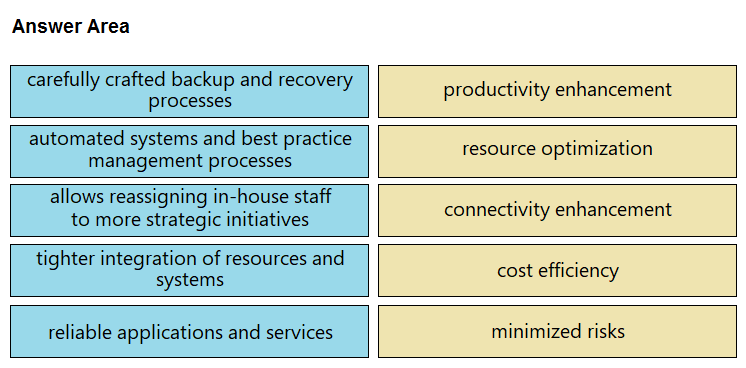
Productivity enhancement matches reassigning in-house staff; resource optimization matches automated systems and best practice management processes; connectivity enhancement matches tighter integration of resources and systems; cost efficiency matches reliable applications and services; minimized risks matches carefully crafted backup and recovery plans.
Question
As technologies such as big data, cloud, and IoT continue to grow, so will the demand for network bandwidth. Business strategies must be flexible to accommodate these changes when it comes to priorities and direction, and the network design strategy also must be agile and adaptable. Drag and drop the benefits from the left onto the corresponding strategic approaches on the right as they relate to network design and management.
Key Takeaways
The trap lies in confusing the mechanism (automation) with the outcome (resource optimization) and misattributing human-centric benefits (staff reassignment) to technical efficiencies.
Learn how to map strategic network approaches like productivity enhancement and resource optimization to their correct operational benefits such as staff reallocation and automation.
Common mistake: Learners frequently swap 'Productivity Enhancement' with 'Resource Optimization', incorrectly associating staff reassignment with automation rather than recognizing it as a result of freed-up capacity from efficient resource management.
Expert Analysis
This drag-and-drop question maps five strategic approaches to their corresponding operational benefits within the context of modern network design. The core task is to align abstract business goals with concrete technical outcomes, ensuring that each benefit logically follows from its designated strategy.
Productivity enhancement is correctly matched with reassigning in-house staff. When networks and systems are optimized, routine maintenance tasks decrease, allowing IT personnel to shift focus toward higher-value strategic initiatives rather than keeping the lights on.
Resource optimization aligns with automated systems and best practice management processes. Automation reduces human error and streamlines workflows, ensuring that physical and virtual resources are utilized efficiently without manual intervention.
Connectivity enhancement corresponds to tighter integration of resources and systems. Enhanced bandwidth and low-latency connections allow disparate components—such as cloud platforms, data centers, and IoT devices—to communicate seamlessly, creating a unified ecosystem.
Cost efficiency is linked to reliable applications and services. High availability minimizes downtime, which directly translates to reduced revenue loss and lower costs associated with service interruptions and emergency repairs.
Minimized risks pairs with carefully crafted backup and recovery plans. Robust disaster recovery strategies ensure that data integrity is maintained and operations can resume quickly after unforeseen events, thereby mitigating potential business disruptions.
The most attractive but wrong approach often involves swapping Productivity and Resource Optimization or misaligning Connectivity with Cost Efficiency. While automation does improve productivity, the specific phrasing "reassigning staff" points to the human resource aspect of productivity, whereas automation itself is a mechanism for optimizing existing resources. Similarly, while connectivity aids cost savings indirectly, direct cost efficiency is driven by reliability and uptime.
Exam Strategy
When answering drag-and-drop questions involving business value, isolate the primary actor: if the benefit involves people or time, look for productivity or staffing terms; if it involves money or downtime, look for cost or reliability; if it involves system interaction, look for integration or connectivity. Always match the most direct causal link rather than a secondary effect.
Frequently Asked Questions
Why is 'reassigning staff' linked to productivity instead of resource optimization?
How does connectivity enhancement lead to tighter integration?
Discussion 4 contributions
Compiled from public community threads and reader submissions, lightly edited for clarity. Handles and vote tallies are shown as recorded, and comments reflect the views of individual contributors.
From public community threads 4
-
biddid 👍 2reliable applications and services -> productivity enhancement Availability = Productivity: Uptime ensures employees can perform their tasks without interruption. tighter integration of resources and systems -> resource optimization Silo Reduction = Efficiency: Integrating disparate systems eliminates redundancy and maximizes asset utilization. automated systems and best practice management processes -> connectivity enhancement Agility = Connectivity: Automation accelerates end-to-end service delivery and business reach. allows reassigning in-house staff to more strategic initiatives -> cost efficiency Operational Savings: Moving labor from "Run" to "Innovate" is a direct optimization of OPEX. carefully crafted backup and recovery processes -> minimized risks Resiliency = Risk Management: Protecting data and ensuring continuity is the primary method to mitigate business risk.
-
biddid 👍 2Not correct. Should be: Productivity enhancement allows reassigning in-house staff to more strategic initiatives Resource optimization - automated systems and best practice management processes Connectivity enhancement - tighter integration of resources and systems Cost efficiency - reliable applications and services (less downtime less cost) Minimized risks - carefully crafted backup and recovery processes
-
elhijodelinfinito 👍 1Productivity → reliable apps and services. Resource optimization → reassigning staff. Connectivity enhancement → tighter integration. Better connectivity is what lets resources and systems work together: cloud, DC, branches, IoT and apps integrated over a well-designed network. Cost efficiency → automation and best-practice processes. Automation removes repetitive manual work and errors, and standardized processes avoid costly mistakes and rework. Minimized risks → backup and recovery.
-
biddid 👍 1Sorry it is wrong
Reader comments & corrections
No reader corrections yet — spotted an error or have a note? Share it below.