Mapping Network Protocols to Functional Descriptions
Short answer
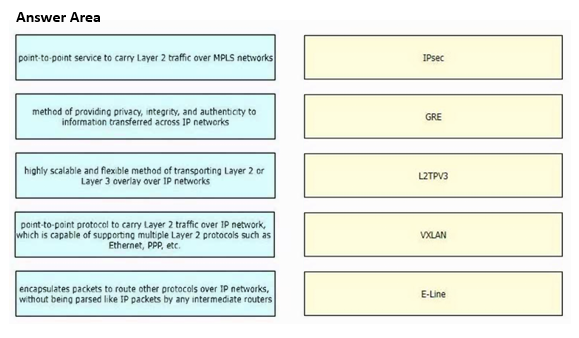
IPsec provides privacy, integrity, and authenticity; GRE encapsulates other protocols over IP without parsing inner packets; L2TPv3 transports Layer 2 frames over IP; VXLAN provides scalable Layer 2/3 overlay.
Question
Drag and drop the right functional descriptions from the left onto the corresponding protocols on the right.
Key Takeaways
The main trap is confusing GRE and L2TPv3; GRE encapsulates Layer 3 protocols while L2TPv3 preserves Layer 2 frames, and confusing IPsec's security role with simple encapsulation.
This question tests knowledge of network protocol functions, matching IPsec to security, GRE to encapsulation, L2TPv3 to Layer 2 transport, and VXLAN to overlay networking.
Common mistake: Candidates often mistake GRE for carrying Layer 2 frames because both are tunneling protocols. However, GRE is primarily for Layer 3 encapsulation, whereas L2TPv3 is explicitly for Layer 2 frame transport.
Expert Analysis
IPsec: Security Services
The Internet Protocol Security (IPsec) suite is designed to provide privacy, integrity, and authenticity for IP traffic. It operates at the network layer to secure communications across untrusted networks like the internet by encrypting packets (confidentiality/privacy), ensuring they haven't been tampered with (integrity), and verifying the source identity (authenticity). This matches the functional description focused on security guarantees.
GRE: Encapsulation of Non-IP Traffic
Generic Routing Encapsulation (GRE) is a tunneling protocol that encapsulates various network layer protocols inside virtual point-to-point links over an IP network. Its primary function is to allow different types of traffic (such as IPv6, AppleTalk, or IPX) to be transported over an IP infrastructure. The key characteristic is that transit routers along the path only process the outer IP header and do not parse the inner packet's payload, effectively making the inner protocol "invisible" to intermediate devices.
L2TPv3: Layer 2 Transport over IP
Layer 2 Tunneling Protocol version 3 (L2TPv3) is used to transport Layer 2 frames (such as Ethernet or PPP) over an IP network. Unlike L2TPv2 which often relies on signaling, L2TPv3 can be configured statically. It creates a point-to-point connection that carries the original Layer 2 frame intact, allowing for services like E-Line emulation. It is distinct from GRE because it preserves the full Layer 2 frame structure rather than just encapsulating Layer 3 packets.
VXLAN: Scalable Overlay
Virtual Extensible LAN (VXLAN) is a network virtualization technology that creates scalable Layer 2 or Layer 3 overlays on top of a Layer 3 underlay network. It uses UDP encapsulation to extend the Layer 2 domain across the Layer 3 fabric, supporting up to 16 million segments (compared to VLANs' 4096 limit). This makes it ideal for data center environments requiring large-scale segmentation and tenant isolation.
Exam Strategy
When faced with drag-and-drop protocol questions, focus on the 'layer' and 'purpose' keywords. Identify if the description mentions encryption/security (IPsec), simple tunneling without inner inspection (GRE), Layer 2 frame preservation (L2TPv3), or scalability/overlay (VXLAN). Eliminate options based on these specific technical boundaries.
Frequently Asked Questions
What is the difference between GRE and L2TPv3?
Why is VXLAN considered more scalable than VLANs?
Discussion 1 contributions
Compiled from public community threads and reader submissions, lightly edited for clarity. Handles and vote tallies are shown as recorded, and comments reflect the views of individual contributors.
From public community threads 1
-
elhijodelinfinito 👍 1IPsec: Privacy, integrity and authenticity across IP networks GRE: Encapsulates other protocols over IP; transit routers do not parse the inner packet L2TPv3: Point-to-point Layer 2 over an IP network; carries Ethernet, PPP and more VXLAN: Highly scalable Layer 2 or Layer 3 overlay over IP E-Line: Point-to-point Layer 2 service over MPLS
Reader comments & corrections
No reader corrections yet — spotted an error or have a note? Share it below.