Resolving Asymmetric Routing with BGP MED
Refer to the exhibit. Two data center sites, X and Y, are connected with a direct backdoor link under these conditions: • Site-specific firewalls are deployed behind the Internet edge routers R1 and R2. • Both sites are advertising the address pool 100.75.10.0/23 toward the Internet. Site-X finds that Internet traffic returning from user PCs comes back on the Site-Y link. Which design resolves the issue? - 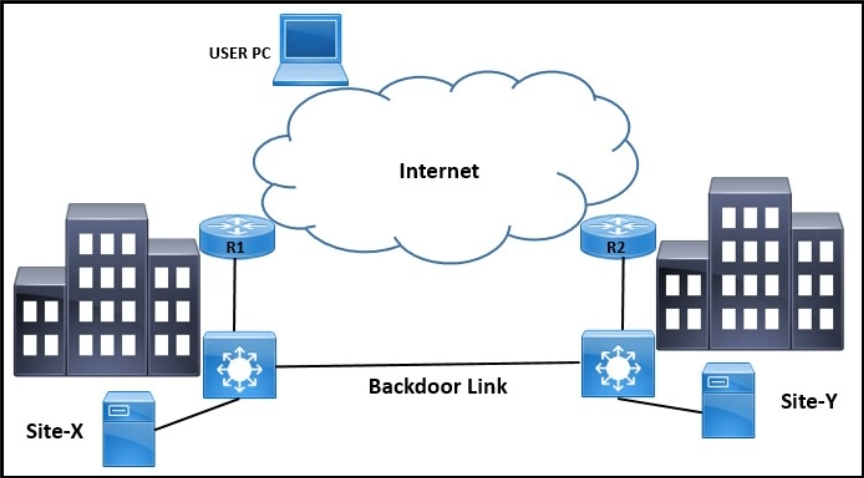
Community Votes
44% of anonymous learners picked answer D. Votes are pick records left by other test-takers — they are not the verified answer.
Community Insight
The question tests the application of BGP MED (Multi-Exit Discriminator) for inbound traffic engineering, a common trap where candidates might look for prefix changes or peering that aren't feasible.
This scenario involves asymmetric routing caused by identical source prefixes advertised from two sites. The solution uses BGP MED to influence return traffic paths when direct path control is limited.
Candidates often choose C (Control plane peering) because they assume peering allows for policy exchange, but peering itself doesn't solve the routing loop without specific prefix adjustments.
Community Discussion (8 comments)
Comments & Corrections
No comments yet — spotted an error or have a note? Share it below.
Expert Analysis
Why the Answer Is Correct
The issue described is asymmetric routing: outbound traffic leaves via Site-X, but return traffic enters via Site-Y because both sites advertise the same /23 prefix. To resolve this without changing IP schemes (which is a design change, not a configuration tweak), we must influence how external peers select the entry point. BGP MED is the standard attribute used for this purpose. By advertising the route with a lower MED from Site-X, edge routers will prefer the Site-X link for returning traffic destined to that prefix.Why the Other Options Are Wrong
Option A adds a static route, which does not affect how external ISPs route traffic back to the advertised prefix. Option B suggests firewall replication; while good for redundancy, it does not change BGP advertisement attributes and thus doesn't fix the routing preference. Option C suggests control plane peering. While peering can facilitate information exchange, simply peering the routers doesn't inherently change the best path selection unless combined with specific route policies or prefix modifications, which are not mentioned.Community Comment Notes
Community consensus is split between C and D. Many users argue for C, assuming peering solves the visibility issue, as one user noted "longer prefix" logic often associated with peering benefits. However, others correctly identify that MED is the specific mechanism for influencing inbound traffic flow in this context. Some comments highlight that MED is non-transitive, which is true, but it applies perfectly to the immediate upstream provider relationship implied here.Official Reference
Exam Strategy
When faced with asymmetric routing due to overlapping advertisements, look for BGP attributes like MED or Local Preference first if IP scheme changes are not an option. Remember that MED influences inbound traffic from neighboring ASes.
Frequently Asked Questions
Why isn't peering (C) the correct answer?
Peering alone does not change path selection. Without modifying route attributes or prefixes, routers still see equal cost paths.
Is MED transitive?
No, MED is non-transitive. It is only exchanged between directly connected autonomous systems, making it suitable for local inbound traffic shaping.