How to Resolve Inter-Switch VLAN Communication Failure?
Refer to the exhibit. Users in the Operations VLAN on Switch A are unable to communicate with users in the Operations VLAN on Switch B. Which action resolves the issue? - 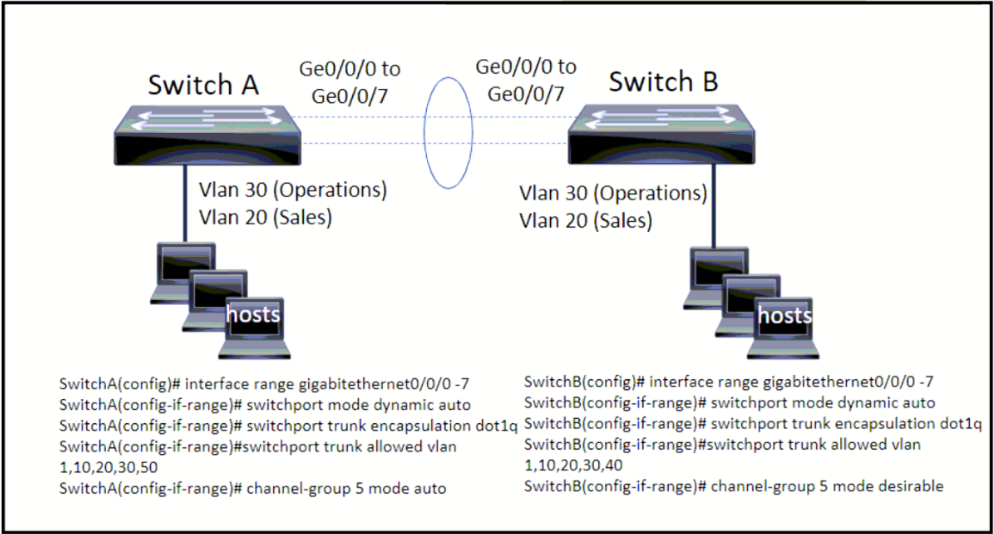
Community Votes
80% of anonymous learners picked answer A. Votes are pick records left by other test-takers — they are not the verified answer.
Community Insight
The question tests whether candidates recognize that an auto/auto DTP pairing prevents trunk establishment, creating a trap where candidates incorrectly prioritize VLAN filtering over basic Layer 2 negotiation.
This question evaluates Dynamic Trunking Protocol (DTP) negotiation behavior between connected switches. The community consensus confirms that changing one interface from dynamic auto to dynamic desirable forces trunk formation, enabling tagged VLAN traffic to pass.
Many candidates select Option C, attempting to configure identical allowed VLAN lists. They overlook that VLAN permits are irrelevant until a trunk link is successfully formed through DTP negotiation.
Community Discussion (8 comments)
Comments & Corrections
No comments yet — spotted an error or have a note? Share it below.
Expert Analysis
Understanding the Core Issue
The scenario describes a failure of VLAN 30 (Operations) traffic to traverse between Switch A and Switch B. Based on the options and community feedback, the connecting interfaces are configured with switchport mode dynamic auto on both sides. According to Cisco’s DTP specification, when both ends are set to auto, neither switch initiates trunk negotiation. Consequently, the link defaults to access mode, carrying only untagged traffic on the native VLAN. Since VLAN 30 frames are 802.1Q tagged, they are dropped at the Layer 2 boundary.Why Option A is Correct
Changing Switch B’s interface to dynamic desirable forces DTP negotiation. The desirable state actively sends DTP frames requesting trunk formation. When paired with auto on Switch A, the negotiation succeeds, establishing a trunk link. Once the trunk is up, tagged VLAN 30 traffic flows freely, resolving the isolation. This directly follows the Cisco DTP matrix: auto/desirable equals Trunk.Why Other Options Fail
- Option B & D (EtherChannel Modes): LACP and PAgP bundle multiple physical links into a single logical channel. The question does not indicate a multi-link aggregation requirement, and altering EtherChannel protocols cannot override a failed DTP negotiation on a single link.
- Option C (Allowed VLAN List): While matching allowed VLANs is standard practice, it is functionally useless if the link isn’t trunking. As noted by multiple community experts, trunk formation must precede VLAN filtering; configuring permit lists on an access port has zero impact.
Community Insights & Clarifications
The vote distribution heavily favors Option A (80%), with seasoned engineers emphasizing the DTP hierarchy. One candidate correctly highlighted that auto/auto yields an access link, while another clarified that Option C addresses EtherChannel consistency rather than basic trunk negotiation. A minor debate exists regarding whether Switch B was already desirable in the exhibit, but the prevailing interpretation confirms the image shows auto on both sides, making A the definitive fix.Official Reference
Exam Strategy
Always verify Layer 2 trunk negotiation status before diving into VLAN-specific configurations. Remember the DTP rule of thumb: auto waits, desirable asks, and trunk forces. When troubleshooting inter-switch connectivity, confirm the link state and DTP mode first to avoid wasting time on secondary settings like allowed VLAN lists or EtherChannel parameters.
Related Analysis
Practice All 350-401 Questions
Access 218 questions with complete answers and detailed explanations.
View Full 350-401 Practice Test →