What is the result of the Python expression (3 * 5) % 2?
Refer to the exhibit. What is the result of this Python code? - 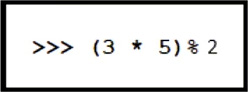
Community Votes
100% of anonymous learners picked answer A. Votes are pick records left by other test-takers — they are not the verified answer.
Community Insight
The trap is confusing the modulo (remainder) result with the integer quotient or a floating-point division result, so knowledge of the % operator's purpose is essential.
This exam question tests your understanding of Python's modulo operator and operator precedence. The community unanimously agrees that (3 5) % 2 evaluates to 1, as the multiplication 35 equals 15, and 15 modulo 2 leaves a remainder of 1.
Choosing 7 (the integer quotient) or 7.5 (the float division result) is common when candidates misread the % symbol as a division or forget that % returns the remainder, not the quotient.
Community Discussion (5 comments)
Comments & Corrections
No comments yet — spotted an error or have a note? Share it below.
Expert Analysis
Why the Answer Is Correct
The expression is (3 5) % 2. According to Python operator precedence, parentheses are evaluated first, so 3 5 becomes 15. Then the modulo operator % works on 15 and 2, returning the remainder after integer division. Dividing 15 by 2 gives a quotient of 7 with a remainder of 1, so 15 % 2 == 1. Option A (1) is therefore the correct answer, and the community votes (100% A) confirm this reasoning.
Why the Other Options Are Wrong
Option B (0) would be the remainder only if the product were even (e.g., if the product were 14, 14 % 2 = 0). Option C (7) is the integer quotient of 15 ÷ 2, not the remainder, and this is a common misreading of the % operator. Option D (7.5) is the result of true division (/) in Python, not modulo, so it is unrelated to the calculation shown. Only option A matches the definition of the modulo operator.
Community Comment Notes
Comments [1], [3], and [4] correctly explain the step-by-step calculation: 3 * 5 = 15, and 15 mod 2 leaves a remainder of 1. Comment [2] reinforces the concept by distinguishing even numbers (remainder 0) from odd numbers (remainder 1), which is exactly why the result is 1. Comment [5] simply agrees with A. The community consistently emphasizes that % means modulo/remainder, not division, which is the core knowledge tested.
Official Reference
Exam Strategy
For Python questions on Cisco exams, remember that % is the modulo operator returning the remainder, while / returns a float and // returns an integer quotient. When you see parentheses, evaluate the inside first, then apply the operator. This will help you quickly identify the correct option and avoid common traps.
Related Analysis
Practice All 350-401 Questions
Access 218 questions with complete answers and detailed explanations.
View Full 350-401 Practice Test →