Which HTTP Request Produced This Cisco DNA Center REST API Response?
Refer to the exhibit. Which HTTP request produced the REST API response that was returned by Cisco DNA Center? - 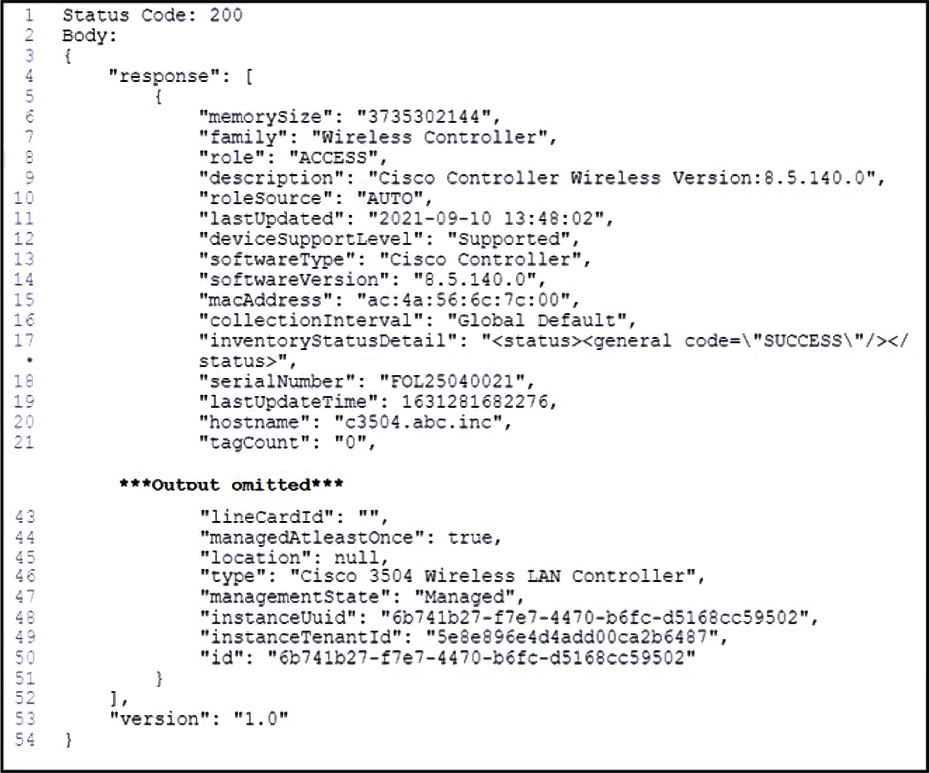
Community Votes
100% of anonymous learners picked answer B. Votes are pick records left by other test-takers — they are not the verified answer.
Community Insight
The question tests whether you understand that GET is the read-only operation used to retrieve network device details, and the trap is confusing response bodies with create/update methods.
This Cisco 350-401 exam question asks which HTTP request returned a REST API response from Cisco DNA Center; community voting strongly confirms the correct answer is GET, reinforcing REST method semantics.
The most common wrong approach is choosing POST or PUT because many REST APIs return data in response to create/update operations; however, the scenario shows a simple retrieval, so GET is correct.
Community Discussion (4 comments)
Comments & Corrections
No comments yet — spotted an error or have a note? Share it below.
Expert Analysis
Why the Answer Is Correct
The request is for network device details based on a MAC address, which is a read-only operation. In REST APIs, GET is defined as a safe, idempotent method used to retrieve resources without changing state. The response body showing the device information is exactly what a GET request to /network-device with a macAddress filter would return. The community consensus (100% votes for B) confirms this interpretation.
Why the Other Options Are Wrong
A (PUT) is used to update or replace an existing resource, not to retrieve it, and would require a full payload in the request body. C (fetch) is not an HTTP method; it is a JavaScript API used to send HTTP requests, so it cannot be the answer. D (POST) is used to create a new resource, and a POST to /network-device would generally create a device, not retrieve one. The commenter correctly noted that POST supports various data types and is not used for simple retrieval.
Community Comment Notes
One commenter observed that many REST APIs return the modified item after PUT or POST, so the response body alone is not always enough to determine the method; however, in this question the intended REST semantics point clearly to GET. Another commenter highlighted that GET only supports string data types, which aligns with the quoted values in the exhibit. The community confidently selected B, and no dissenting view was provided.
Official Reference
Exam Strategy
Memorize the core REST method mapping: GET = read/retrieve, POST = create, PUT = update, DELETE = delete. When you see a response that simply returns device details with no indication of a state change, choose GET even if the response body contains data.
Related Analysis
Practice All 350-401 Questions
Access 218 questions with complete answers and detailed explanations.
View Full 350-401 Practice Test →