How to Restore OSPF Adjacency on Passive Interfaces?
Refer to the exhibit. A network engineer connected two routers using OSPF but the routers are not sharing routes. Which command completes the configuration? - 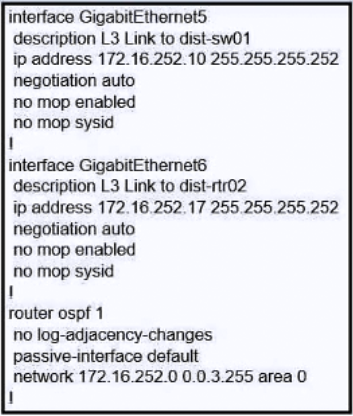
Community Votes
100% of anonymous learners picked answer D. Votes are pick records left by other test-takers — they are not the verified answer.
Community Insight
The question tests whether you recognize that passive-interface default suppresses OSPF Hellos globally, requiring a targeted no passive-interface command to restore neighbor discovery on specific WAN links.
This question evaluates your understanding of OSPF passive interface behavior and how to selectively enable routing adjacencies. The community overwhelmingly agrees that applying the no passive-interface command to the router-facing link resolves the route-sharing failure.
Candidates frequently choose interface configuration mode or OSPF process restart commands, overlooking that the protocol is already running but intentionally silenced by a passive configuration. Some also misidentify the switch-connected port as the router peer, leading them to apply the command to the wrong interface.
Community Discussion (9 comments)
Comments & Corrections
No comments yet — spotted an error or have a note? Share it below.
Expert Analysis
Core Concept: OSPF Passive Interface Behavior
In Cisco IOS, the passive-interface command prevents an interface from sending or receiving OSPF Hello packets, effectively disabling neighbor adjacency formation while still advertising the connected subnet. When engineers use passive-interface default, this suppression applies to all current and future interfaces automatically. To establish OSPF adjacencies on specific links (such as those connecting to other routers), you must explicitly override the default behavior using the no passive-interface <interface-name> command.Why Option D is Correct
Based on the scenario and community consensus, the exhibit shows a configuration where passive-interface default is active, and one interface connects to a neighboring router while another terminates at a Layer 3 switch. Applying no passive-interface GigabitEthernet6 (the router-to-router link) re-enables OSPF Hello transmission on that specific interface, allowing neighbor discovery, adjacency establishment, and subsequent route exchange. Comment [9] correctly notes that this targeted negation is the standard best practice when using passive-interface default.Why Other Options Fail
Options referencingrouter ospf 1 simply enter or verify the OSPF process, which does not change the passive state of any interface. Similarly, entering interface GigabitEthernet5 places you in interface configuration mode but does not modify OSPF behavior. As highlighted in comment [1], the switch-connected interface is a red herring; OSPF adjacencies are only required between routers, not switches. Comment [3] further clarifies that the goal is to restore route sharing across the entire topology, which requires activating the correct inter-router link rather than reloading the routing process or misconfiguring access ports. Official Reference
- https://www.cisco.com/c/en/us/support/docs/ip/open-shortest-path-first-ospf/22845-osppassive.html
- Cisco IOS IP Routing: OSPF Configuration Guide, "Configuring OSPF Passive Interfaces"
- RFC 2328, OSPF Version 2, Section 10.5 (Hello Packets)
- Cisco ENCOR 350-401 Official Cert Guide, Chapter 10: OSPF Implementation
Exam Strategy
When troubleshooting OSPF neighbor failures, always audit the router configuration for passive-interface commands before checking physical connectivity or authentication. Remember that passive-interface default silences all interfaces, so you must use no passive-interface followed by the specific WAN-facing interface name to restore adjacencies without compromising security on access networks.
Related Analysis
Practice All 350-401 Questions
Access 218 questions with complete answers and detailed explanations.
View Full 350-401 Practice Test →