How to Configure Static NAT Port Redirection for Internal Servers?

Refer to the exhibit. The web server is configured to listen only to TCP port 8080 for all HTTP requests. Which command is required to allow Internet users to access the web server on HTTP port 80? - image
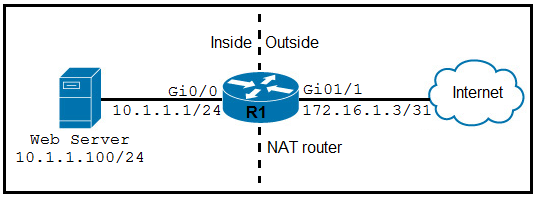
  1. ip nat outside static tcp 10.1.1.100 8080 10.1.1.100 80
  2. ip nat inside static tcp 10.1.1.100 80 10.1.1.100 8080
  3. ip nat inside static tcp 10.1.1.100 8080 10.1.1.100 80 Source Reference Answer
  4. ip nat outside static tcp 10.1.1.100 80 10.1.1.100 8080

Community Votes

C
83%
D
17%

83% of anonymous learners picked answer C. Votes are pick records left by other test-takers — they are not the verified answer.

Community Insight

The question tests the exact parameter order of Cisco's static NAT command and clarifies why the 'inside' keyword applies to inbound translation rules rather than just outbound traffic.

This question evaluates your ability to configure static NAT with port redirection to expose an internal web server on port 8080 to external users via standard HTTP port 80. The community consensus strongly supports option C as the correct mapping syntax.

Option D is the most frequent incorrect choice, as candidates mistakenly associate 'outside' with incoming internet traffic or reverse the port sequence, overlooking that Cisco IOS requires the local/internal IP and port to be listed before the global/external equivalents.

Community Discussion (14 comments)

Shri_Fcb10 👍 11 Selected: C
To allow Internet users to access the web server on HTTP port 80 when the web server is configured to listen only on TCP port 8080, you need to create a static Network Address Translation (NAT) rule that translates incoming requests on port 80 to port 8080 on the web server. The correct command to achieve this is: C. ip nat inside static tcp 10.1.1.100 8080 172.16.1.3 80 Here's a breakdown of the command: - ip nat inside static tcp: This specifies a static NAT translation for TCP traffic on the inside interface. - 10.1.1.100 8080: This is the local address of the web server and the port it's listening on (8080). - 172.16.1.3 80: This is the public address (on the outside interface) and the port that will be used for incoming traffic (80). So, the command translates requests coming to 172.16.1.3 on port 80 to 10.1.1.100 on port 8080, effectively allowing the web server to receive HTTP requests on port 80.
chiacche 👍 1 Selected: C
ip nat inside static tcp 10.1.1.100 8080 172.16.1.3 80
Gene_nstudy 👍 3
All options are wrong command syntax. ---------------------------- INET(config)#ip nat inside static tcp 10.1.1.100 8080 10.1.1.100 80 ^ % Invalid input detected at '^' marker. ---------------------------- The correct command syntax is as follows C. ip nat inside source static tcp 10.1.1.100 8080 172.16.1.3 80 Cisco exam question writers should review the questions they create.
sharonmiller 👍 1 Selected: D
none of this makes sense... internet users are outside using port 80... they have to be translated from OUTSIDE to and then to use port 8080.. the answer is D
[Removed] 👍 1 Selected: C
C is correct since we want to allow external users to access the internal web server on port 80 while the server listens on port 8080, the inside NAT rule is appropriate.
TTOG 👍 2 Selected: C
IMHO, the only valid explanation of this mess is that while we are "outside" we still not in the "internet" which implies that internet SNAT/DNAT is happening in an other device not showing in the diagram and therefor we are using private space of 172.16... This reduce the question to tcp port redirection and, in that case answer will be C.
babanaber 👍 3 Selected: C
In the exibit 3. Redirect TCP Traffic to Another TCP Port or Address part the scenario is the same and the nat is applied to inside. There is a note under the config which goes: Note: The configuration description for the static NAT command indicates any packet received in the inside interface with a source address of 172.16.10.8:8080 is translated to 172.16.10.8:80. This also implies that any packet received on the outside interface with a destination address of 172.16.10.8:80 has the destination translated to 172.16.10.8:8080. The server is still listening and http requests are received from outside but this note is pretty explanatory. https://www.cisco.com/c/en/us/support/docs/ip/network-address-translation-nat/13772-12.html#toc-hId--521872001
KZM 👍 3 Selected: C
D. is incorrect, I think. There is no appropriate outside static NAT option in the given answers. For the outside static NAT, the command should that; "ip nat outside static tcp 172.16.1.3 80 10.1.1.100 8080", I think.
lazizz 👍 1
The correct answer is "С", tested on eve-ng
PyoJH 👍 4 Selected: D
D, 'ip nat outside static tcp 10.1.1.100 80 10.1.1.100 8080', This command means that TCP traffic coming from the outside network to port 80 of IP address 10.1.1.100 will be redirected to port 8080 of the same IP address.
[Removed] 👍 4
answers doesn't make sense in my opinion
buddhagaut 👍 3
I think its D. The server only listens on 8080 while users from internet send traffic to port 80 First Command: ip nat inside static tcp 10.1.1.100 8080 10.1.1.100 80 ip nat inside: This means the translation is applied for traffic originating from the inside network (private network) going out to the outside network (public network). The translation is from port 8080 on the internal host to port 80 on the external side. Second Command: ip nat outside static tcp 10.1.1.100 80 10.1.1.100 8080 ip nat outside: This means the translation is applied for traffic originating from the outside network (public network) coming in to the inside network (private network). The translation is from port 80 on the external side to port 8080 on the internal host. I think the question is referring to the latter... let me know if the understanding is incorrect
NazgulNr5 👍 2
All answers are kinda wrong as Internet users won't be able to access the internal IP without that being NATted too. But C would also allow internal users to access the server on port 80.
Mizuchan 👍 3 Selected: C
This command effectively maps incoming TCP traffic on port 8080 to the web server's port 80, allowing external users to access the web server on the standard HTTP port 80.

Comments & Corrections

No comments yet — spotted an error or have a note? Share it below.

Log in to comment, report an error, or add a note about this question.

Submitted for moderation before publishing. Keep it helpful and respectful.

Expert Analysis

Core Concept: Static NAT Port Redirection

When an internal server listens on a non-standard port (like 8080) but needs to be accessible externally on a standard port (like 80), you must configure Static NAT with Port Redirection (often called port forwarding). This ensures that inbound packets destined for the public IP on port 80 are translated to the internal IP on port 8080 before reaching the server.

Command Syntax Breakdown

The underlying Cisco IOS command structure is ip nat inside source static tcp <local-ip> <local-port> <global-ip> <global-port>. Despite the slight simplification in the exam options (omitting the word source), the logical structure remains identical.
  • Local (Inside): 10.1.1.100 8080 (the actual server and its listening port)
  • Global (Outside): 10.1.1.100 80 (the address/port exposed to the internet)
Option C correctly follows this sequence, placing the internal server details first and the external-facing details second.

Why the 'Inside' Keyword?

Candidates often confuse the inside and outside keywords based on traffic direction. In Cisco NAT terminology, ip nat inside source static defines how the router translates addresses relative to the inside network. Even though the traffic is incoming from the internet, the rule is applied under the inside context because it modifies the destination attributes for the inside host. As noted by community members, using outside static would require a completely different syntax structure that isn't valid here.

Analyzing the Distractors

  • Option A & D: Incorrectly use outside static, which does not align with standard Cisco IOS NAT command hierarchy for port forwarding. Additionally, D reverses the port mapping order, which would translate internal port 80 to external port 8080—the opposite of the requirement.
  • Option B: Reverses the port order, failing to match the specific local-to-global translation required.
Note on Syntax: Commenters have pointed out that real-world IOS strictly requires ip nat inside source static tcp.... While the exam simplifies this, recognizing the local-ip local-port global-ip global-port pattern is the critical skill being tested, as highlighted in user discussions regarding command validity.

Official Reference

Exam Strategy

Memorize the exact parameter order for Cisco NAT commands: always list the local (inside) IP and port first, followed by the global (outside) IP and port. When stuck, identify which IP/port belongs to the internal server versus the external client and place them accordingly in the command structure.

Related Analysis

Practice All 350-401 Questions

Access 218 questions with complete answers and detailed explanations.

View Full 350-401 Practice Test →

← Back to 350-401 Study Guide