How to Configure Port Forwarding for an Internal Web Server?
Refer to the Exhibit. External users require HTTP connectivity to an internal company web server that is listening on TCP port 8080. Which command set accomplishes? - 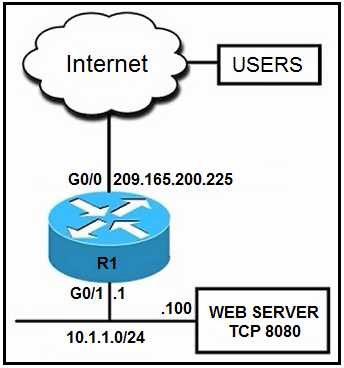
Community Votes
59% of anonymous learners picked answer C. Votes are pick records left by other test-takers — they are not the verified answer.
Community Insight
It tests precise mastery of the ip nat inside source static tcp command syntax and the inside/outside address hierarchy, where candidates often confuse parameter order or misidentify the target server IP.
This question tests the correct syntax and application of static NAT with port translation to expose an internal web server on a non-standard port to external users. The community consensus identifies option C as correct, acknowledging a known exam typo while validating its port-mapping logic.
Candidates frequently select options A or D by misinterpreting destination NAT syntax or choosing configurations that reference the router's own interface IP instead of the actual web server IP, resulting in failed packet translation.
Community Discussion (15 comments)
Comments & Corrections
No comments yet — spotted an error or have a note? Share it below.
Expert Analysis
Core Concept: Static NAT with Port Translation
The scenario requires exposing an internal web server listening on a non-standard port to external users accessing via standard HTTP. This is achieved through Static NAT with Port Translation (often called port forwarding or Destination NAT). The router must translate incoming packets destined for its Outside Global IP on port 80 into packets destined for the Inside Local IP on port 8080.Command Syntax Breakdown
Cisco IOS enforces a strict syntax for static NAT mappings: ip nat inside source static tcp <inside_local_ip> <inside_local_port> <outside_global_ip> <outside_global_port> The command begins with inside source, indicating that traffic from the inside is translated when crossing outward, and vice versa for inbound traffic. Interfaces must be correctly designated with ip nat inside and ip nat outside.Why Option C is Correct
Despite a widely noted typo in the exam dump where the inside IP is listed as the router's gateway instead of the actual server IP, Option C remains the intended answer because it correctly follows the parameter order and port mapping logic. As highlighted by community experts, the mapping aligns perfectly with the requirement: external users hit port 80, and the router forwards it to the server's port 8080. Community consensus confirms that this bidirectional NAT rule handles both inbound HTTP requests and outbound responses seamlessly.Analyzing Incorrect Options
- Option A incorrectly places the Outside Global IP first in the NAT statement, violating Cisco IOS syntax requirements.
- Options B and D suffer from similar syntactical errors or incorrect IP/port combinations. Several candidates pointed out that multiple options erroneously use the router's interface IP instead of the web server's IP, which would cause NAT to drop traffic since the router itself isn't hosting the web service. Mislabeling interface directions further invalidates these configurations.
Official Reference
- https://www.cisco.com/c/en/us/td/docs/ios-xml/ios/ipaddr_nat/configuration/xe-3s/nat-xe-3s-book/nat-static.html
- RFC 3022: Classical IP and ARP over Ethernet
Exam Strategy
When tackling NAT configuration questions, immediately map the four translation components: Inside Local IP/Port and Outside Global IP/Port. Memorize the exact Cisco IOS syntax order to rapidly eliminate distractors that swap public/private parameters, and always verify that the translated IP matches the actual end-host rather than the router's gateway interface.
Related Analysis
Practice All 350-401 Questions
Access 218 questions with complete answers and detailed explanations.
View Full 350-401 Practice Test →