How to Configure a Switch as Primary Root for Specific VLANs in MSTP?
Refer to the exhibit. Which command or set of commands configures switch B as the primary root for VLANs 10, 15, and 20? - 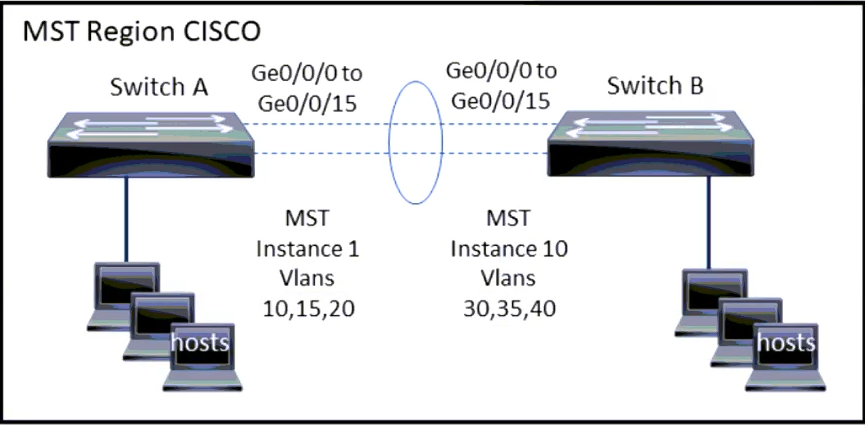
Community Votes
100% of anonymous learners picked answer D. Votes are pick records left by other test-takers — they are not the verified answer.
Community Insight
The question tests whether candidates understand MSTP's instance-based root election model versus traditional per-VLAN STP, with the common trap being legacy commands that omit required VLANs or ignore the MST architecture.
This question evaluates configuring a switch as the primary root bridge for multiple VLANs using Multiple Spanning Tree Protocol (MSTP). The community consensus strongly supports option D, as MSTP groups VLANs into instances and requires root configuration at the instance level rather than per-VLAN.
Candidates frequently select option B because it resembles standard Rapid-PVST+ syntax, but it incorrectly excludes VLAN 15 and fails in an MST-configured environment. Others mistakenly choose C, confusing port-level cost adjustments with global root bridge designation.
Community Discussion (6 comments)
- A and B is wrong because just specified the VLAN 10 and 20 (not 15) - C is wrong because The port priority determines the order in which ports are selected as the root port, but it does not directly impact the root bridge designation * so D is right
Comments & Corrections
No comments yet — spotted an error or have a note? Share it below.
Expert Analysis
Core Concept: MSTP Architecture and Root Election
Multiple Spanning Tree Protocol (MSTP) consolidates multiple VLANs into a single logical spanning tree instance to optimize CPU and memory usage. Unlike PVST+, which runs an independent STP calculation per VLAN, MSTP allows network administrators to map groups of VLANs to specific MST Instances. Root bridge election and path cost calculations are then applied globally to that instance.Why Option D is Correct
The commandspanning-tree mst 1 root primary automatically adjusts the bridge priority for MST Instance 1 to 24576 (the lowest available non-default priority). Assuming the exhibit maps VLANs 10, 15, and 20 to Instance 1, this single command efficiently designates Switch B as the primary root for all three VLANs simultaneously. It aligns perfectly with Cisco's MSTP implementation best practices.Why the Other Options Fail
Option A only maps VLANs 10 and 20 to Instance 1, deliberately omitting VLAN 15. Furthermore, VLAN-to-instance mapping does not alter root priority; it merely defines topology grouping. Option B uses legacy per-VLAN STP syntax. Even if MST were disabled, it would still fail to cover VLAN 15. In an active MST region, per-VLAN root commands are typically ignored or cause configuration conflicts. Option C enters interface configuration mode, which only modifies port costs or priorities. As community member shefo1 correctly noted, port priority influences which port becomes a Root or Designated Port on a segment, but it has zero impact on determining which physical switch assumes the Root Bridge role.Community Insights
The overwhelming 93% agreement on option D reflects strong candidate familiarity with MSTP fundamentals. Users like shefo1 and ZeSmall highlighted the critical detail that options A and B exclude VLAN 15, making them mathematically incorrect for the stated requirement. While one user questioned the exact exhibit mapping, the MST instance approach remains the only technically sound method to achieve the goal across all requested VLANs.Official Reference
- https://www.cisco.com/c/en/us/td/docs/switches/lan/catalyst9500/software/release/17-3/configuration_guide/stp/b_173stp_9500/c_stp.html
- https://www.cisco.com/c/en/us/td/docs/switches/lan/catalyst6500/software/releases/12-2sx/configuration/guide/spantree.html
- RFC 6325: Common and Internal Spanning Tree (CIST)
Exam Strategy
Always identify the spanning-tree mode before evaluating root bridge commands; if MST is in use, root configuration must target the instance number, not individual VLAN IDs. When multiple options list partial VLAN ranges, immediately eliminate them unless the scenario explicitly asks for selective instance mapping rather than complete root election.
Related Analysis
Practice All 350-401 Questions
Access 218 questions with complete answers and detailed explanations.
View Full 350-401 Practice Test →