Which Command Enables HSRP Preemption for Router Failover?
Refer to the exhibit. An engineer must modify the existing configuration so that R2 can take over as the primary router when serial interface 0/0.1 on R1 goes down. Which command must the engineer apply? - 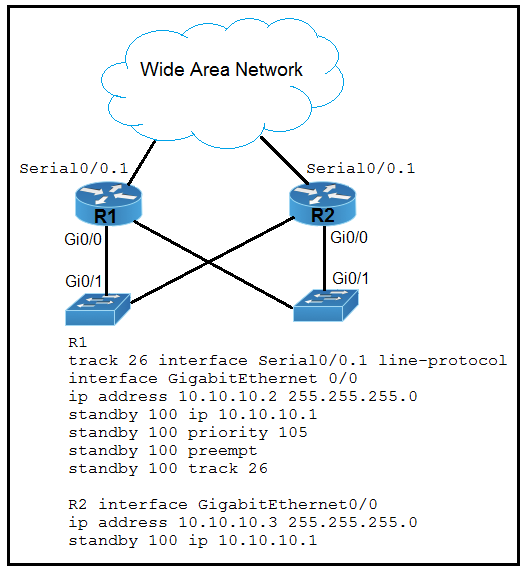
Community Votes
100% of anonymous learners picked answer A. Votes are pick records left by other test-takers — they are not the verified answer.
Community Insight
The question tests the critical distinction between HSRP priority tracking and preemption behavior, with the common trap being the assumption that tracking commands must be mirrored on the backup router or that priority drops automatically force a failover.
This question evaluates HSRP failover mechanics, specifically how interface tracking lowers priority and how preemption triggers role changes. The community consensus confirms that enabling standby preempt on the standby router is the sole missing configuration required for seamless takeover.
Candidates frequently select options C or D, incorrectly attempting to configure tracking on R2 for an interface that belongs to R1. They overlook that R1 already monitors the serial interface, and without explicitly enabling preemption on R2, it will remain in standby mode even if R1's priority drops below R2's.
Community Discussion (9 comments)
Comments & Corrections
No comments yet — spotted an error or have a note? Share it below.
Expert Analysis
HSRP Tracking vs. Preemption Mechanics
Hot Standby Router Protocol (HSRP) uses a priority-based election process where the router with the highest priority becomes the active router. By default, priorities start at 100. To enable dynamic failover, engineers use the standby track command to monitor an upstream interface. When that interface fails, the tracked router’s HSRP priority is decremented (default is 10), allowing the standby router to potentially assume the active role.Why Option A is Correct
As highlighted by multiple community experts, R1 already hasstandby 100 track 26 configured. When Serial0/0.1 on R1 goes down, R1’s priority will automatically drop. However, HSRP does not allow a standby router to forcibly take over unless preemption is explicitly enabled. Configuring standby 100 preempt on R2 ensures that once R1’s priority falls below R2’s, R2 will immediately transition to the active state. The default decrement value of 10 means specifying decrement 10 (Option C) is redundant, and tracking R1’s interface on R2 (Options C and D) is architecturally incorrect since routers cannot directly track each other’s local interfaces in this manner.Evaluating the Distractors
Options B, C, and D introduce unnecessary or misapplied configurations. Setting a static priority (Option B) doesn’t solve the dynamic failover requirement. Options C and D attempt to configure tracking on the wrong device or duplicate default behaviors. As noted in Cisco documentation, the standby track command modifies local priority based on local interface states, making cross-device tracking impossible via these CLI commands. Therefore, only preemption on the standby router bridges the gap between a priority change and an actual role transition.Official Reference
Exam Strategy
Always map out which router requires configuration changes before evaluating commands. Remember that HSRP tracking only adjusts priority locally; it never triggers a role change without the standby preempt command on the backup router, a frequent exam trap designed to test your understanding of protocol state transitions.
Related Analysis
Practice All 350-401 Questions
Access 218 questions with complete answers and detailed explanations.
View Full 350-401 Practice Test →