How to Configure Static NAT Interface Directions Correctly?
Refer to the exhibit. An engineer applies this configuration to R1: ip nat inside source static 192.168.10.17 192.168.27.42 Which command set should be added to complete the configuration? - 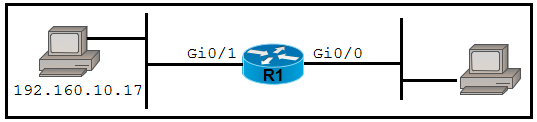
Community Votes
100% of anonymous learners picked answer A. Votes are pick records left by other test-takers — they are not the verified answer.
Community Insight
The question tests the foundational NAT principle that interface direction dictates traffic flow and translation rules, with candidates frequently tripping up on swapped directions or invalid CLI syntax.
This question evaluates your ability to correctly assign inside and outside interface designations for static NAT. Community consensus confirms that matching the private source network to the inside interface and the translated network to the outside interface is critical.
Many candidates incorrectly choose the option with reversed inside/outside assignments because they fail to recognize that 192.168.x.x addresses belong to the internal zone, leading them to misapply the ip nat outside command to the wrong physical port.
Community Discussion (5 comments)
Comments & Corrections
No comments yet — spotted an error or have a note? Share it below.
Expert Analysis
Core Concept: Static NAT and Interface Roles
Static NAT creates a permanent one-to-one mapping between a private IPv4 address and a public or routable IPv4 address. In this scenario, the commandip nat inside source static 192.168.10.17 192.168.27.42 defines that internal host 192.168.10.17 will be translated to 192.168.27.42. For this translation to function, the router must know which traffic originates internally and which exits externally. This is achieved through interface-level directives: ip nat inside and ip nat outside.Why Option A is Correct
Option A correctly appliesip nat inside to the interface connected to the private network and ip nat outside to the interface facing the external network. As noted in the community discussion, the private IP range 192.168.0.0/16 unequivocally marks the adjacent interface as the NAT inside zone. Conversely, the translated address sits on the outside interface.Eliminating Distractors
Several common traps exist in the remaining options. First, some candidates mistakenly look forip pat, but as community expert Mistwalker points out, ip pat is not a valid Cisco IOS command. PAT is configured automatically when using overload or is implied in dynamic NAT pools, but never via a standalone directive. Second, other options typically present the exact same interface names but swap the inside and outside tags. Applying these backward breaks the NAT lookup table entirely, causing packets from the private network to be dropped before translation can occur.Best Practices for NAT Implementation
Always verify the IP addressing scheme first. Private RFC 1918 addresses should always be associated with theip nat inside interface. Public or provider-routed addresses belong on ip nat outside. Once the interfaces are tagged, the static translation command will seamlessly map traffic bidirectionally. Official Reference
Exam Strategy
When faced with NAT interface questions, immediately identify which network segment contains private RFC 1918 addresses; those interfaces must receive the ip nat inside command. Cross-check any distractor options for syntactically invalid commands or reversed interface roles to quickly eliminate incorrect choices.
Related Analysis
Practice All 350-401 Questions
Access 218 questions with complete answers and detailed explanations.
View Full 350-401 Practice Test →