How Do You Enable RESTCONF on Cisco IOS XE?
Refer to the exhibit. Which command must be applied to complete the configuration and enable RESTCONF? - 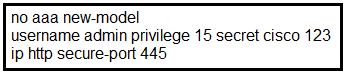
Community Votes
100% of anonymous learners picked answer D. Votes are pick records left by other test-takers — they are not the verified answer.
Community Insight
The question evaluates understanding of RESTCONF's strict dependency on encrypted HTTPS transport, commonly tricking candidates into selecting generic HTTP commands instead of the secure variant.
This question verifies the exact CLI command required to activate the underlying transport layer for RESTCONF on Cisco IOS XE platforms. Community feedback consistently confirms that enabling the HTTPS secure server is the mandatory step before the RESTCONF service can accept requests.
Test-takers frequently choose ip http server because it activates the device's built-in web server, but RESTCONF explicitly requires TLS encryption and cannot operate over unencrypted HTTP connections.
Community Discussion (4 comments)
Comments & Corrections
No comments yet — spotted an error or have a note? Share it below.
Expert Analysis
Prerequisites for RESTCONF Activation
RESTCONF is a network management protocol that uses HTTPS to transfer data modeled using YANG. On Cisco IOS XE devices, enabling RESTCONF requires two distinct configuration steps: entering global configuration mode and issuing the restconf command, followed by enabling the secure HTTP server. Without the secure server enabled, the router will reject RESTCONF API calls even if the feature itself is activated.
Why Option D is Correct
The command ip http secure-server explicitly enables the HTTPS server on the device, binding it to port 443 by default. As highlighted by community lab verification, this command provides the necessary cryptographic foundation (TLS) that RESTCONF mandates for secure, authenticated API communication. Once executed, the device can successfully process RESTCONF GET, POST, PATCH, and DELETE operations.
Why Other Options Fail
- ip http server: Activates a basic, unencrypted HTTP server used for legacy web-based device management. RESTCONF explicitly forbids unencrypted transport due to security standards, making this option incorrect.
- ip http client username restconf: Configures outbound HTTP client credentials for API polling, not inbound server acceptance.
- ip http secure-port 443: Only changes the listening port number; it does not actually enable the HTTPS server daemon itself. The server must be explicitly turned on first.
restconf global command must pair directly with ip http secure-server to establish a fully functional API endpoint. Official Reference
Exam Strategy
Always identify the transport protocol requirement when studying network automation features; RESTCONF and NETCONF both mandate secure channels, so look for HTTPS/TLS enabling commands paired with the feature-specific toggle. Practice labbing these configurations to memorize the exact command syntax and avoid distractor options that modify ports or clients instead of activating the server.
Related Analysis
Practice All 350-401 Questions
Access 218 questions with complete answers and detailed explanations.
View Full 350-401 Practice Test →