How to Configure PAT with One Global Address for Many Local Addresses?
Refer to the exhibit. An engineer must configure PAT to provide internet access to all users by using one global address for many local addresses. Which command set completes the configuration? - 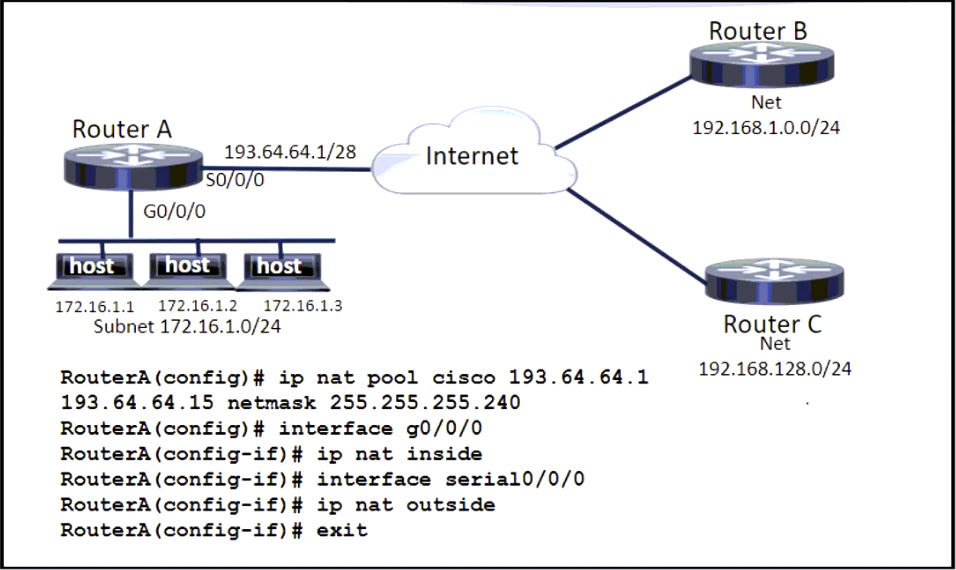
Community Votes
100% of anonymous learners picked answer D. Votes are pick records left by other test-takers — they are not the verified answer.
Community Insight
This question tests your knowledge of NAT overload (PAT) syntax—the 'overload' keyword is required to map many local addresses to one global address, and missing it leaves you with ordinary one-to-one dynamic NAT.
Learn how to configure Port Address Translation (PAT) on Cisco routers using the 'overload' keyword to allow multiple internal users to share a single global IP address. Community consensus overwhelmingly selects option D for this exam question.
A common mistake is choosing C (static NAT), which maps a single local address to a single global address, but PAT requires dynamic NAT with 'overload' to serve all users with one global address.
Community Discussion (3 comments)
Comments & Corrections
No comments yet — spotted an error or have a note? Share it below.
Expert Analysis
Why the Answer Is Correct
PAT, also called NAT overloading, allows multiple internal hosts to share a single public IP by multiplexing TCP/UDP port numbers. The commandip nat inside source list 1 pool cisco overload tells the router to translate addresses matched by ACL 1 using the addresses in pool "cisco" while applying overload. This exactly matches the requirement of "one global address for many local addresses."Why the Other Options Are Wrong
Option A (ip nat inside source static 172.16.1.1 172.16.1.2) is a one-to-one static mapping between two private addresses, not PAT. Option B (ip nat inside source list 1 pool cisco) performs dynamic one-to-one NAT and will not allow multiple local addresses to share one global address; it uses one pool address per translation. Option C (ip nat inside source static 172.16.1.1 193.64.64.1) is a one-to-one static NAT mapping a private address to a public address, not many-to-one.Community Comment Notes
A community comment correctly notes that PAT is enabled with the "overload" keyword and assumes access-list 1 is already configured to permit 172.16.1.0 0.0.0.255. Another comment simply points out that "using one global address for many local addresses" is the definition of Overload. All voters (100%) selected D, reinforcing that this is a straightforward overload/PAT identification question.Official Reference
Exam Strategy
Look for the keyword "overload" whenever the question mentions PAT, NAT overload, or one global address for many local addresses. Remember that dynamic NAT without "overload" only translates as many hosts as there are addresses in the pool, so it can never satisfy a many-to-one requirement.
Related Analysis
Practice All 350-401 Questions
Access 218 questions with complete answers and detailed explanations.
View Full 350-401 Practice Test →