What Does This Python Script Achieve When Retrieving ACLs via NETCONF?
Refer to the exhibit. What is achieved by this Python script? - 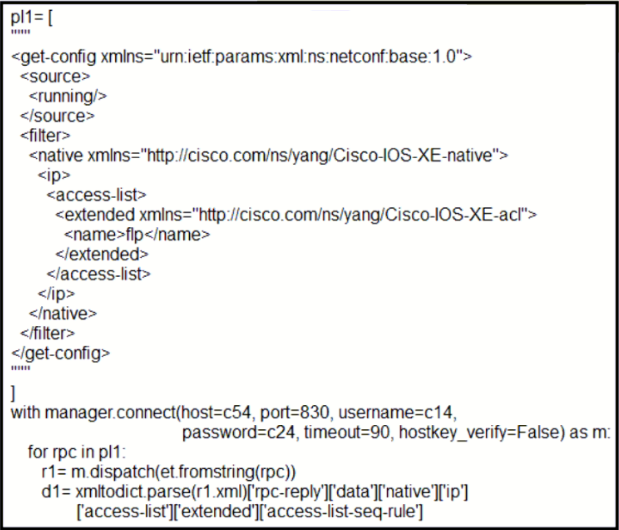
Community Votes
100% of anonymous learners picked answer A. Votes are pick records left by other test-takers — they are not the verified answer.
Community Insight
The question tests your recognition of NETCONF RPC verbs versus Python data serialization methods, with the primary trap being the confusion between configuration push operations and data retrieval workflows.
This question evaluates your ability to interpret Python scripts that interact with network devices using NETCONF and XML parsing libraries. Community consensus confirms that the script leverages a read-only NETCONF operation alongside the xmltodict module to transform retrieved ACL configuration into a structured Python dictionary.
Candidates occasionally choose Option C, incorrectly assuming the script modifies device configurations. This mistake stems from overgeneralizing automation tool behavior without verifying whether the underlying NETCONF command is a read (<get-config>) or write (<edit-config>) operation.
Community Discussion (3 comments)
Comments & Corrections
No comments yet — spotted an error or have a note? Share it below.
Expert Analysis
NETCONF Read Operations
The core of this script relies on the <get-config> RPC call, which is a standardized NETCONF verb used exclusively for retrieving running or candidate configuration data from a network device. As noted by community experts, this operation functions as a strict read verb, meaning it cannot alter or push settings to the target system.XML-to-Dictionary Conversion
Once the device returns the configuration payload, it arrives in standard XML format. The script utilizes the xmltodict Python library to parse this raw XML response and convert it into a native Python dictionary or dictionary list. This transformation allows developers to easily iterate through, filter, or analyze ACL statements programmatically without manually handling complex XML DOM trees.Why the Alternatives Fail
Option B is incorrect because the script stores the parsed data in memory rather than explicitly printing it to a terminal screen. Option C is invalid since configuration changes require the <edit-config> operation, not <get-config>. Option D misrepresents the output format; while dictionaries can be displayed, the primary achievement is structural data conversion for programmatic use, not direct human-readable text rendering.Official Reference
Exam Strategy
Always identify the primary NETCONF or RESTCONF verb in automation questions first; distinguish clearly between read operations like <get-config> and write operations like <edit-config>. Additionally, recognize standard Python networking libraries such as ncclient and xmltodict, as they frequently dictate how data flows from device CLI/XML responses into usable Python structures.
Related Analysis
Practice All 350-401 Questions
Access 218 questions with complete answers and detailed explanations.
View Full 350-401 Practice Test →