NTP Configuration Elements: Association, Client, Access Group, Authentication
DRAG DROP
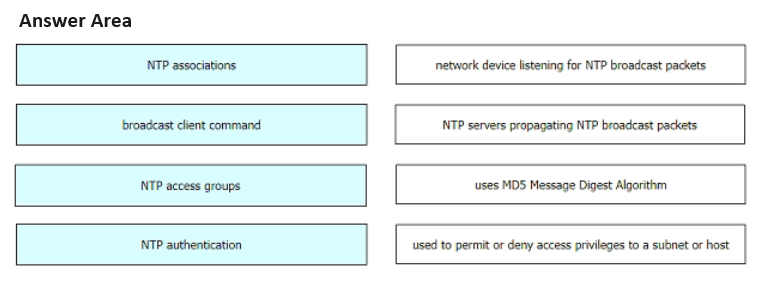
Drag and drop the NTP elements from the left onto the correct descriptions on the right.
Community Insight
The core trap is confusing 'NTP association' (which defines how a device participates in the time hierarchy) with 'NTP client' behavior, and misattributing MD5 hashing to access groups rather than authentication.
This question tests the ability to map Cisco IOS NTP configuration commands to their functional descriptions, specifically distinguishing between association modes, access control lists, and authentication mechanisms.
Learners often incorrectly swap the definitions of NTP association and NTP client, assuming association always implies listening for broadcasts when it actually refers to the relationship type (server, peer, or broadcast).
Community Discussion (5 comments)
Comments & Corrections
No comments yet — spotted an error or have a note? Share it below.
Expert Analysis
Why the Answer Is Correct
NTP elements must be mapped based on standard Cisco IOS command behaviors. An NTP association defines the role of the device in the NTP hierarchy (e.g., acting as a server, peer, or client). The NTP client command explicitly configures the device to listen for NTP broadcast packets from a specified source. NTP access groups are used to permit or deny access privileges to specific subnets or hosts based on ACLs, controlling who can query the NTP service. Finally, NTP authentication utilizes algorithms like MD5 (or SHA) to verify the integrity and origin of NTP messages, ensuring that only trusted sources are accepted.Why Other Candidate Answers Are Wrong
Confusing 'association' with 'client' is a common error; while clients are a type of association, the term 'association' is broader and includes peers and servers. Misidentifying access groups as authentication is incorrect because access groups handle network-level filtering (IP-based), whereas authentication handles cryptographic verification (key-based). Comments suggesting the first two should be swapped likely misunderstand the specific context of the drag-and-drop items provided in the exam interface.Community Comment Notes
Community feedback is mixed, with some users confirming the correct mapping of MD5 to authentication and others questioning the association/client definitions. One user noted that 'associations = propagate' which is partially true for servers but misleading for general associations. Another comment highlighted that 'access = permit or deny access,' correctly identifying the function of NTP access groups. A dissenting view claimed the answer was incorrect regarding the first two items, but this contradicts standard documentation where 'ntp client' is indeed for listening to broadcasts.Official Reference
Exam Strategy
When dealing with NTP questions, clearly separate 'Access Control' (who can talk to you) from 'Authentication' (is the message valid). Remember that 'Client' specifically relates to receiving broadcast/multicast updates, while 'Association' is the umbrella term for the relationship.
Frequently Asked Questions
What is the difference between NTP association and NTP client?
NTP association is the general term for the relationship (server, peer, client). NTP client is a specific directive telling the device to actively listen for broadcast or multicast time sources.
Does NTP access group use MD5?
No. NTP access groups use IP addresses and ACLs to filter traffic. NTP authentication uses MD5 or SHA keys to verify the content of the NTP packet.
Related Analysis
Practice All 350-401 Questions
Access 218 questions with complete answers and detailed explanations.
View Full 350-401 Practice Test →