Is BFD Required for Sub-Second Fiber-Break Convergence?
Short answer
A A fiber break causes immediate carrier loss and an interface-down event, so OSPF reconverges sub-second without BFD.
Question
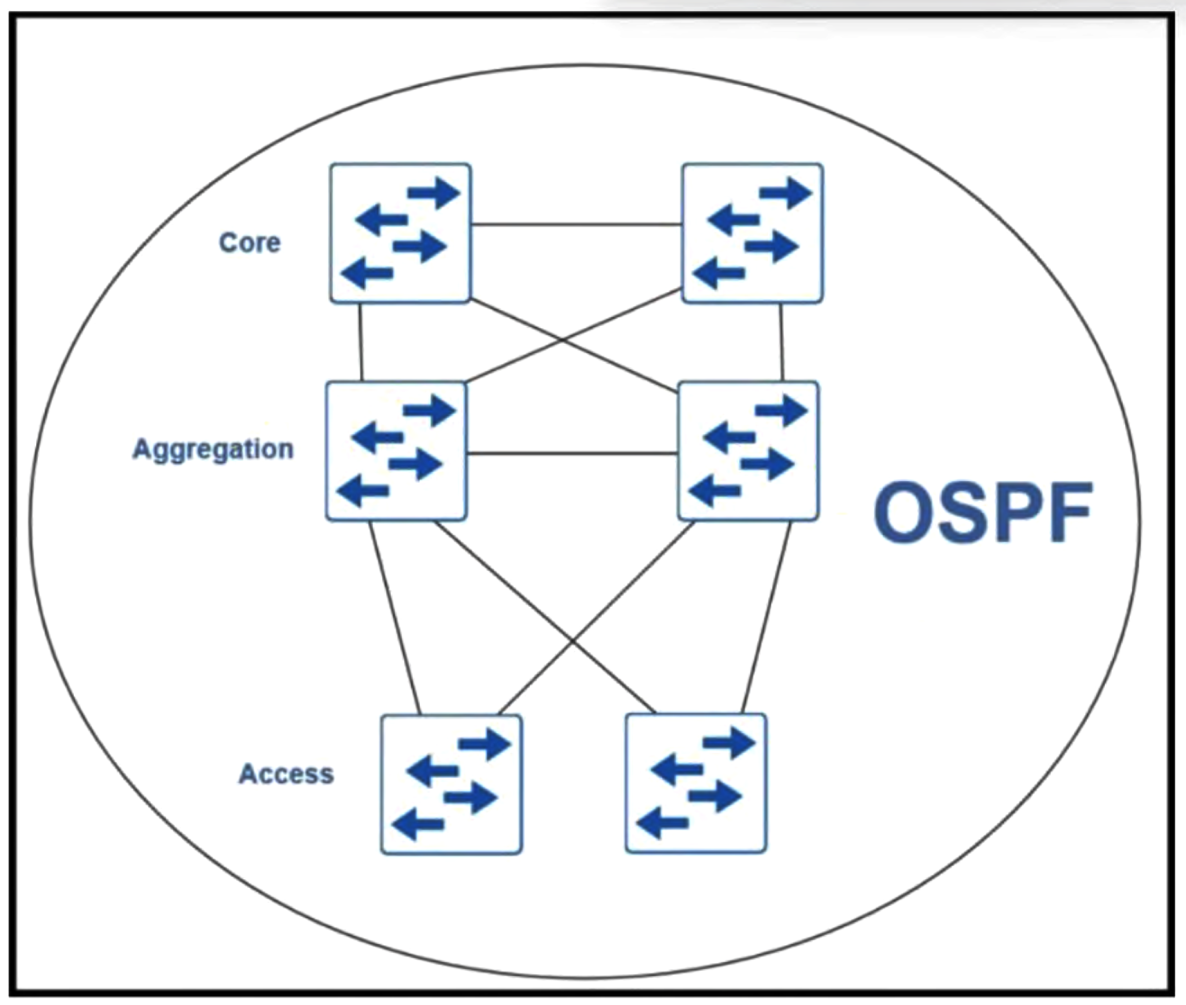
Refer to the exhibit. An architect is designing a Layer 3 routed network using point-to-point fiber links between the topology layers. BFD is supported on the software that runs within the infrastructure. Is BFD required within the design to provide sub-second convergence in the event of a fiber breakage?
Key Takeaways
The question tests whether you can distinguish physical failure detection (carrier loss on a fiber break) from logical/indirect failure detection where BFD actually adds value; the trap is assuming BFD is always needed for fast convergence.
In a Layer 3 design built with point-to-point fiber between topology layers, a fiber cut is a physical-layer event that the interface itself reports as loss of carrier, triggering an immediate OSPF interface-down reaction and SPF recalculation. This page establishes that BFD is therefore not required to achieve sub-second convergence in this scenario, making option A the correct choice.
Common mistake: Option D is the most tempting wrong answer: learners recall that BFD's default timers are too slow for sub-second detection and conclude BFD must be tuned, but they miss that on a fiber break BFD is unnecessary in the first place because the hardware already signals the failure instantly.
Expert Analysis
Why the Answer Is Correct
A fiber break severs light transmission, so the receiving interface immediately loses signal and the link is placed in down state, which is a physical/hardware failure-detection mechanism. Cisco's BFD guidance states that such hardware mechanisms can already detect failures quickly, so OSPF is driven by the interface-down event and runs its SPF calculation at once rather than waiting for hello or dead timers. Because the topology layers are connected by point-to-point fiber with the failure visible at Layer 1, sub-second convergence is achieved without any BFD configuration, so A is correct. BFD's real value appears when no such physical indication exists, for example a failure beyond the directly connected link where the interface stays up.
Why the Other Options Are Wrong
Option C is wrong because BFD never "automatically" provides anything — sessions must be configured under the OSPF process/interface, and even then its default timers are not sub-second. Option D describes a true fact about BFD defaults but answers the wrong question: tuning BFD would only matter for failures that do not drop carrier, not for a fiber breakage that already produces an instant interface-down signal. Option B is wrong because retuning OSPF hello and dead intervals is exactly the slow, CPU-expensive mechanism BFD exists to avoid, and it is still unnecessary when carrier loss is detected in hardware.
Community Comment Notes
drinu89 argued that a fiber break is a physical-layer failure and that the interface detects loss of carrier immediately, noting that Cisco's BFD white paper says "physical/hardware failure-detection mechanisms can detect failures quickly". e14efdb reinforced the same line of reasoning, stating that "BFD is not being used for physical issues but logical issues" and that OSPF recalculates SPF on interface-down. By contrast, _MaGIC_13 selected D solely because "BFD does not support sub-second convergence w/ it's default timers", which is accurate about BFD but does not justify needing BFD for a fiber break at all.
Exam Strategy
Ask yourself what the failure physically looks like before reaching for BFD: if the event drops carrier and forces an interface-down, OSPF already converges sub-second. Reserve BFD for scenarios where the local interface stays up, such as failures beyond the directly connected link or non-physical (logical) failures.
Frequently Asked Questions
Why isn't BFD needed when a fiber link is cut?
When is BFD actually required in an OSPF design?
Do BFD default timers provide sub-second detection?
Discussion 4 contributions
Compiled from public community threads and reader submissions, lightly edited for clarity. Handles and vote tallies are shown as recorded, and comments reflect the views of individual contributors.
From public community threads 4
-
drinu89 👍 3 Answered AA fiber break is a physical-layer failure. The interface detects loss of signal/carrier and goes down immediately, so OSPF is notified through the interface-down event rather than waiting for hello/dead timers or BFD. Cisco’s BFD white paper explains that physical/hardware failure-detection mechanisms can detect failures quickly, while BFD is mainly useful when those mechanisms are unavailable, inconsistent, or hidden from routing protocols. BFD is excellent for silent failures, for example when the interface stays up but forwarding is broken. But this question is specifically about fiber breakage on point-to-point fiber, where link failure is directly detected.
-
bp3t3r_ 👍 1 Answered DTricky question.. So they say it's a L3 routed network and the access switches are also part of the OSPF domain. A typical fiber patch cable (duplex) consist of 2 strands. If you cut only one of the strands, the port on the RX end will go down, however it will remain up on the TX side. The switch on the RX end will immediately drop the OSPF connection but the other switch will continue to work business as usual until OSPF dead timer will eventually count to zero and then it will the connection. This will be pretty slow, so you want to enable BFD, you also want to tune it to achieve sub second failover. Note that BFD does not have default BFD timers on Catalyst switches.
-
e14efdb 👍 1 Answered AI fully agree with drinu89. BFD is not being used for physical issues but logical issues. OSPF will detect the interface going down and recalculate its SPF immediately.
-
_MaGIC_13 👍 1 Answered DBFD does not support sub-second convergence w/ it's default timers (too slow) you can modify them to achieve the sub-second convergence. D
Reader comments & corrections
No reader corrections yet — spotted an error or have a note? Share it below.
Related Analysis
Practice All 300-420 Questions
Access 150 questions with complete answers and detailed explanations.
View Full 300-420 Practice Test →