Advertising a Default Route from Core to Aggregation to Hide Instability
Refer to the exhibit. An architect is designing a Layer 3 campus network. The design must hide network instability, reduce network overhead, and conserve critical device memory. Which route summarization solution must the architect select? - 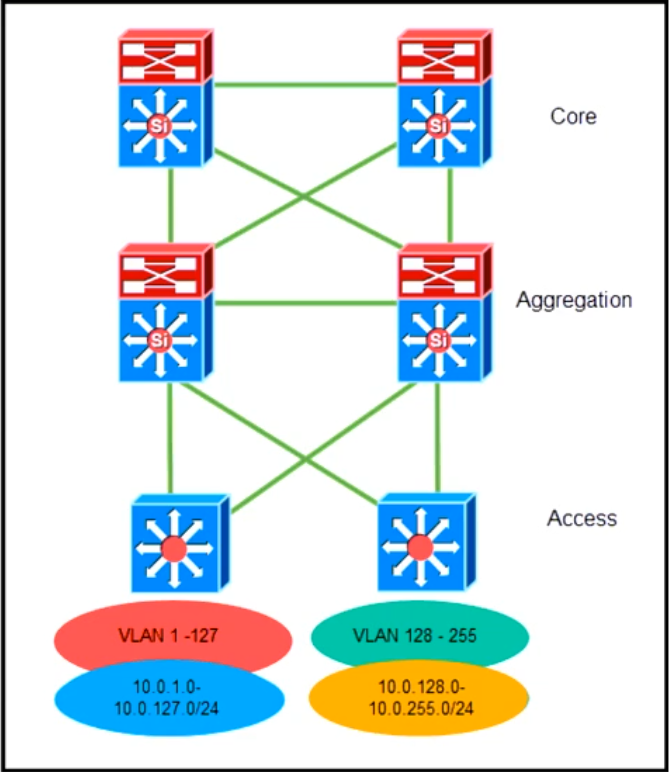
Community Votes
62% of anonymous learners picked answer B. Votes are pick records left by other test-takers — they are not the verified answer.
Community Insight
Summarize at the top: push a default toward the lower tier so it never learns specifics. The goal trio (hide instability, reduce overhead, conserve memory) is the signature of default-route-toward-aggregation.
In a routed Layer 3 campus, the core advertises a default route down to the aggregation layer. The aggregation (and tiers below) then carry only a default, which hides core/aggregation instability, reduces routing overhead, and conserves memory on those devices.
Picking C (default toward access): access switches are the least memory-constrained and already have small tables; the 'critical device memory' the question protects is the core/aggregation, which the default toward aggregation shields.
Community Discussion (5 comments)
Comments & Corrections
No comments yet — spotted an error or have a note? Share it below.
Expert Analysis
Why the Answer Is Correct
B is correct. The core advertises a default route toward the aggregation layer, so the aggregation (and everything below it) receives only a default route. That single default hides core/aggregation topology changes, removes the need to propagate specifics (less overhead), and keeps the routing tables on those critical devices small.Why the Other Options Are Wrong
A advertises a default from aggregation up to the core, which does the opposite of shielding the core. C pushes a default toward the access layer, but access switches are not the 'critical device memory' the question protects, and it leaves the aggregation still learning specifics. D duplicates B's direction but the reasoning above (protect core/aggregation memory) makes B the intended choice.Community Comment Notes
The vote is B (63) vs C (38). The top comment cites Cisco's routed-campus design guidance: summarization happens at the aggregation and a default is presented downstream toward the core, supporting B.Exam Strategy
Identify 'conserve memory' or 'hide instability' as keywords requiring downstream default routes. Choose the upstream layer (Core) sending the default to the downstream layer (Aggregation) to minimize routing table size on the most critical infrastructure points.
Frequently Asked Questions
Why does the core advertise a default route instead of specific routes?
Advertising a single default route prevents aggregation switches from learning every core change, which stabilizes the network and saves memory on critical devices.
Why is option C incorrect for protecting device memory?
Pushing defaults to the access layer leaves the aggregation layer with full routing tables, failing to conserve memory on the more critical aggregation switches.
Related Analysis
Practice All 300-420 Questions
Access 150 questions with complete answers and detailed explanations.
View Full 300-420 Practice Test →