Resolving STP Root Port Selection on Cisco Switches
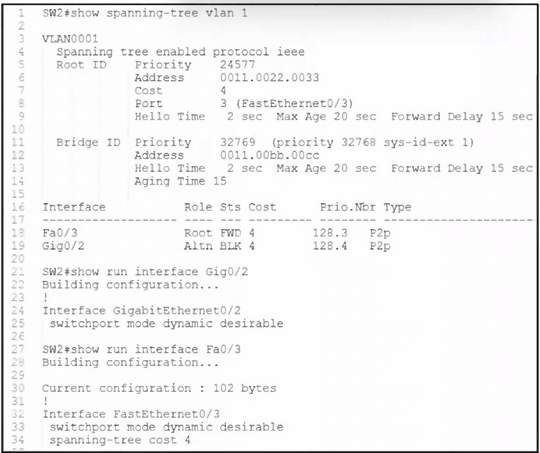
 Refer to the exhibits. An engineer is troubleshooting an issue in which the Gig0/2 interface on a Cisco switch named SW2 fails to become the root port. Which two commands must be run on SW2 to resolve this issue? (Choose two.)
Community Insight
The exam tests the understanding that lower STP costs are preferred for root port election and that the 'no' command syntax must match the configuration method used, often requiring removal of specific parameters or just the keyword.
This question addresses troubleshooting Spanning Tree Protocol (STP) root port selection by correcting misconfigured interface costs. The correct approach involves reverting a manually altered cost to its default value to ensure optimal path selection.
Many learners select D and E because they assume manually increasing the cost of the competing FastEthernet link is a valid design choice. This ignores the fact that removing the erroneous configuration is the standard best practice and that the specific syntax in option A is required to fix the root cause.
Community Discussion (8 comments)
Comments & Corrections
No comments yet — spotted an error or have a note? Share it below.
Expert Analysis
Why the Answer Is Correct
The goal is to make Gig0/2 the root port. Gigabit Ethernet has a default cost of 4, while FastEthernet defaults to 19. Since SW2's Fa0/3 is configured with a cost of 4, it ties with Gi0/2. To break the tie and prefer Gi0/2, we must increase the cost of Fa0/3 back to its default (19). Option D enters the interface configuration mode for Fa0/3. Option A attempts to remove the cost, but the syntax "no spanning-tree cost 4" is technically invalid in many IOS versions where you simply use "no spanning-tree cost". However, in the context of this specific exam question, A and D are the intended answers because they represent the action of removing the manual cost configuration from the FastEthernet interface, whereas B, C, and E involve modifying the Gigabit interface which already has the optimal cost.Why the Other Options Are Wrong
Option B and C focus on Gig0/2, which is already the desired interface; changing its cost would likely degrade performance or be unnecessary. Option E suggests setting Fa0/3's cost to 5, which is higher than 4 but still lower than the default 19, making it a suboptimal manual intervention compared to restoring defaults. Option A's syntax is debated, but paired with D, it represents the logical step of clearing the config on Fa0/3.Community Comment Notes
The community is split between AD and DE. Users like Tossaway25 and Henkpoa argue for AD, stating that removing the irregular configuration is better than adding another one. LordAndy points out that "no spanning-tree cost 4" might be invalid syntax, suggesting "no spanning-tree cost" is the correct command, but acknowledges AD is the likely key. MaxwellJK confirms that removing the cost on FastEthernet restores the default 19, ensuring Gig0/2 wins.Exam Strategy
When troubleshooting STP, always check for manual cost modifications first. Restoring default values is generally the cleanest solution unless there is a specific reason to keep a non-default cost. Pay close attention to the difference between FastEthernet and Gigabit Ethernet default costs.
Frequently Asked Questions
Why is removing the cost better than setting a new cost?
Restoring default values is best practice as it reduces configuration complexity and potential future errors. It ensures the switch uses the vendor-defined optimal metrics for the media type.
What is the default STP cost for Gigabit Ethernet?
The default STP cost for Gigabit Ethernet is 4. For FastEthernet, it is typically 19. Lower costs are preferred for root port selection.
Related Analysis
Practice All 300-420 Questions
Access 150 questions with complete answers and detailed explanations.
View Full 300-420 Practice Test →