BGP Route Reflector Design Reducing iBGP Peerings
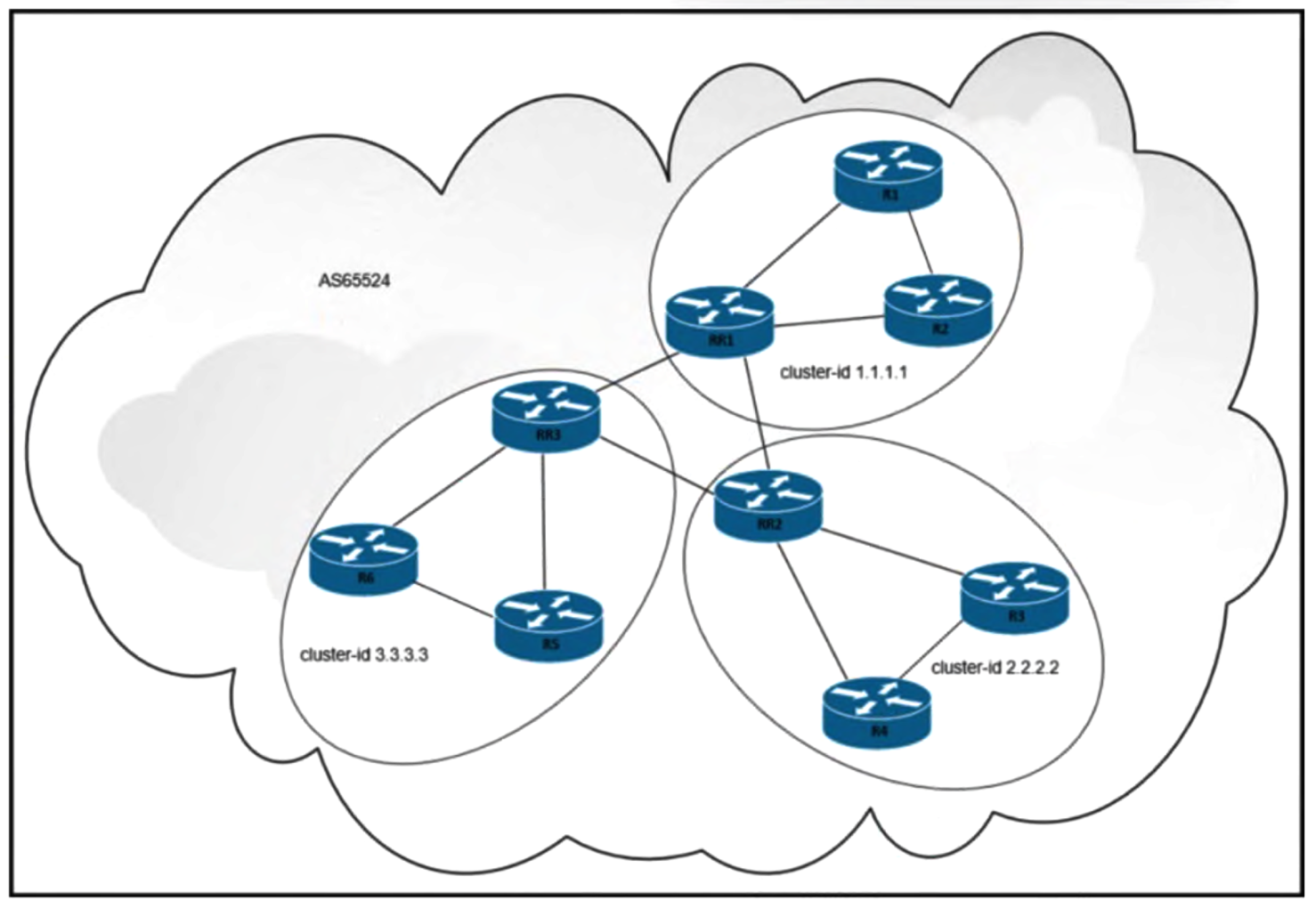 Refer to the exhibit. An architect designed a BGP routing solution to reduce the number of IBGP peerings to conserve resources. The original design had a total of 36 IBGP peerings. The new design reduces the number of peerings by how many?
Community Insight
The question tests the iBGP full-mesh formula n(n-1)/2 versus route reflector topology math; the trap is reporting the new total of 9 peerings instead of the reduction asked for.
This 300-420 design question tests how a route reflector topology shrinks iBGP peering count: a full mesh of nine routers needs 36 peerings, while three route reflectors with two clients each plus an RR-to-RR mesh needs only 9, a reduction of 27.
Option A (24) and D (13) reflect arithmetic slips, but the most common error is answering 9 — the remaining peerings — because the question asks by how many the count was reduced, giving 36 − 9 = 27.
Community Discussion (2 comments)
Comments & Corrections
No comments yet — spotted an error or have a note? Share it below.
Expert Analysis
Why the Answer Is Correct
The original full mesh of 36 peerings implies nine routers, since 9×8/2 = 36. The new design uses three route reflectors (RR1, RR2, RR3), each with two clients, producing 3×2 = 6 client peerings, plus a full mesh among the three RRs giving 3 peerings, for 9 total. The reduction is therefore 36 − 9 = 27, which matches option C. This is the classic route reflector scalability calculation tested under BGP design objectives.Why the Other Options Are Wrong
Option A (24) would require a new total of 12 peerings, which does not correspond to any correct RR counting for three reflectors with two clients each. Option B (11) and option D (13) imply residual totals of 25 and 23 peerings respectively, numbers that do not arise from either full-mesh or RR formulas. Any answer equal to 9 (the post-design total) would answer the wrong question, since the stem explicitly asks by how many the peerings were reduced.Community Comment Notes
As drinu89 laid out, "There are 3 Route Reflectors: RR1 RR2 RR3" with two clients each, giving 6 + 3 = 9 peerings and a 36 − 9 = 27 reduction. A second commenter said "I fully agree with drinu89" and pointed to a similar route reflector question, reinforcing that both the RR math and the subtraction are consistent across learners.Official Reference
Exam Strategy
Compute the peering counts in two clearly labeled lines — original full mesh vs. new RR design — then subtract, since the question asks for the difference, not the new total. Watch for 'reduced by how many' wording that traps you into answering the remaining peerings.
Frequently Asked Questions
Why does the original design have 36 iBGP peerings?
A full iBGP mesh uses n(n-1)/2 sessions; with nine routers that is 9×8/2 = 36 peerings.
Why is 9 not the correct answer if the new design has 9 peerings?
The question asks by how many the count was reduced, so you subtract the new total: 36 − 9 = 27.
Related Analysis
Practice All 300-420 Questions
Access 150 questions with complete answers and detailed explanations.
View Full 300-420 Practice Test →