BGP Route Filtering for Loop Prevention in AS64514
Short answer
A An as-path access-list matching the originating AS number attached to a deny route-map statement, with route-map applied to each neighbor inbound
Question
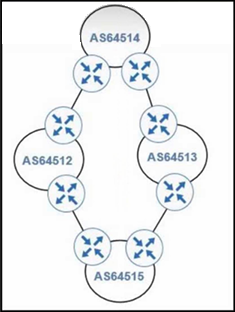
Refer to the exhibit. Which route filtering technique is required within AS64514 to ensure that BGP prefixes originating locally are not accepted from AS64512 or AS64513?
Key Takeaways
The main trap is confusing inbound vs. outbound application; filtering must be inbound to prevent acceptance of routes, and AS-path filtering is preferred over prefix-lists for AS-specific loop prevention.
Learn how to configure BGP route filtering to prevent accepting locally originated prefixes from external peers using AS-path access-lists and route-maps.
Common mistake: Choosing Option D (outbound filtering) is common, but this only controls what you send, not what you accept. Choosing Option B ignores the need for explicit configuration best practices.
Expert Analysis
The scenario involves BGP routing within AS64514, which receives updates from neighbors in AS64512 and AS64513. The goal is to prevent AS64514 from accepting prefixes that it originates itself (originating in AS64514) if those prefixes are somehow advertised back into the network by external peers.
BGP has a built-in loop prevention mechanism: a router will reject any update containing its own AS number in the AS_PATH attribute. However, relying solely on this implicit behavior is not considered a robust security or stability practice for production designs, especially when dealing with potential misconfigurations or route leaks. Furthermore, the question asks for a specific "route filtering technique," implying an explicit configuration rather than just default behavior.
Let's analyze the options:
- Option A proposes using an AS-path access-list matching the originating AS number (AS64514), attached to a deny statement in a route-map, applied inbound. This explicitly filters out any prefix whose AS_PATH contains AS64514. Since prefixes originating locally would have AS64514 as the first AS in the path (or only AS if no other ASes are traversed), this effectively blocks them from being accepted via inbound updates from external peers. This is the standard best practice for preventing accidental acceptance of one's own routes.
- Option B suggests no filtering, which relies entirely on the implicit loop detection. While functionally similar in many cases, it lacks the explicit control required by the question's context of "required technique" for ensuring stability.
- Option C uses a prefix-list matching locally originated prefixes. This is less reliable because prefix overlap can occur, and it doesn't leverage the unique AS_PATH signature. Also, applying a deny for local prefixes inbound might block legitimate re-advertisements if they were supposed to be propagated differently, but more importantly, AS-path filtering is the canonical method for AS-based loop prevention.
- Option D applies the filter outbound. Filtering outbound prevents sending bad routes, but does not prevent accepting them. The question specifically asks about ensuring prefixes are not accepted.
Therefore, Option A is the correct technical approach to explicitly filter incoming updates that contain the local AS number, providing a defense-in-depth layer against loops.
Exam Strategy
When asked about preventing acceptance of routes, always look for 'inbound' application of filters. For loop prevention involving your own AS, prioritize AS-path filtering over prefix-lists unless specific prefix ranges are the sole concern. Remember that BGP's implicit loop detection exists, but explicit filtering is often the tested 'best practice' solution.
Frequently Asked Questions
Why not rely on BGP's built-in loop prevention?
What is the difference between AS-path and prefix-list filtering here?
Community Votes
100% of anonymous learners picked answer B. Votes are pick records left by other test-takers — they are not the verified answer.
Discussion 2 contributions
Compiled from public community threads and reader submissions, lightly edited for clarity. Handles and vote tallies are shown as recorded, and comments reflect the views of individual contributors.
From public community threads 2
-
G_Singh12 👍 1 Answered B• f the router detects its own Autonomous System number (AS64514) anywhere inside that AS_PATH list, it means the route originally started inside its own network, looped through neighboring ASes (like AS64512 or AS64513), and is now trying to re-enter. The router will automatically drop and reject the update.
-
bp3t3r_ 👍 1 Answered BRouters in AS64514 will automatically drop prefixes which includes the AS Path 64514. Built in loop prevention.
Reader comments & corrections
No reader corrections yet — spotted an error or have a note? Share it below.
Related Analysis
Practice All 300-420 Questions
Access 150 questions with complete answers and detailed explanations.
View Full 300-420 Practice Test →