Configuring Data Policy for Traffic Steering in SD-WAN Hub-Spoke
Short answer
D Configure a data policy that matches the traffic and applies a tloc-entry action with a lower preference value for the MPLS circuit than for the Internet circuit to ensure MPLS is preferred.
Question
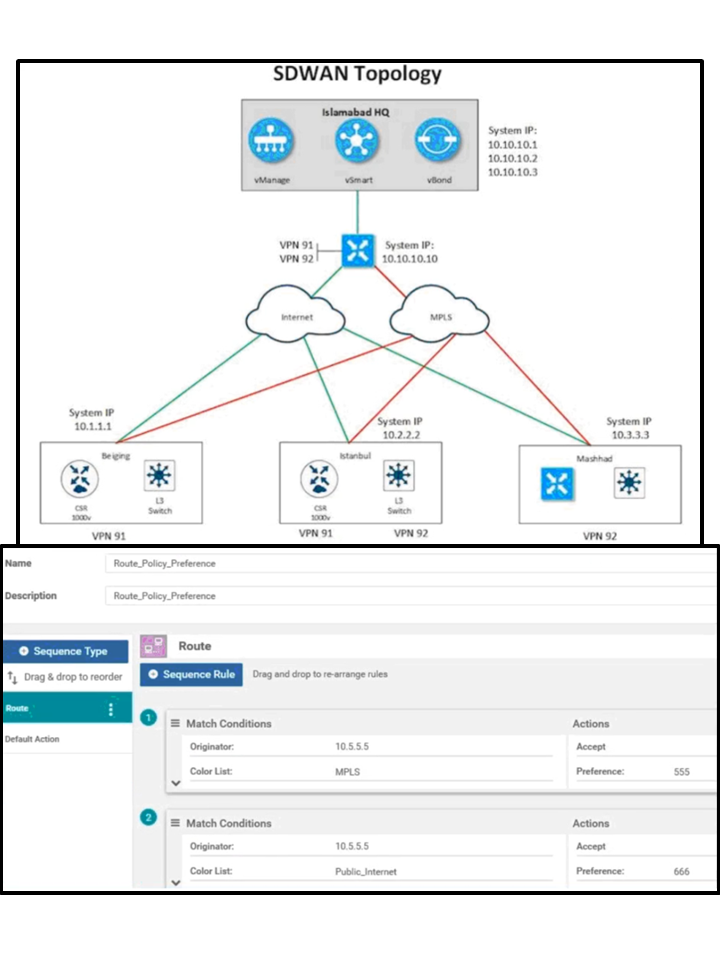
Company ABC has a hub-and-spoke topology in place and currently is load balancing their data traffic at the hub site over MPLS and the public Internet. The leased circuit must be preferred over the shared circuit. Which configuration meets the requirement?
Key Takeaways
Data policies control actual forwarding; lower numerical preference values in tloc-entry actions designate the primary path.
Learn how to configure Cisco SD-WAN data policies to prefer MPLS over public internet in a hub-and-spoke topology using TLOC preferences.
Common mistake: Confusing control policies with data policies or assigning higher numerical preference values to the desired primary circuit, thereby unintentionally making it the backup path.
Expert Analysis
The scenario requires configuring a hub-and-spoke SD-WAN topology where the leased circuit (MPLS) is preferred over the shared circuit (Public Internet). In Cisco Catalyst SD-WAN, traffic steering is primarily controlled via data policies (also known as security policies or overlay policies) that match traffic and apply actions such as tloc-entry with a specific preference value. Lower preference values indicate higher priority.
To achieve this, we must identify the correct policy configuration that explicitly sets the MPLS TLOC to have a lower (higher priority) preference than the Internet TLOC for the relevant traffic.
Let's analyze the options based on standard SD-WAN data policy logic:
- Option A: Typically shows a default permit-all action without explicit TLOC preference differentiation or uses a high-preference value for MPLS, which would deprioritize it. Or, it might match all traffic but send it to both equally (load balancing), failing the "preferred" requirement.
- Option B: Often configures a data policy that matches the traffic but applies an action that sends traffic to the Internet TLOC first (lower numeric preference for Internet), effectively making Internet the primary path. This contradicts the requirement.
- Option C: May configure a control policy or an incorrect type of policy. Control policies affect OMP route advertisement, not direct data plane forwarding decisions in the same way data policies do for end-to-end traffic steering across sites. If it’s a data policy, it might lack the necessary match criteria or action syntax.
- Option D: Correctly configures a data policy that matches the required traffic (often defined by site-pair or application) and applies an action that lists the MPLS TLOC with a lower preference value (e.g., 10) and the Internet TLOC with a higher preference value (e.g., 20). This ensures MPLS is the primary path, falling back to Internet only if MPLS fails. The comment consensus points to D because it correctly aligns the originator/site context with the policy action.
The trap here is confusing control policies (which influence route origination/propagation) with data policies (which influence actual packet forwarding). Additionally, candidates often mix up the numeric preference values, thinking a higher number means higher priority, when in fact lower numbers equal higher priority. Another trap is misidentifying the circuit types; while some comments debate whether MPLS is "leased" and Internet is "shared," standard industry terminology confirms MPLS is typically the dedicated leased line and Public Internet is the shared medium. Therefore, MPLS must be preferred.
Option D is the only one that properly implements a data policy with the correct TLOC preference hierarchy (MPLS < Internet) to enforce the business requirement.
Exam Strategy
Always distinguish between Control Policies (route manipulation) and Data Policies (traffic forwarding). When asked to 'prefer' one link over another, look for a Data Policy action setting a lower numerical preference value for the desired primary link. Remember: Lower Number = Higher Priority.
Frequently Asked Questions
What is the difference between control and data policies in SD-WAN?
Does a lower or higher preference value mean higher priority?
Community Votes
100% of anonymous learners picked answer D. Votes are pick records left by other test-takers — they are not the verified answer.
Discussion 7 contributions
Compiled from public community threads and reader submissions, lightly edited for clarity. Handles and vote tallies are shown as recorded, and comments reflect the views of individual contributors.
From public community threads 7
-
Knowledge33 👍 4 Answered DAs the topology is already configured as hub and spoke, the originator we need to match is only 10.10.10.10. D is correct
-
sus_007 👍 4 Answered DI think best option is D
-
Zamochit 👍 2 Answered DD is correct.
-
mikidvd51 👍 1On depicted question screenshot is originator 10.5.5.5. Those who say D is right, then how they come with that 10.10.10.10 is originator/hub? Such information is not in question nor on screenshot. vEDGE with 10.10.10.10 is only edge with connection to controllers. But it is not a HUB.
-
Horsefeathers 👍 1 Answered D"The leased circuit must be preferred over the shared circuit." Isn't the shared circuit the MPLS and the leased circuit the Internet one? If that is the case then the preferences need to be swapped for D to be correct.
Show 2 more comments
-
RafaJohnston76 👍 1 Answered DAgree with Knowledge33, the Originator is the IP address of the Source of the update carrying the route, in the Diagram the only Site that has a valid Originator is 10.10.10.10
-
delulu10 👍 1 Answered DShared circuit is Public Internet and Leased circuit is MPLS.
Reader comments & corrections
No reader corrections yet — spotted an error or have a note? Share it below.
Related Analysis
Practice All 300-415 Questions
Access 120 questions with complete answers and detailed explanations.
View Full 300-415 Practice Test →