Fixing vBond-vManage Connectivity with Default Routes
Short answer
C Configuring a default route on vBond pointing to 172.16.2.254 resolves the connectivity issue by ensuring vBond can route traffic back to vManage.
Question
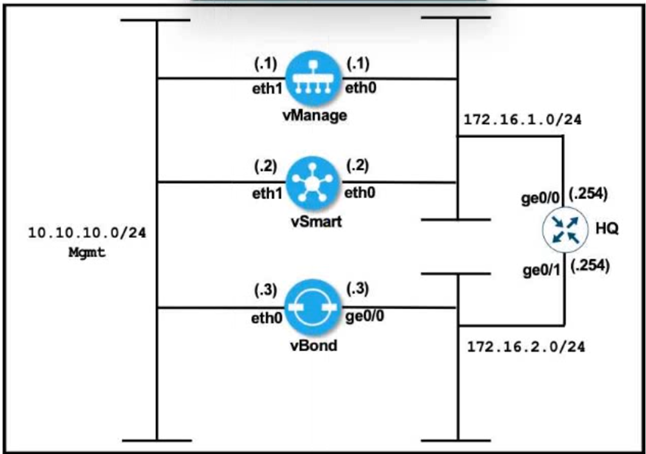
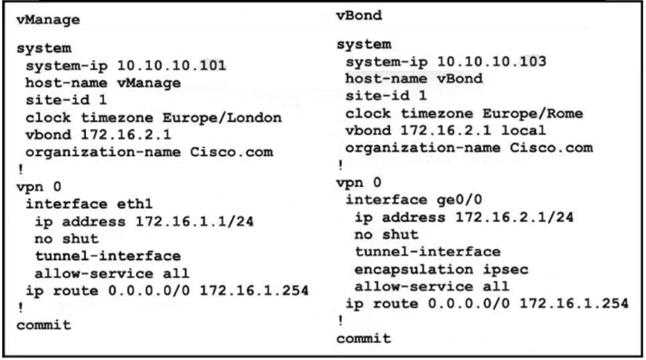
Refer to the exhibit. vManage and vBond have an issue establishing a connection to each other. Which configuration resolves the issue?
Key Takeaways
Tests understanding of basic IP routing prerequisites for SD-WAN control plane components; the trap is focusing on encryption settings instead of underlying network reachability.
Learn how to resolve vBond and vManage connection failures in Cisco SD-WAN by configuring essential default routes for control plane reachability.
Common mistake: Choosing to modify encapsulation settings (B or D) because students assume the 'issue' is related to security protocols rather than simple IP routing gaps.
Expert Analysis
Control Plane Connectivity Requirement
The core issue is that vManage cannot establish a connection to the vBond orchestrator. In Cisco Catalyst SD-WAN architecture, control plane communication relies on TCP port 12346 (or 443 for some cloud variants). For this connection to succeed, the device initiating the contact (vManage) must have an IP route to reach the vBond's TLOC IP address.
Analyzing the Routing Table
The exhibit shows vBond has a management interface with IP 172.16.2.1/24. The gateway for this subnet is typically 172.16.2.254. If vBond lacks a default route (0.0.0.0/0), it can only communicate within its local subnet. While vManage might be able to ping vBond locally, complex control plane handshakes often require return routing through the WAN or internet if the devices are not strictly on the same Layer 2 broadcast domain, or more simply, if the question implies general reachability issues.
Evaluating the Options
Option C suggests configuring a default route on vBond pointing to 172.16.2.254. This ensures that any traffic destined outside vBond's local subnet (including potential return traffic or management traffic routed via the gateway) has a valid path. Without this route, vBond may drop packets intended for networks beyond its directly connected interfaces, breaking the control channel establishment.
Why Other Options Fail
Options A and B involve configuration changes on vManage, but the problem is connectivity to vBond. Changing timezone or encapsulation on vManage does not fix vBond's missing routing table entry. Option D removes encryption from the tunnel interface, which is irrelevant to basic IP connectivity and security policy compliance. The most fundamental networking principle here is that bidirectional reachability requires proper routing on both ends; adding the default route on vBond resolves the asymmetry.
Exam Strategy
When troubleshooting SD-WAN component connectivity, always verify Layer 3 reachability first before diving into protocol-specific configurations like OMP or TLS. Check routing tables on both endpoints to ensure bidirectional paths exist, especially for default gateways on management subnets.
Frequently Asked Questions
Why is a default route needed for vBond?
Does encapsulation ipsec affect vBond connectivity?
Community Votes
100% of anonymous learners picked answer C. Votes are pick records left by other test-takers — they are not the verified answer.
Discussion 7 contributions
Compiled from public community threads and reader submissions, lightly edited for clarity. Handles and vote tallies are shown as recorded, and comments reflect the views of individual contributors.
From public community threads 7
-
nbvolz 👍 2So is the time zone doesn't matter?
-
Mario_134354 👍 1 Answered Cincorrect interface configured on vManage. it is supposed to be eth0 with IP 172.16.1.1 instead of eth1. though we change the default route on vBond, technically the connectivity issue is not resolve. lol
-
Eliasmiranda 👍 1 Answered CEncapsulation ipsec on VPN 0 interface for vManage is incorrect. C is correct.
-
msstanick 👍 1 Answered CCCNA level question about the default route. CIsco does not stop amazing me
-
PureInertiaCopy 👍 1This is what I'm wondering...
Show 2 more comments
-
PepaZdepa33 👍 1 Answered CC is correct answer
-
konate 👍 1 Answered CI'll go for C
Reader comments & corrections
No reader corrections yet — spotted an error or have a note? Share it below.
Related Analysis
Practice All 300-415 Questions
Access 120 questions with complete answers and detailed explanations.
View Full 300-415 Practice Test →