EIGRP Connectivity Issues During Peak Hours
Short answer
C Increase the MTU on the interfaces that connect R1 and R2 to ensure consistent packet sizes for EIGRP adjacency maintenance.
Question
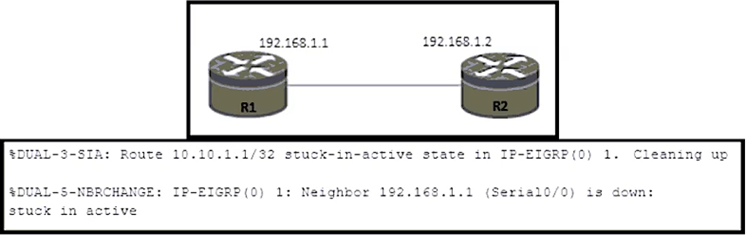
Refer to the exhibit. An engineer notices a connectivity problem between routers R1 and R2. The frequency of this problem is high during peak business hours. Which action resolves the issue?
Key Takeaways
The problem tests the understanding that EIGRP requires a matched MTU for adjacency formation, and large packets dropped due to MTU issues cause intermittent connectivity.
This question addresses EIGRP neighbor adjacency failures occurring during high traffic periods, specifically focusing on the impact of MTU mismatches on routing protocol stability.
Common mistake: Many users incorrectly select Option A (Increase bandwidth) because they associate 'peak hours' with congestion, ignoring that EIGRP neighbors must establish adjacency before data flows are affected by bandwidth limits.
Expert Analysis
Why the Answer Is Correct
The correct action is to ensure the MTU is consistent across the link between R1 and R2. EIGRP uses multicast packets (Hello packets and Updates) to establish and maintain neighbor relationships. If an interface has a lower MTU than its neighbor, large EIGRP Update packets may be fragmented or dropped if the Don't Fragment (DF) bit is set (which it often is in modern implementations to avoid fragmentation overhead). This results in the loss of Hello packets or successful Updates but failed Acknowledgments, leading to flapping adjacencies or complete failure to form neighbors. While peak hours increase traffic volume, the root cause of the connectivity problem (adjacency instability) is the MTU mismatch preventing reliable control plane communication.
Why the Other Options Are Wrong
Option A is incorrect because increasing bandwidth does not fix a Layer 3 MTU mismatch; even with high bandwidth, packets exceeding the path's minimum MTU will still be dropped if DF is set. Option B is dangerous; decreasing keepalive timers would make the link more sensitive to transient packet loss, potentially causing more frequent neighbor resets during peak hours rather than resolving the issue. Option D is incorrect because static neighbor configuration does not bypass the underlying physical/link layer constraint of MTU; if the MTU is mismatched, the static neighbors will still fail to exchange necessary updates or hellos properly.
Community Comment Notes
One user pointed out that "EIGRP DUAL-3-SIA" errors are often linked to missing or incorrect bandwidth configurations, which can influence path selection and lead to Stuck-In-Active states. However, another commenter strongly argued for Option C, noting that MTU mismatches are a classic cause of such intermittent failures. The consensus leans towards addressing the packet size limitation as the primary suspect for adjacency drops under load.
Official Reference
This link opens the official vendor documentation in a new tab.
Exam Strategy
When troubleshooting routing protocol issues that seem related to traffic volume, always check Layer 3 parameters like MTU first. High traffic doesn't just mean congestion; it means more packets being sent, which increases the likelihood of hitting MTU limits if they are mismatched.
Frequently Asked Questions
Why doesn't increasing bandwidth fix EIGRP issues?
Can EIGRP work with mismatched MTUs?
Discussion 3 contributions
Compiled from public community threads and reader submissions, lightly edited for clarity. Handles and vote tallies are shown as recorded, and comments reflect the views of individual contributors.
From public community threads 3
-
HungarianDish_111 👍 6 Answered Ahttps://www.cisco.com/c/en/us/support/docs/ip/enhanced-interior-gateway-routing-protocol-eigrp/13676-18.html EIGRP DUAL-3-SIA -Missing or incorrect bandwidth interface configuration parameter -Incorrect bandwidth configured to influence path selection
-
inteldarvid 👍 2 Answered Ayes, give anwser is correct
-
Mario73 👍 1 Answered CCorrect answer is C
Reader comments & corrections
No reader corrections yet — spotted an error or have a note? Share it below.
Related Analysis
Practice All 300-410 Questions
Access 159 questions with complete answers and detailed explanations.
View Full 300-410 Practice Test →