Match Subnet Masks to 10.10.13.0 Networks
Short answer
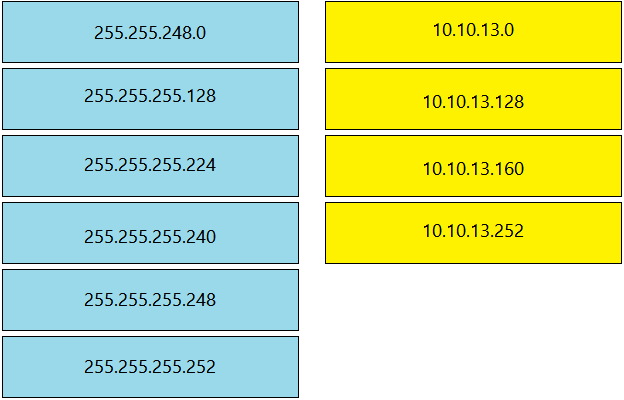
10.10.13.0 → 255.255.255.128 (/25); 10.10.13.128 → 255.255.255.240 (/28); 10.10.13.160 → 255.255.255.248 (/29); 10.10.13.252 → 255.255.255.252 (/30).
Question
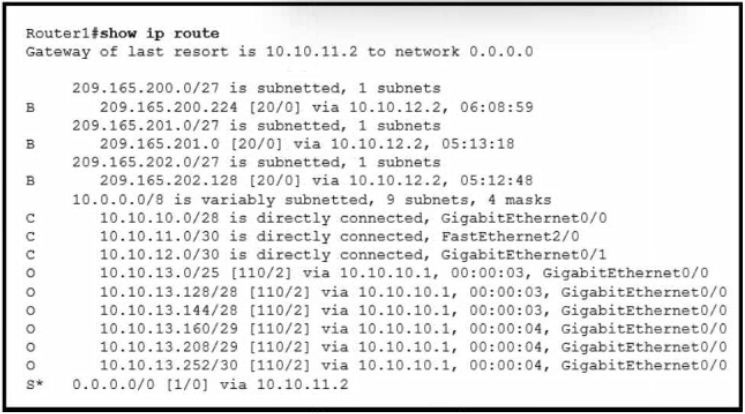
Refer to the exhibit. Drag and drop the subnet masks from the left onto the corresponding subnets on the right. Not all subnet masks are used.
Key Takeaways
The trap is treating the 96-address gap before 10.10.13.252 as a single block; 10.10.13.160 must be the smaller /29, and masks must be matched by address rather than drag position.
This drag-and-drop tests deriving subnet masks from network boundaries inside 10.10.13.0/24: 10.10.13.0 takes 255.255.255.128 (/25), 10.10.13.128 takes 255.255.255.240 (/28), 10.10.13.160 takes 255.255.255.248 (/29), and 10.10.13.252 takes 255.255.255.252 (/30).
Common mistake: Assigning /26 or /27 to 10.10.13.160 because the gap to 10.10.13.252 looks large, which produces overlapping subnets and a wrong broadcast address; also dropping masks in exhibit order instead of aligning each mask with its network address.
Expert Analysis
What the exhibit actually asks
This drag-and-drop wants the mask that makes each listed network a valid subnet of the parent 10.10.13.0/24 block. The four target networks are 10.10.13.0, 10.10.13.128, 10.10.13.160 and 10.10.13.252. Because they are contiguous and non-overlapping, you simply take the distance to the next network as the block size in the fourth octet: 128 addresses, then 32, then 4, then 4.
Deriving each mask
- 10.10.13.0 to 10.10.13.128 is a 128-address block → /25 → 255.255.255.128.
- 10.10.13.128 to 10.10.13.160 is a 32-address block → /28 → 255.255.255.240.
- 10.10.13.160 to 10.10.13.252 is 96 addresses, which is not a power of two, so 10.10.13.160 cannot be a /26 or /27. It must be the smaller /29 → 255.255.255.248, occupying 160–167.
- 10.10.13.252 is the only address left, and 252 mod 4 = 0, so it is a /30 → 255.255.255.252, occupying 252–255.
The highest-voted community answer ("255.255.255.128 255.255.255.240 255.255.255.248 255.255.255.252") matches this, and other learners independently posted the same four pairings. One learner also warned that "answers are listed backwards," which is the real risk here — the exhibit's left column order may not match the top-to-bottom order of the target networks, so match by address, never by position. Another noted "too many errors" in published answers, so verify rather than memorise.
The adjacent decision and the flip condition
The skill tested is objective 1.6: deriving a mask from required host count or from network boundaries, not recalling dotted-decimal values. If the exhibit instead asked for masks given a fixed number of hosts per subnet, you would compute 2^h − 2 hosts and pick the next larger block. If a target address were not on a natural boundary — say 10.10.13.150 as a subnet ID — the question would be invalid as stated and you would need the enclosing block's mask.
Operational consequence of getting it wrong
A wrong mask silently changes the broadcast address and which addresses the device claims as local. For 10.10.13.160, using /28 would claim 160–175, overlapping the /29 and the 168–191 range, producing duplicate-address and unreachable-host faults that are painful to troubleshoot.
Exam Strategy
For mask-matching drag-and-drops, write the block size between consecutive network IDs first (128, 32, 4, 4 here), then convert to /prefix and dotted decimal. Never assume exhibit column order matches the target order — drag by address. Reject any mask that would make the network ID off-boundary or overlap a neighbour.
Frequently Asked Questions
Why is 10.10.13.160 a /29 and not a /26 or /27?
How do I know 10.10.13.252 needs 255.255.255.252?
What should I do if the exhibit's mask order looks reversed?
Discussion 16 contributions
Compiled from public community threads and reader submissions, lightly edited for clarity. Handles and vote tallies are shown as recorded, and comments reflect the views of individual contributors.
From public community threads 16
-
gewe 👍 120255.255.255.128 255.255.255.240 255.255.255.248 255.255.255.252
-
Simon_1103 👍 2610.10.13.0 --> 255.255.255.128 10.10.13.128 --> 255.255.255.240 10.10.13.160 --> 255.255.255.248 10.10.13.252 --> 255.255.255.252
-
rogi2023 👍 8I am just wondering, if someone would just memorize the answers provided by authors/admins of the page if they would successfully pass the exam. Here are just to many errors.
-
Lse 👍 4Its great we had this community discussion, so many incorrect answer is selected.
-
JJY888 👍 4Why are the answers listed backwards? Please correct.
Show 11 more comments
-
HelloPeople 👍 4The admin gets almost every answer wrong.
-
a35233a 👍 3Browsing this gives me skyrim Bethesda vibe. Community is doing a good job fixing dev's bs
-
Bahaa2 👍 3How could you mistaken in such a stupid question?
-
Peter_panda 👍 3under 50%.... :-)
-
lidi2912 👍 3Correct
-
Portcullis 👍 2please fix the answer to this question mods...
-
Tdawg1968 👍 2Yikes!
-
maximus_007 👍 1Answers should be: 10.10.13.0 /25 255.255.255.128 10.10.13.128 /28 255.255.255.240 10.10.13.160 /29 255.255.255.248 10.10.13.252 /30 255.255.255.252
-
IwanTtopass9 👍 1What should i do in the exam? Put the suggested answer even if it's wrong or put the right answer? Confusing.
-
rogi2023 👍 1So please, at least fix those ones which all commented as errors. PLease.
-
Njavwa 👍 110.10.13.0 does not even have an answer listed
Reader comments & corrections
No reader corrections yet — spotted an error or have a note? Share it below.
Related Analysis
Practice All 200-301 Questions
Access 220 questions with complete answers and detailed explanations.
View Full 200-301 Practice Test →