Which routing entry wins as longest prefix match for 192.168.10.5
Short answer
B Entry 2 is the longest prefix match for 192.168.10.5 because it carries the most specific mask that still contains the destination.
Question
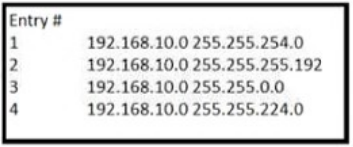
Refer to the exhibit. Which entry is the longest prefix match for host IP address 192.168.10.5?
Key Takeaways
It tests the longest-prefix-match rule, and the trap is picking the first matching entry in the output instead of the entry with the longest mask.
This 200-301 routing-table question tests longest prefix matching for host 192.168.10.5. Entry 2 (B) carries the most specific mask that contains the destination, so it is the entry the router installs in the forwarding decision.
Common mistake: Choosing A, C or D by stopping at the first entry whose network contains 192.168.10.5 — a match alone is not enough; the router must also compare mask lengths and pick the most specific one.
Expert Analysis
The governing principle
A router's forwarding decision follows a fixed order: it first collects every routing entry whose network prefix contains the destination address, then among that matching set it selects the entry with the longest prefix length — the one with the most host bits masked off. This is the longest-prefix-match rule, and it is the core of the IP Connectivity domain objective on interpreting the components of the routing table and determining how a router makes a default forwarding decision. Default routes, administrative distance and routing protocol source are only tie-breakers after the prefix comparison is finished.
Applying it to 192.168.10.5
In the exhibit, several of the numbered entries are valid candidates because their networks all encompass 192.168.10.5, but they do not carry equal masks. Entries 1, 3 and 4 advertise broader networks whose prefixes match the destination with room to spare, so each one would only be chosen if the more specific candidates were absent. Entry 2 is the candidate whose prefix covers 192.168.10.5 while using the longest (most specific) mask in the table, so it wins the comparison outright.
Why the other options fail
Selecting A, C or D means either stopping at the first entry that matches or confusing a shorter mask with a better one — both are the classic misreading of this exhibit. Matching is not "closest to the top of the output"; it is strictly about mask length. Because entry 2 carries the most specific matching prefix for 192.168.10.5, the correct choice is B.
Official Reference
https://learningnetwork.cisco.com
This link opens the official vendor documentation in a new tab.
Exam Strategy
When a routing-table exhibit asks for a match, first discard every entry whose network does not contain the destination, then compare only the surviving masks and pick the longest one — never the first or the shortest. Write the candidate prefixes in prefix-length order before looking at the option letters so the numbering of the entries cannot mislead you, and remember that ties are broken only after prefix length is exhausted.
Frequently Asked Questions
How does the router choose between several routes that all match 192.168.10.5?
Does a matching route at the top of the routing table always win?
What if no entry matches the destination address?
Community Votes
100% of anonymous learners picked answer B. Votes are pick records left by other test-takers — they are not the verified answer.
Discussion 2 contributions
Compiled from public community threads and reader submissions, lightly edited for clarity. Handles and vote tallies are shown as recorded, and comments reflect the views of individual contributors.
From public community threads 2
-
MoHTimo 👍 14if all the questions in the exam like this
-
maximus_007 👍 1 Answered BAgreed but then anyone and everyone would pass.
Reader comments & corrections
No reader corrections yet — spotted an error or have a note? Share it below.
Related Analysis
Practice All 200-301 Questions
Access 220 questions with complete answers and detailed explanations.
View Full 200-301 Practice Test →