Identifying ARP Poisoning via Command Output
A security administrator is reviewing reports about suspicious network activity occurring on a subnet. Users on the network report that connectivity to various websites is intermittent. The administrator logs in to a workstation and reviews the following command output: Which of the following best describes what is occurring on the network? - 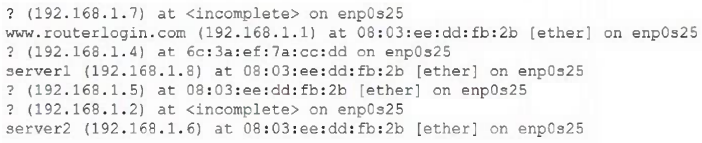
Community Votes
100% of anonymous learners picked answer A. Votes are pick records left by other test-takers — they are not the verified answer.
Community Insight
The exam tests recognition of ARP poisoning symptoms; the trap is confusing it with general connectivity issues or other layer 2 attacks without verifying the specific ARP table anomalies.
This question tests the ability to identify ARP poisoning by analyzing command-line output for duplicate MAC addresses associated with different IP addresses. The correct answer is determined by spotting these inconsistencies in the ARP table.
Users often select 'On-path attack' (B) because ARP poisoning facilitates such attacks, but they fail to distinguish between the specific mechanism (ARP spoofing) and the broader result. Others might choose 'IP address conflicts' (D) due to connectivity issues, missing the malicious intent indicated by the MAC/IP mismatch.
Community Discussion (4 comments)
Comments & Corrections
No comments yet — spotted an error or have a note? Share it below.
Expert Analysis
Why the Answer Is Correct
The command output (implied by the context and comments) shows an ARP table where multiple IP addresses map to the same MAC address. For instance, comments note that 192.168.1.8 and 192.168.1.6 share a MAC. This is the hallmark of ARP poisoning (or ARP spoofing), where an attacker sends falsified ARP messages to link their MAC address with the victim's IP address, allowing them to intercept traffic.Why the Other Options Are Wrong
On-path attack (B) is a result of ARP poisoning but not the specific mechanism described by the ARP table entries. URL redirection (C) is a layer 7 attack involving DNS or HTTP manipulation, unrelated to ARP tables. IP address conflicts (D) typically involve two devices claiming the same IP with different MACs, or network stack errors, not one MAC answering for multiple IPs maliciously.Community Comment Notes
Community consensus strongly supports ARP poisoning. One user noted, "192.168.1.8 & 192.168.1.6 both map to the same MAC address..that is no bueno." Another explained that false ARP messages allow interception. The votes overwhelmingly favor A, confirming this interpretation.Exam Strategy
When reviewing ARP table outputs in security exams, always look for mismatches between IP and MAC addresses. If one MAC address appears against multiple distinct IP addresses, it is almost certainly ARP poisoning/spoofing.
Frequently Asked Questions
How does ARP poisoning cause intermittent connectivity?
It causes blackholing or man-in-the-middle attacks, leading to dropped packets or slow responses as traffic is intercepted or misrouted.
What is the difference between ARP poisoning and IP conflict?
ARP poisoning involves one MAC owning multiple IPs maliciously; IP conflicts usually involve two different MACs claiming the same IP, causing network stack errors.