Key Vault rotation policies: keys and certificates, not secrets
Short answer
D Key1 and Cert1 only support a native Key Vault rotation policy in Vault1; Secret1 can be versioned and expired but does not expose a rotation-policy object.
Question
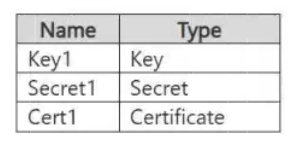
Which resources support the creation of a rotation policy?
Key Takeaways
The question tests the boundary between native rotation-policy support for keys and certificates versus general secret lifecycle controls such as versioning and expiration.
Azure Key Vault rotation policies are native to keys and certificates; secrets do not expose a rotation-policy object. For Vault1, the correct answer is D: Key1 and Cert1 only.
Common mistake: Choosing F assumes every Key Vault object has a rotation policy; Secret1 does not, because secret rotation requires manual versioning or external automation rather than a built-in policy.
Expert Analysis
What the question actually asks The phrase "rotation policy" is narrower than "can be rotated." In Azure Key Vault, a rotation policy is a native configuration object that schedules new versions and can raise near-expiry notifications. The scenario gives three object types in Vault1: Key1 is a key, Secret1 is a secret, and Cert1 is a certificate. The decision must be made from the Key Vault object model, not from the broader idea that any credential can be replaced.
Where the boundary falls
Keys support a native rotationPolicy with automatic rotation and notification settings. Certificates support an auto-renewal policy built from lifetime actions; Microsoft's certificate-rotation tutorial describes this as configuring certificate rotation. Secrets are the exception: Azure Key Vault secrets have versions and attributes such as enabled, activation date, and expiration date, but they do not expose a native rotation-policy resource. Secret rotation is normally manual or implemented externally, for example by using Event Grid notifications and an Azure Function or Logic App to write a new secret version.
Applying it to the options Because Secret1 lacks the native rotation-policy feature, every option that includes Secret1 is out: C, E, and F. Option A is the older simplification that only keys count, but it ignores certificate lifetime actions. Option B is the opposite overcorrection. That leaves D, Key1 and Cert1 only. A commenter summarized the history: older material said rotation policy applied only to keys, while Microsoft later documented certificate auto-rotation. That history explains the trap but does not change the current boundary.
Official Reference
- https://learn.microsoft.com/en-us/azure/key-vault/general/about-keys-secrets-certificates
- https://learn.microsoft.com/en-us/azure/key-vault/certificates/tutorial-rotate-certificates
These links open the official vendor documentation in a new tab.
Exam Strategy
When a question asks which Key Vault object types support a native policy, think in terms of the ARM resource schema: keys expose rotationPolicy, certificates use lifetime actions for auto-renewal, and secrets expose only attributes such as enabled, nbf, and exp. Do not let generic lifecycle features—versioning, expiration, or external automation—turn a "no native policy" object into a yes. Build the support matrix first, then eliminate any option that includes Secret1.
Frequently Asked Questions
Does Secret1 support a native Azure Key Vault rotation policy?
Why does Cert1 qualify for a rotation policy?
Is choosing Key1 only still correct?
Community Votes
100% of anonymous learners picked answer D. Votes are pick records left by other test-takers — they are not the verified answer.
Discussion 1 contributions
Compiled from public community threads and reader submissions, lightly edited for clarity. Handles and vote tallies are shown as recorded, and comments reflect the views of individual contributors.
From public community threads 1
-
Ernsqk23 👍 1 Answered DIn some older exam materials, it was simplified by stating that the Rotation Policy applied only to keys. Microsoft later added auto-rotation capabilities for certificates. https://learn.microsoft.com/en-us/azure/key-vault/certificates/tutorial-rotate-certificates
Reader comments & corrections
No reader corrections yet — spotted an error or have a note? Share it below.
Related Analysis
Practice All SC-500 Questions
Access 100 questions with complete answers and detailed explanations.
View Full SC-500 Practice Test →