Azure Functions hosting plans for ExpressRoute outbound traffic
Short answer
C Include Fa1 (Flex Consumption) and Fa3 (Dedicated) only, because both hosting plans support the outbound VNet integration needed to send function app traffic to on-premises over ExpressRoute.
Question
Fabrikam, Inc. is a consulting company. The company has a main office in New York City and branch offices in Amsterdam and Singapore.
Existing Environment. Network environment
The on-premises network contains a datacenter in each office.
Existing Environment. Cloud environment
Fabrikam has two Azure subscriptions named Sub1 and Sub2 and a Microsoft 365 subscription that includes Microsoft 365 E5 licenses.
All the subscriptions are linked to a Microsoft Entra tenant named fabrikam.com that contains the identities shown in the following table.
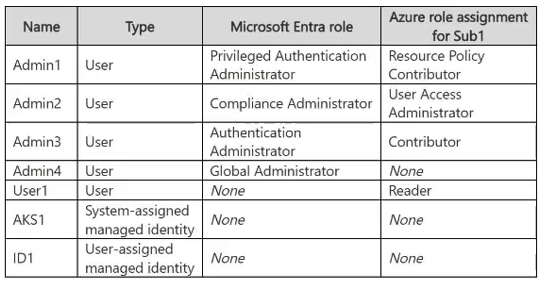
The tenant contains the groups shown in the following table.
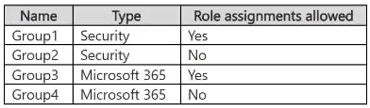
All devices are enrolled in Microsoft Intune.
Existing Environment. Sub1 Resources
Sub1 contains a resource group named RG1 that contains the resources shown in the following table.
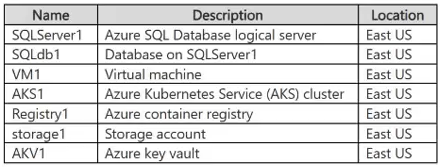
SQLServer1 uses Microsoft SQL Server authentication.
Sub1 has an Azure Web Application Firewall (WAF) named WAF1 that has the following types of rule sets:
Bot Manager 1.1
Azure-managed Default Rule Set (DRS)
Sub1 has the following compliance standards assigned in Microsoft Defender for Cloud:
NIST SP 800-53 Rev. 4
Microsoft cloud security benchmark (MCSB)
System and Organization Controls (SOC) 2 Type 2
Existing Environment. Sub2 Resources
Sub2 contains a resource group named RG2.
Planned Changes and Requirements. Planned Changes
Fabrikam plans to implement the following changes:
Deploy the following key vaults to RG1:
AKV2 in the West Europe Azure region
AKV3 in the Central US Azure region
AKV4 in the East US Azure region
Deploy the following key vaults to RG2:
AKV5 in the East US region
Configure VM1 to read data from storage1.
Create function apps that have the following hosting plans:
Fa1: Flex Consumption hosting plan
Fa2: Consumption hosting plan
Fa3: Dedicated hosting plan
For WAF1, implement rate limiting rules based on the request location.
Enable the NIST SP 800-53 Rev. 5 compliance standard in Defender for Cloud.
Create a new storage account named storage2 that supports Azure Table storage.
Enforce multifactor authentication (MFA) when database administrators access SQLdb1.
Implement ExpressRoute circuits to the on-premises network as shown in the following table.
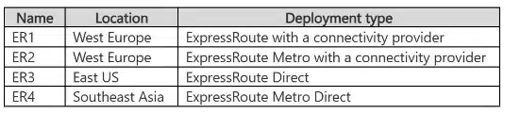
For RG1, create a new Privileged Identity Management (PIM) eligible role assignment that assigns the Contributor role to supported groups.
Planned Changes and Requirements. Technical Requirements
Fabrikam has the following technical requirements:
If VM1 is deleted, the permissions for VM1 must be removed automatically.
The AKS1 managed identity must only be able to pull images from Registry1.
The ID1 managed identity must be able to push images to and pull images from Registry1.
All the data in the storage accounts must be encrypted by using Fabrikam-managed keys.
All outbound traffic from the function apps to the on-premises network must use ExpressRoute circuits.
ExpressRoute connectivity between the on-premises network and the Azure environment must be encrypted by using Layer 2 or Layer 3 encryption.
You need to implement the function apps to meet the technical requirements.
Which apps should you include in the implementation?
Key Takeaways
It tests which Azure Functions hosting plans support outbound VNet integration for ExpressRoute; the trap is assuming the classic Consumption plan can route to on-premises like Flex Consumption and Dedicated plans.
This SC-500 scenario tests Azure Functions hosting plans and outbound VNet integration for ExpressRoute. The correct implementation includes Fa1 and Fa3 only, so the answer is C.
Common mistake: Choosing D (all three) because every function app must reach on-premises; Fa2's classic Consumption plan lacks outbound VNet integration, so it cannot be forced over ExpressRoute.
Expert Analysis
Requirement direction The requirement is not about inbound access to the function apps; it is about outbound traffic from each app to the on-premises network. ExpressRoute provides the private path, but an Azure Functions app can use that path only when the app is integrated with a virtual network and routes its on-premises-bound traffic through that VNet. The hosting plan determines whether that outbound VNet integration is available.
Supported plans Fa1 uses the Flex Consumption plan and Fa3 uses a Dedicated (App Service) plan; both support outbound virtual network integration. Fa2 uses the classic Consumption plan, which does not support VNet integration for outbound routing. A supplied comment captures the filter succinctly: “Only Fa1 and Fa3 have outbound VNet integration.” That makes option C the correct implementation: include Fa1 and Fa3 only.
The attractive wrong answer Option D is the most tempting because it includes every planned function app and appears to satisfy the phrase “all outbound traffic from the function apps.” It also correctly includes Fa1 and Fa3. The single point where D breaks is Fa2: a classic Consumption plan cannot join a VNet for outbound traffic, so its traffic to on-premises cannot be forced over ExpressRoute. Option A includes Fa2 and omits the supported Fa3; option B includes Fa2 and omits the supported Fa1. Those are wrong for the same plan-capability reason.
Exam takeaway For SC-500, separate the network service from the resource capability. ExpressRoute alone does not make a function app use it; the app’s plan must support VNet integration.
Official Reference
- https://learn.microsoft.com/en-us/azure/azure-functions/functions-networking-options
- https://learn.microsoft.com/en-us/azure/azure-functions/flex-consumption-plan
These links open the official vendor documentation in a new tab.
Exam Strategy
When an SC-500 item asks which Azure Functions apps can meet a networking requirement, first identify whether the control is inbound (private endpoint or access restrictions) or outbound (VNet integration). Then filter by hosting plan: Flex Consumption and Dedicated/App Service plans support regional VNet integration, while classic Consumption does not. Eliminate any option that includes an unsupported plan, even if the option is otherwise broader or safer-looking.
Frequently Asked Questions
Why can't Fa2 use ExpressRoute for outbound traffic?
Do Flex Consumption and Dedicated plans both support VNet integration?
Does ExpressRoute automatically route all function app traffic on-premises?
Community Votes
100% of anonymous learners picked answer C. Votes are pick records left by other test-takers — they are not the verified answer.
Discussion 1 contributions
Compiled from public community threads and reader submissions, lightly edited for clarity. Handles and vote tallies are shown as recorded, and comments reflect the views of individual contributors.
From public community threads 1
-
volto 👍 1 Answered COnly Fa1 and Fa3 have outbound VNet integration.
Reader comments & corrections
No reader corrections yet — spotted an error or have a note? Share it below.
Related Analysis
Practice All SC-500 Questions
Access 100 questions with complete answers and detailed explanations.
View Full SC-500 Practice Test →