Which KQL Table and Status Code Show Unauthorized Requests?
HOTSPOT
You have an Azure subscription that contains a Log Analytics workspace named Workspace1.
You configure Azure activity logs and Microsoft Entra ID logs to be forwarded to Workspace1.
You need to query Workspace1 to identify all the requests that failed due to insufficient authorization.
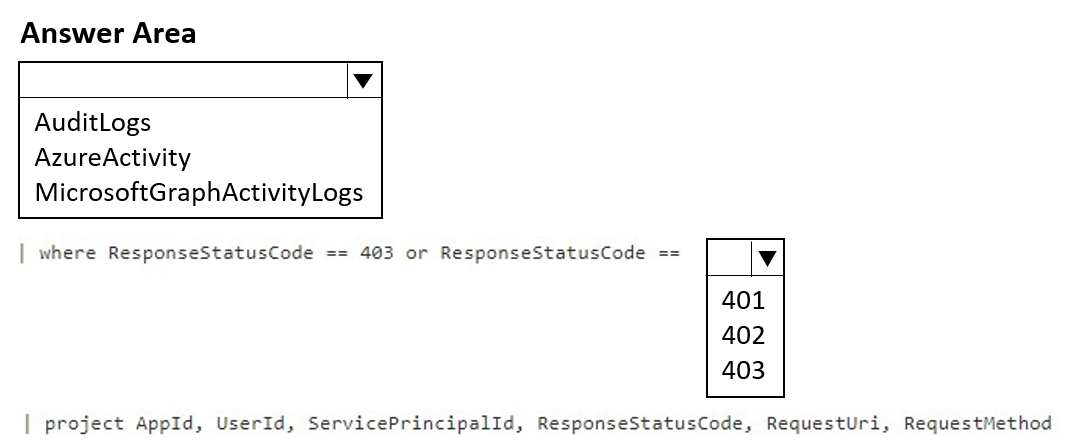
How should you complete the KQL query? To answer, select the appropriate options in the answer area.
NOTE: Each correct selection is worth one point.
Community Insight
The exam tests choosing the log table that exposes HTTP response codes and mapping the failed-authorization scenario to ResponseStatusCode 401, with the trap being AzureActivity, which does not contain that column.
This SC-200 hotspot asks you to complete a KQL query in a Log Analytics workspace to find failed Microsoft Graph requests. The correct table is MicrosoftGraphActivityLogs, and the status code to filter is 401 for unauthorized requests.
Selecting AzureActivity because Azure activity logs were forwarded, even though that table lacks ResponseStatusCode, or confusing 403 Forbidden with the intended 401 Unauthorized status.
Community Discussion (15 comments)
Comments & Corrections
No comments yet — spotted an error or have a note? Share it below.
Expert Analysis
Why the Answer Is Correct
The KQL query must read fromMicrosoftGraphActivityLogs because that table stores Microsoft Graph API request records, including the ResponseStatusCode column used to filter failures. The scenario asks for requests rejected due to insufficient authorization, and in the Graph activity log context the exam targets ResponseStatusCode == 401 (Unauthorized). This combination lets Workspace1 surface the failed Graph calls without needing to join AzureActivity or AuditLogs. As sapphire noted, “Microsoft Graph activity logs and 401 are correct answers,” and f90c339 added that AzureActivity has no ResponseStatusCode.Why Other Candidate Answers Are Wrong
AzureActivity is tempting because Azure activity logs are forwarded, but it records control-plane operations and does not expose a ResponseStatusCode field for Graph API replies. AuditLogs tracks directory changes rather than per-request HTTP outcomes, so it cannot isolate 401 failures. Choosing 403 Forbidden or 402 is also off-target for this hotspot: 402 is reserved, and the scenario’s unauthorized-request wording maps to 401 in the Graph activity logs. Commenters such as Tuitor01 stressed that 401 is the code to use, while BtwIdonno pointed to the table reference confirming ResponseStatusCode in MicrosoftGraphActivityLogs.Community Comment Notes
The thread shows a split early on: some learners suggested AzureActivity and 401, but sapphire corrected that to Microsoft Graph activity logs and 401. f90c339’s explanation is the most useful technical check because it notes “The AzureActivity table doesn't have the column ResponseStatusCode.” Several others, including BtwIdonno and Tuitor01, reinforced the MicrosoftGraphActivityLogs plus 401 combination, while a minority argued for 403. The consensus that matters here is the schema evidence, not the vote count.Official Reference
Exam Strategy
First identify which table has the ResponseStatusCode column; only MicrosoftGraphActivityLogs fits this hotspot. Then map the failure description to the status-code dropdown—do not pick AzureActivity just because activity logs are mentioned in the scenario.
Frequently Asked Questions
Why is AzureActivity not the table for this SC-200 KQL hotspot?
AzureActivity records Azure control-plane operations and lacks ResponseStatusCode; MicrosoftGraphActivityLogs stores Graph API HTTP status codes, so it is the correct table.
Does insufficient authorization mean 401 or 403 in MicrosoftGraphActivityLogs?
This hotspot targets 401 Unauthorized, which Graph activity logs capture for requests rejected as unauthorized; 403 Forbidden represents a separate permissions condition.
Related Analysis
Practice All SC-200 Questions
Access 80 questions with complete answers and detailed explanations.
View Full SC-200 Practice Test →