How to Configure Active/Passive Dedicated Interconnect?
You have the networking configuration shown in the diagram. A pair of redundant Dedicated Interconnect connections (int-Iga1 and int-Iga2) terminate on the same Cloud Router. The Interconnect connections terminate on two separate on-premises routers. You are advertising the same prefixes from the Border Gateway Protocol (BGP) sessions associated with the Dedicated Interconnect connections. You need to configure one connection as Active for both ingress and egress traffic. If the active Interconnect connection falls, you want the passive Interconnect connection to automatically begin routing all traffic. Which two actions should you take to meet this requirement? (Choose two.) - 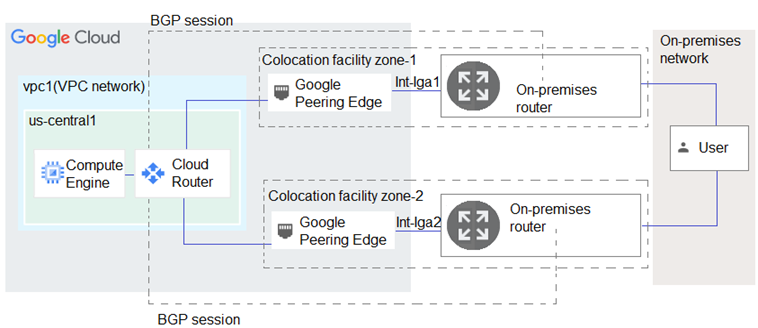
Community Votes
67% of anonymous learners picked answer CE. Votes are pick records left by other test-takers — they are not the verified answer.
Community Insight
This question tests your understanding of how GCP Cloud Router and on-premises routers use BGP attributes to control traffic flow, with the common trap being reversed priority/MED directionality.
Mastering active/passive Dedicated Interconnect requires correctly applying BGP route priority and MED to steer ingress and egress traffic. The community consensus confirms that setting a higher priority on the passive link and a lower MED on the active link ensures seamless failover.
Many candidates incorrectly select A and C, mistakenly believing that a higher advertised route priority (200) makes the active interconnect more preferred, when GCP actually treats lower numeric values as higher priority.
Community Discussion (10 comments)
Comments & Corrections
No comments yet — spotted an error or have a note? Share it below.
Expert Analysis
Why the Answer Is Correct
Configuring an active/passive Dedicated Interconnect relies on steering traffic in both directions. For ingress traffic entering Google Cloud, advertising a lower Multi-Exit Discriminator (MED) on the active connection ensures on-premises routers prefer that path (Option C). For egress traffic leaving Google Cloud, BGP advertised route priority determines selection within the Cloud Router, where a lower value wins. Setting the passive connection’s priority to 200 while keeping the active at the default 100 guarantees that all return traffic routes through the primary link (Option E).Why the Other Options Are Wrong
Option A incorrectly assigns a priority of 200 to the active interconnect, which would actually demote it to a backup role since higher numbers indicate lower preference in GCP. Option B suggests a priority greater than 10,200, which falls outside standard operational ranges and serves no purpose here. Option D advertises a lower MED on the passive link, causing on-premises routers to direct ingress traffic away from the intended active connection. Together, these choices either invert the desired traffic flow or introduce invalid configurations.Community Comment Notes
Candidates consistently highlight that the default BGP advertised route priority in Cloud Router is 100, making a value of 200 ideal for the passive link [1][6]. Multiple experts confirm that MED exclusively governs ingress routing from the customer side, reinforcing why a lower MED belongs on the active interconnect [4][7]. Several users reference official Google Cloud documentation to validate that combining these two attributes creates a reliable active/passive architecture [1][5]. Despite initial confusion from overlapping exam questions, the overwhelming majority converges on CE as the definitive solution.Official Reference
Exam Strategy
When tackling interconnect failover scenarios, always separate ingress and egress traffic control: use MED to influence on-premises router decisions and BGP advertised route priority for internal Cloud Router selection. Verify the numeric directionality (lower equals preferred) for each attribute before selecting options to avoid common inversion traps.
Related Analysis
Practice All PCNE Questions
Access 80 questions with complete answers and detailed explanations.
View Full PCNE Practice Test →