Generative AI Terms: Token, Embedding, RAG
HOTSPOT
An ML engineer is building a generative AI application on Amazon Bedrock by using large language models (LLMs).
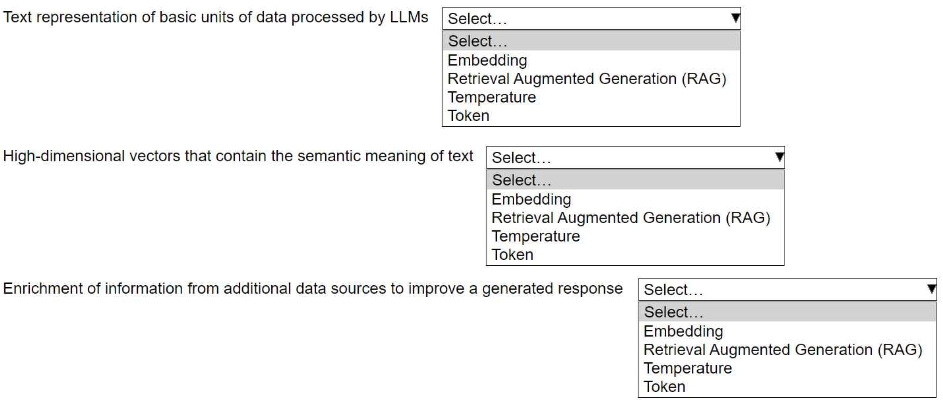
Select the correct generative AI term from the following list for each description. Each term should be selected one time or not at all. (Select three.)
• Embedding
• Retrieval Augmented Generation (RAG)
• Temperature
• Token
Community Insight
The question tests the ability to distinguish between data units (Tokens), vector representations (Embeddings), and retrieval techniques (RAG). A common trap is confusing Embeddings with simple text tokens or misunderstanding how RAG integrates external knowledge.
This question tests the understanding of core generative AI concepts including Tokens, Embeddings, and Retrieval Augmented Generation (RAG). The page establishes the correct mapping of these terms to their technical definitions for the MLA-C01 exam.
Learners often confuse 'Token' with 'Embedding', thinking both are just ways to represent text. Others might misinterpret 'Temperature' as a retrieval mechanism rather than a generation parameter, leading to incorrect placement in the definition slots.
Community Discussion (4 comments)
Comments & Corrections
No comments yet — spotted an error or have a note? Share it below.
Expert Analysis
Why the Answer Is Correct
The correct terms are Token, Embedding, and Retrieval Augmented Generation (RAG).- Token: This is the smallest unit of text that an LLM processes (e.g., a word or subword). It matches the description regarding processing units.
- Embedding: This converts text into high-dimensional vectors that capture semantic meaning, allowing models to understand context and similarity. It matches the description about vector representation.
- RAG: This technique combines generated content with retrieved external information to enrich output and reduce hallucinations. It matches the description involving retrieval from external sources.
Why Other Candidate Answers Are Wrong
Temperature is incorrect because it controls the randomness and creativity of the model's output distribution, not data processing, vector conversion, or retrieval. It does not fit any of the provided descriptions.Community Comment Notes
Community consensus strongly supports this answer. As user djeong95 noted, "Tokens are the smallest units... Embeddings transform text into high-dimensional vectors... RAG combines generated content with retrieved external information." User AzureDP900 also correctly identified that Temperature controls randomness, confirming it is not one of the three required terms.Exam Strategy
Focus on defining the fundamental building blocks of LLMs. Memorize the specific role of each term: Token (input unit), Embedding (semantic vector), and RAG (retrieval method). Distinguish clearly between generation parameters (like Temperature) and data/retrieval mechanisms.
Frequently Asked Questions
What is the difference between a Token and an Embedding?
A Token is the raw unit of text (word/subword) processed by the model. An Embedding is the numerical vector representation of that token used to capture semantic meaning.
Why is Temperature not the correct answer here?
Temperature controls the randomness of the output. The descriptions provided refer to data units, vector conversions, and retrieval methods, none of which describe output randomness.
Related Analysis
Practice All MLA-C01 Questions
Access 115 questions with complete answers and detailed explanations.
View Full MLA-C01 Practice Test →