Optimize Amazon SageMaker AI Training Time
Short answer
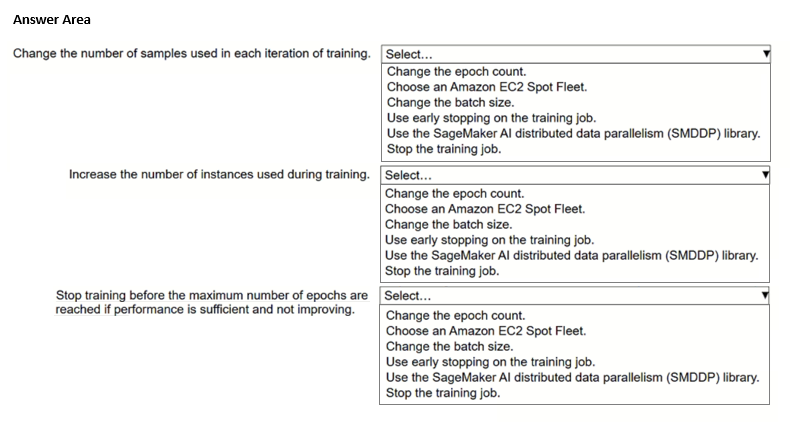
Select: Change the batch size, Use the SageMaker AI distributed data parallelism (SMDDP) library, and Use early stopping on the training job.
Question
A company uses a training job on Amazon SageMaker AI to train a neural network. The job first trains a model and then evaluates the model's performance against a test dataset. The company uses the results from the evaluation phase to decide if the trained model will go to production.
The training phase takes too long. The company needs solutions that can shorten training time without decreasing the model's final performance.
Select the correct solutions from the following list to meet the requirements for each description. Select each solution one time or not at all. (Choose three.)
• Change the epoch count.
• Choose an Amazon EC2 Spot Fleet.
• Change the batch size.
• Use early stopping on the training job.
• Use the SageMaker AI distributed data parallelism (SMDDP) library.
• Stop the training job.
Key Takeaways
The question tests knowledge of specific SageMaker optimization techniques; the trap is confusing performance-affecting hyperparameters with infrastructure or convergence controls.
This page explains how to reduce Amazon SageMaker AI training duration while maintaining model accuracy using SMDDP, early stopping, and batch size adjustments.
Common mistake: Learners often incorrectly select 'Change the epoch count' because reducing epochs speeds up training but directly harms final model performance by underfitting.
Expert Analysis
Why the Answer Is Correct
To shorten training time without decreasing final performance, you must optimize efficiency rather than limit learning. Using the SageMaker AI Distributed Data Parallelism (SMDDP) library allows multiple GPUs/instances to process data in parallel, significantly speeding up training. Early stopping monitors validation metrics and halts training when performance plateaus, preventing wasted compute on unnecessary epochs. Changing the batch size can also accelerate convergence per unit of time, allowing the model to reach optimal weights faster.
Why Other Candidate Answers Are Wrong
Changing the epoch count directly limits the number of times the model sees the data; reducing it typically leads to underfitting and lower performance. Choosing an EC2 Spot Fleet reduces cost but introduces interruptions that can delay or fail training jobs, not necessarily shorten effective training time reliably. Stopping the training job manually prevents the model from reaching its potential performance entirely.
Community Comment Notes
Community consensus correctly identifies SMDDP, Early Stopping, and Batch Size as the trio. As ChiggaBoy noted, "Batch size → fewer iterations... Early stopping → don't waste epochs," highlighting the efficiency gains. The group agrees that these three methods improve speed without sacrificing the final model quality.
Exam Strategy
Focus on differentiating between cost-saving measures (Spot Instances) and performance-optimizing measures (SMDDP, Early Stopping). Remember that 'performance' in the question refers to model accuracy, so any option that limits learning (epochs) is likely incorrect if accuracy must be maintained.
Frequently Asked Questions
Does changing batch size affect model accuracy?
Why isn't Spot Fleet a correct answer here?
Discussion 1 contributions
Compiled from public community threads and reader submissions, lightly edited for clarity. Handles and vote tallies are shown as recorded, and comments reflect the views of individual contributors.
From public community threads 1
-
ChiggaBoy 👍 1Remember: Batch size → fewer iterations SMDDP → more GPUs/instances working together Early stopping → don't waste epochs So select: 1. Change the batch size 2. Use SMDDP 3. Use early stopping
Reader comments & corrections
No reader corrections yet — spotted an error or have a note? Share it below.
Related Analysis
Practice All MLA-C01 Questions
Access 115 questions with complete answers and detailed explanations.
View Full MLA-C01 Practice Test →