Intune Bulk Custom Notifications Supported Devices
You have a Microsoft 365 subscription that contains devices enrolled in Microsoft intune as shown in the following table. You need to use a bulk device action to send custom notifications. To which devices can you send the custom notifications? - 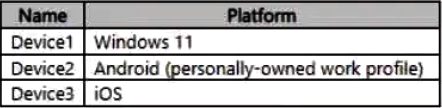
Community Votes
60% of anonymous learners picked answer C. Votes are pick records left by other test-takers — they are not the verified answer.
Community Insight
Custom notifications test your knowledge of supported platforms (iOS/Android) and enrollment states (managed/enrolled), trapping those who assume all Android registrations or Windows devices qualify.
Microsoft Intune custom notifications require devices to be fully enrolled and running a supported OS. This page establishes that only managed iOS/iPadOS and Android devices can receive these push notifications, excluding registered-only Android and Windows devices.
Choosing Device2 and Device3 (Option D), assuming that any Android device registration qualifies, ignoring that registered (MAM-only) devices without Intune enrollment cannot receive MDM push notifications.
Community Discussion (7 comments)
Comments & Corrections
No comments yet — spotted an error or have a note? Share it below.
Expert Analysis
Why the Answer Is Correct
Option C is correct because custom notifications in Microsoft Intune are only supported on managed iOS/iPadOS and Android devices. Device3 represents an enrolled iOS device, which meets both the platform and enrollment requirements. A bulk device action targeting custom notifications will successfully send the push notification to Device3 via the Apple Push Notification Service (APNS).Why the Other Options Are Wrong
Device1 is a Windows device, and Windows is explicitly not supported for Intune custom notifications. Device2 is a personally owned Android device that is registered but not enrolled in Intune; because it lacks MDM management, it cannot receive the MDM push notifications required for this feature. Therefore, options A, B, D, and E are incorrect as they either include unsupported platforms or unenrolled devices.Community Comment Notes
Commenters correctly pointed out that Windows and macOS are unsupported platforms, as GamingFuntime1985 noted with "Windows -NO, Personal Android (registered, no Intune)- NO". The confusion between options C and D stems from whether registered Android devices qualify; they do not, because custom notifications require full Intune enrollment. As Meek_Learner summarized, "custom notifications can be sent to iOS/iPadOS and Android devices only, appearing as push notifications... macOS and Windows devices do not support custom Intune notifications."Official Reference
Exam Strategy
When evaluating Intune remote actions, always verify both the OS platform support and the device's enrollment state. Registered-only (MAM) devices do not receive MDM-specific push notifications like custom alerts.
Related Analysis
Practice All MD-102 Questions
Access 92 questions with complete answers and detailed explanations.
View Full MD-102 Practice Test →