Cloud Policy Service for Microsoft 365 Device Support
You have a Microsoft 365 E5 subscription that contains the devices shown in the following table. All the devices are enrolled in Microsoft Intune and have Microsoft 365 Apps for enterprise installed. On which devices can you use the Cloud Policy service for Microsoft 365 to manage Microsoft 365 Apps for enterprise? - 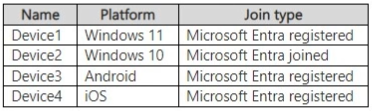
Community Votes
100% of anonymous learners picked answer E. Votes are pick records left by other test-takers — they are not the verified answer.
Community Insight
The Cloud Policy service applies to devices running Windows, macOS, iOS, and Android regardless of domain-join status; the common trap is assuming it only applies to Windows or domain-joined devices.
The Cloud Policy service for Microsoft 365 allows administrators to manage Microsoft 365 Apps for enterprise across various operating systems. This page establishes that all major platforms (Windows, macOS, iOS, and Android) are supported, making Option E the correct answer.
Choosing an option that excludes iOS or Android devices, assuming Cloud Policy is restricted to traditional desktop operating systems like Windows and macOS.
Community Discussion (3 comments)
Comments & Corrections
No comments yet — spotted an error or have a note? Share it below.
Expert Analysis
Why the Answer Is Correct
The Cloud Policy service for Microsoft 365 is designed to enforce policy settings for Microsoft 365 Apps for enterprise across multiple platforms. As noted in the official documentation, policy settings roam to devices running Windows, macOS, iOS, and Android. Therefore, if the four devices in the scenario represent these supported operating systems, Cloud Policy can manage Microsoft 365 Apps on all of them, making Option E correct.Why the Other Options Are Wrong
Options A, B, C, and D incorrectly exclude one or more devices from being managed by the Cloud Policy service. These options reflect the mistaken assumption that Cloud Policy is limited to specific platforms like Windows and macOS, or that it requires devices to be domain-joined or exclusively Intune-managed to apply policies.Community Comment Notes
Community members confirmed that all four devices are supported because the service applies across multiple operating systems. As Moot2 noted, "Policy settings are available for devices running Windows, macOS, iOS, and Android", emphasizing that the platform coverage is comprehensive. Another user provided the official Microsoft documentation link to validate this broad support.Official Reference
Exam Strategy
Remember that the Cloud Policy service for Microsoft 365 is platform-agnostic for major OSs (Windows, macOS, iOS, Android) and does not require devices to be domain-joined. When a question asks about Cloud Policy scope, include all supported OS device types.
Related Analysis
Practice All MD-102 Questions
Access 92 questions with complete answers and detailed explanations.
View Full MD-102 Practice Test →